
Mind map
Leapfrogging
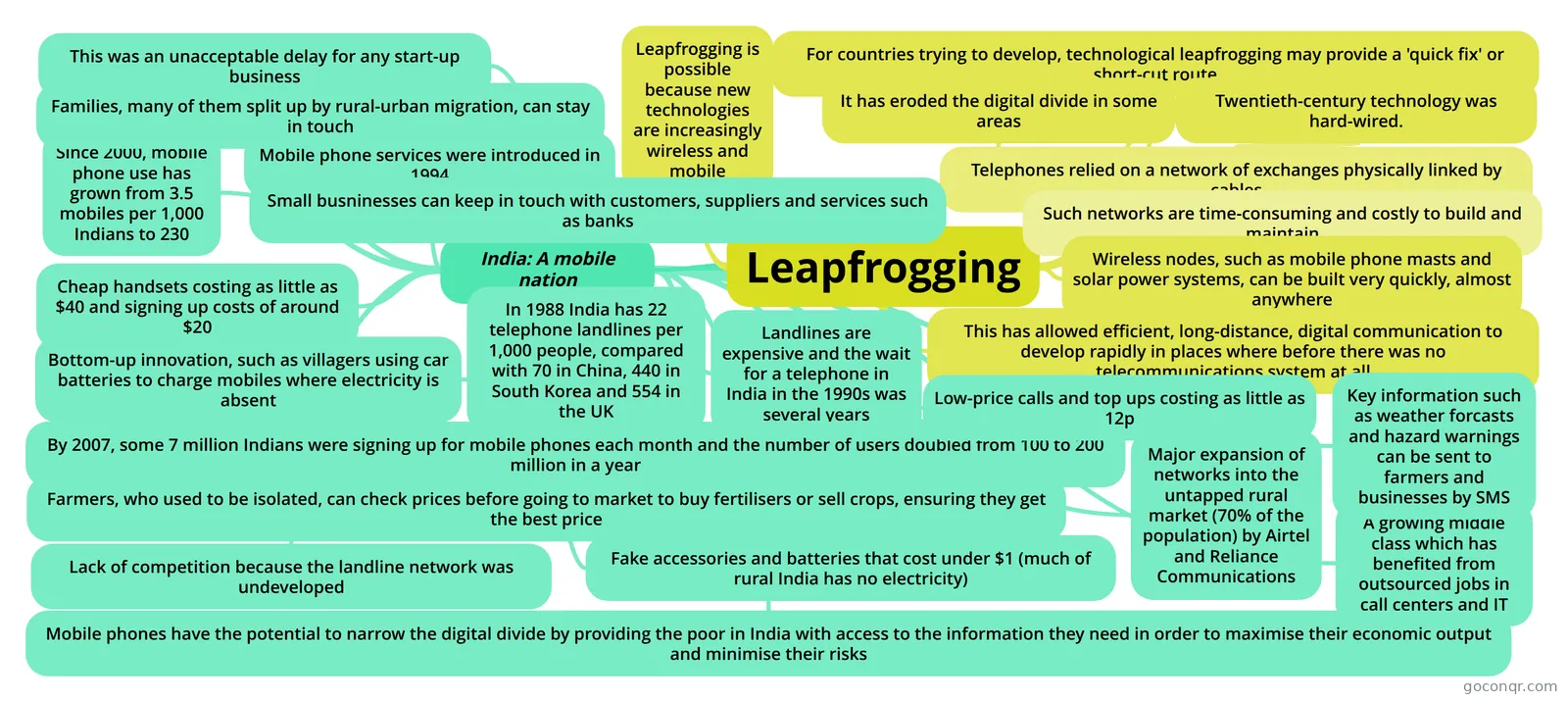
Mind map: Leapfrogging
Map content
Leapfrogging
For countries trying to develop, technological leapfrogging may provide a 'quick fix' or short-cut route
Twentieth-century technology was hard-wired.
- Telephones relied on a network of exchanges physically linked by cables
- Such networks are time-consuming and costly to build and maintain
- Telephones relied on a network of exchanges physically linked by cables
Leapfrogging is possible because new technologies are increasingly wireless and mobile
Wireless nodes, such as mobile phone masts and solar power systems, can be built very quickly, almost anywhere
This has allowed efficient, long-distance, digital communication to develop rapidly in places where before there was no telecommunications system at all
It has eroded the digital divide in some areas
India: A mobile nation
- In 1988 India has 22 telephone landlines per 1,000 people, compared with 70 in China, 440 in South Korea and 554 in the UK
- Landlines are expensive and the wait for a telephone in India in the 1990s was several years
- This was an unacceptable delay for any start-up business
- Mobile phone services were introduced in 1994
- Since 2000, mobile phone use has grown from 3.5 mobiles per 1,000 Indians to 230
- By 2007, some 7 million Indians were signing up for mobile phones each month and the number of users doubled from 100 to 200 million in a year
- Cheap handsets costing as little as $40 and signing up costs of around $20
- Low-price calls and top ups costing as little as 12p
- Lack of competition because the landline network was undeveloped
- A growing middle class which has benefited from outsourced jobs in call centers and IT
- Fake accessories and batteries that cost under $1 (much of rural India has no electricity)
- Bottom-up innovation, such as villagers using car batteries to charge mobiles where electricity is absent
- Major expansion of networks into the untapped rural market (70% of the population) by Airtel and Reliance Communications
- Families, many of them split up by rural-urban migration, can stay in touch
- Farmers, who used to be isolated, can check prices before going to market to buy fertilisers or sell crops, ensuring they get the best price
- Mobile phones have the potential to narrow the digital divide by providing the poor in India with access to the information they need in order to maximise their economic output and minimise their risks
- Small busninesses can keep in touch with customers, suppliers and services such as banks
- Key information such as weather forcasts and hazard warnings can be sent to farmers and businesses by SMS
Information
- Description
- A-Levels Geography (The Technological Fix) Mind Map on Leapfrogging, created by Jodie Goodacre on 03/11/2013.
- Created by
- Jodie Goodacre
- Views
- 99
- Tags
- Rating