
Mind map
TRAIT THEORIES
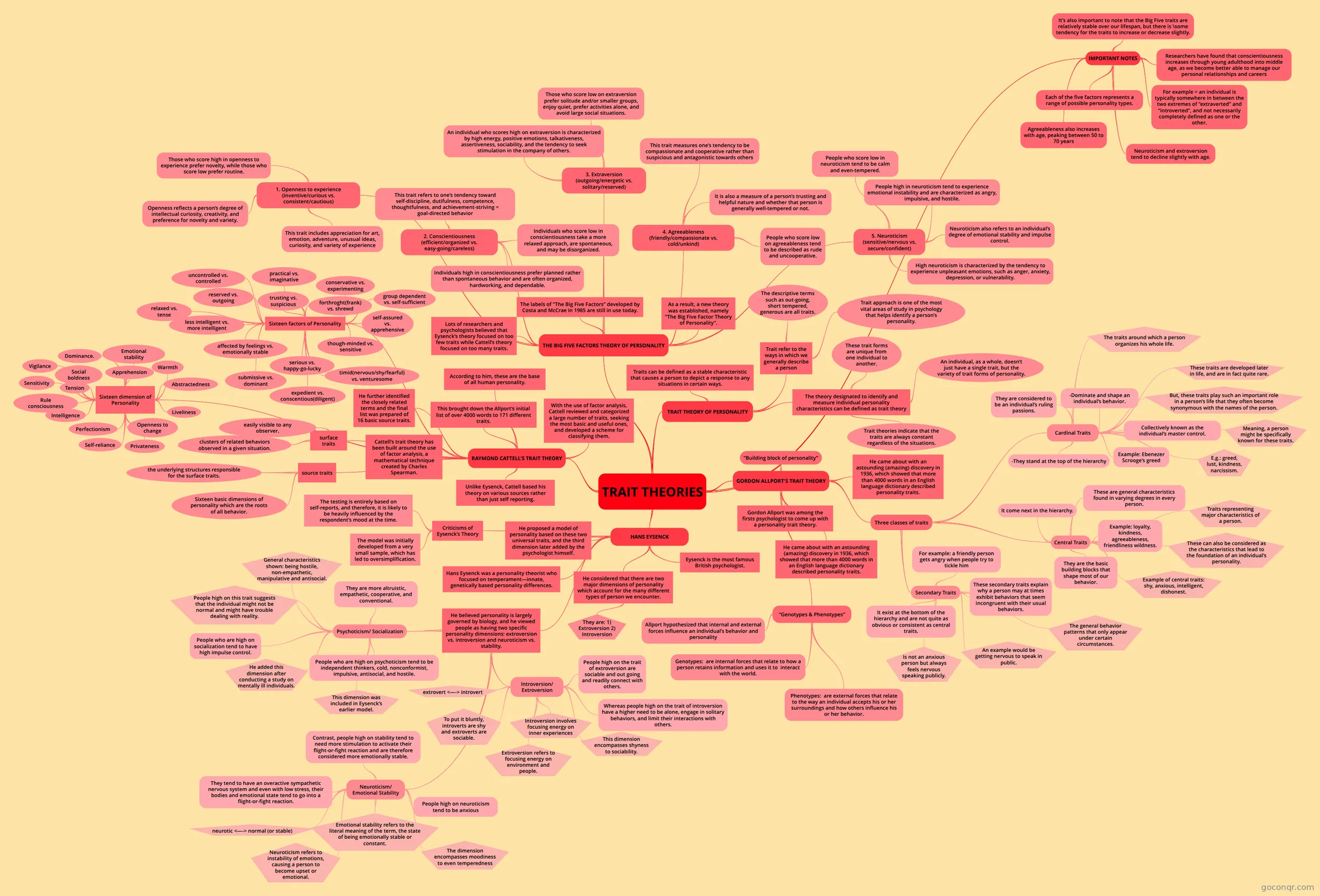
Mind map: Trait theories
Map content
TRAIT THEORIES
TRAIT THEORY OF PERSONALITY
- Traits can be defined as a stable characteristic that causes a person to depict a response to any situations in certain ways.
- Trait refer to the ways in which we generally describe a person
- The descriptive terms such as out-going, short tempered, generous are all traits.
- Trait approach is one of the most vital areas of study in psychology that helps identify a person’s personality.
- The theory designated to identify and measure individual personality characteristics can be defined as trait theory
- These trait forms are unique from one individual to another.
- An individual, as a whole, doesn’t just have a single trait, but the variety of trait forms of personality.
- Trait theories indicate that the traits are always constant regardless of the situations.
GORDON ALLPORT'S TRAIT THEORY
- Gordon Allport was among the firsts psychologist to come up with a personality trait theory.
- “Building block of personality”
- He came about with an astounding (amazing) discovery in 1936, which showed that more than 4000 words in an English language dictionary described personality traits.
- He came about with an astounding (amazing) discovery in 1936, which showed that more than 4000 words in an English language dictionary described personality traits.
- Three classes of traits
- Cardinal Traits
- -Dominate and shape an individual’s behavior.
- -They stand at the top of the hierarchy
- Collectively known as the individual’s master control.
- They are considered to be an individual’s ruling passions.
- Example: Ebenezer Scrooge’s greed
- The traits around which a person organizes his whole life.
- These traits are developed later in life, and are in fact quite rare.
- But, these traits play such an important role in a person’s life that they often become synonymous with the names of the person.
- Meaning, a person might be specifically known for these traits.
- E.g.: greed, lust, kindness, narcissism.
- Central Traits
- It come next in the hierarchy.
- These are general characteristics found in varying degrees in every person.
- Example: loyalty, kindness, agreeableness, friendliness wildness.
- They are the basic building blocks that shape most of our behavior.
- Traits representing major characteristics of a person.
- These can also be considered as the characteristics that lead to the foundation of an individual’s personality.
- Example of central traits: shy, anxious, intelligent, dishonest.
- Secondary Traits
- It exist at the bottom of the hierarchy and are not quite as obvious or consistent as central traits.
- These secondary traits explain why a person may at times exhibit behaviors that seem incongruent with their usual behaviors.
- For example: a friendly person gets angry when people try to tickle him
- The general behavior patterns that only appear under certain circumstances.
- An example would be getting nervous to speak in public.
- Is not an anxious person but always feels nervous speaking publicly.
- Cardinal Traits
- “Genotypes & Phenotypes”
- Allport hypothesized that internal and external forces influence an individual’s behavior and personality
- Genotypes: are internal forces that relate to how a person retains information and uses it to interact with the world.
- Phenotypes: are external forces that relate to the way an individual accepts his or her surroundings and how others influence his or her behavior.
HANS EYSENCK
- Eysenck is the most famous British psychologist.
- He considered that there are two major dimensions of personality which account for the many different types of person we encounter.
- They are: 1) Extroversion 2) Introversion
- He proposed a model of personality based on these two universal traits, and the third dimension later added by the psychologist himself.
- Hans Eysenck was a personality theorist who focused on temperament—innate, genetically based personality differences.
- He believed personality is largely governed by biology, and he viewed people as having two specific personality dimensions: extroversion vs. introversion and neuroticism vs. stability.
- Introversion/ Extroversion
- People high on the trait of extroversion are sociable and out going and readily connect with others.
- Whereas people high on the trait of introversion have a higher need to be alone, engage in solitary behaviors, and limit their interactions with others.
- This dimension encompasses shyness to sociability.
- Introversion involves focusing energy on inner experiences
- Extroversion refers to focusing energy on environment and people.
- To put it bluntly, introverts are shy and extroverts are sociable.
- extrovert <—-> introvert
- Neuroticism/ Emotional Stability
- People high on neuroticism tend to be anxious
- They tend to have an overactive sympathetic nervous system and even with low stress, their bodies and emotional state tend to go into a flight-or-fight reaction.
- Contrast, people high on stability tend to need more stimulation to activate their flight-or-fight reaction and are therefore considered more emotionally stable.
- The dimension encompasses moodiness to even temperedness
- Emotional stability refers to the literal meaning of the term, the state of being emotionally stable or constant.
- Neuroticism refers to instability of emotions, causing a person to become upset or emotional.
- neurotic <—-> normal (or stable)
- Psychoticism/ Socialization
- People who are high on psychoticism tend to be independent thinkers, cold, nonconformist, impulsive, antisocial, and hostile.
- People who are high on socialization tend to have high impulse control.
- They are more altruistic, empathetic, cooperative, and conventional.
- This dimension was included in Eysenck’s earlier model.
- He added this dimension after conducting a study on mentally ill individuals.
- People high on this trait suggests that the individual might not be normal and might have trouble dealing with reality.
- General characteristics shown: being hostile, non-empathetic, manipulative and antisocial.
- Introversion/ Extroversion
- Criticisms of Eysenck’s Theory
- The model was initially developed from a very small sample, which has led to oversimplification.
- The testing is entirely based on self-reports, and therefore, it is likely to be heavily influenced by the respondent’s mood at the time.
RAYMOND CATTELL'S TRAIT THEORY
- Unlike Eysenck, Cattell based his theory on various sources rather than just self reporting.
- Cattell’s trait theory has been built around the use of factor analysis, a mathematical technique created by Charles Spearman.
- With the use of factor analysis, Cattell reviewed and categorized a large number of traits, seeking the most basic and useful ones, and developed a scheme for classifying them.
- This brought down the Allport’s initial list of over 4000 words to 171 different traits.
- He further identified the closely related terms and the final list was prepared of 16 basic source traits.
- According to him, these are the base of all human personality.
- surface traits
- easily visible to any observer.
- clusters of related behaviors observed in a given situation.
- source traits
- the underlying structures responsible for the surface traits.
- Sixteen basic dimensions of personality which are the roots of all behavior.
- Sixteen dimension of Personality
- Abstractedness
- Warmth
- Apprehension
- Emotional stability
- Liveliness
- Openness to change
- Perfectionism
- Privateness
- Intelligence
- Rule consciousness
- Tension
- Sensitivity
- Social boldness
- Self-reliance
- Vigilance
- Dominance.
- Sixteen factors of Personality
- reserved vs. outgoing
- less intelligent vs. more intelligent
- affected by feelings vs. emotionally stable
- submissive vs. dominant
- serious vs. happy-go-lucky
- expedient vs. conscentious(diligent)
- timid(nervous/shy/fearful) vs. venturesome
- though-minded vs. sensitive
- trusting vs. suspicious
- practical vs. imaginative
- forthroght(frank) vs. shrewd
- self-assured vs. apprehensive
- conservative vs. experimenting
- group dependent vs. self-sufficient
- uncontrolled vs. controlled
- relaxed vs. tense
THE BIG FIVE FACTORS THEORY OF PERSONALITY
- The labels of “The Big Five Factors” developed by Costa and McCrae in 1985 are still in use today.
- Lots of researchers and psychologists believed that Eysenck’s theory focused on too few traits while Cattell’s theory focused on too many traits.
- As a result, a new theory was established, namely “The Big Five Factor Theory of Personality”.
- 1. Openness to experience (inventive/curious vs. consistent/cautious)
- This trait includes appreciation for art, emotion, adventure, unusual ideas, curiosity, and variety of experience
- Openness reflects a person’s degree of intellectual curiosity, creativity, and preference for novelty and variety.
- Those who score high in openness to experience prefer novelty, while those who score low prefer routine.
- 2. Conscientiousness (efficient/organized vs. easy-going/careless)
- This trait refers to one’s tendency toward self-discipline, dutifulness, competence, thoughtfulness, and achievement-striving = goal-directed behavior
- Individuals high in conscientiousness prefer planned rather than spontaneous behavior and are often organized, hardworking, and dependable.
- Individuals who score low in conscientiousness take a more relaxed approach, are spontaneous, and may be disorganized.
- 3. Extraversion (outgoing/energetic vs. solitary/reserved)
- An individual who scores high on extraversion is characterized by high energy, positive emotions, talkativeness, assertiveness, sociability, and the tendency to seek stimulation in the company of others.
- Those who score low on extraversion prefer solitude and/or smaller groups, enjoy quiet, prefer activities alone, and avoid large social situations.
- 4. Agreeableness (friendly/compassionate vs. cold/unkind)
- This trait measures one’s tendency to be compassionate and cooperative rather than suspicious and antagonistic towards others
- It is also a measure of a person’s trusting and helpful nature and whether that person is generally well-tempered or not.
- People who score low on agreeableness tend to be described as rude and uncooperative.
- 5. Neuroticism (sensitive/nervous vs. secure/confident)
- High neuroticism is characterized by the tendency to experience unpleasant emotions, such as anger, anxiety, depression, or vulnerability.
- Neuroticism also refers to an individual’s degree of emotional stability and impulse control.
- People high in neuroticism tend to experience emotional instability and are characterized as angry, impulsive, and hostile.
- People who score low in neuroticism tend to be calm and even-tempered.
IMPORTANT NOTES
- Each of the five factors represents a range of possible personality types.
- For example = an individual is typically somewhere in between the two extremes of “extraverted” and “introverted”, and not necessarily completely defined as one or the other.
- It’s also important to note that the Big Five traits are relatively stable over our lifespan, but there is \some tendency for the traits to increase or decrease slightly.
- Researchers have found that conscientiousness increases through young adulthood into middle age, as we become better able to manage our personal relationships and careers
- Agreeableness also increases with age, peaking between 50 to 70 years
- Neuroticism and extroversion tend to decline slightly with age.
Information
- Description
- Mind Map on TRAIT THEORIES, created by Anis Humaira Abdul Hafiz on 02/09/2021.
- Created by
- Anis Humaira Abdul Hafiz
- Views
- 0
- Rating