
Mind map
Functionalism A2 continued.
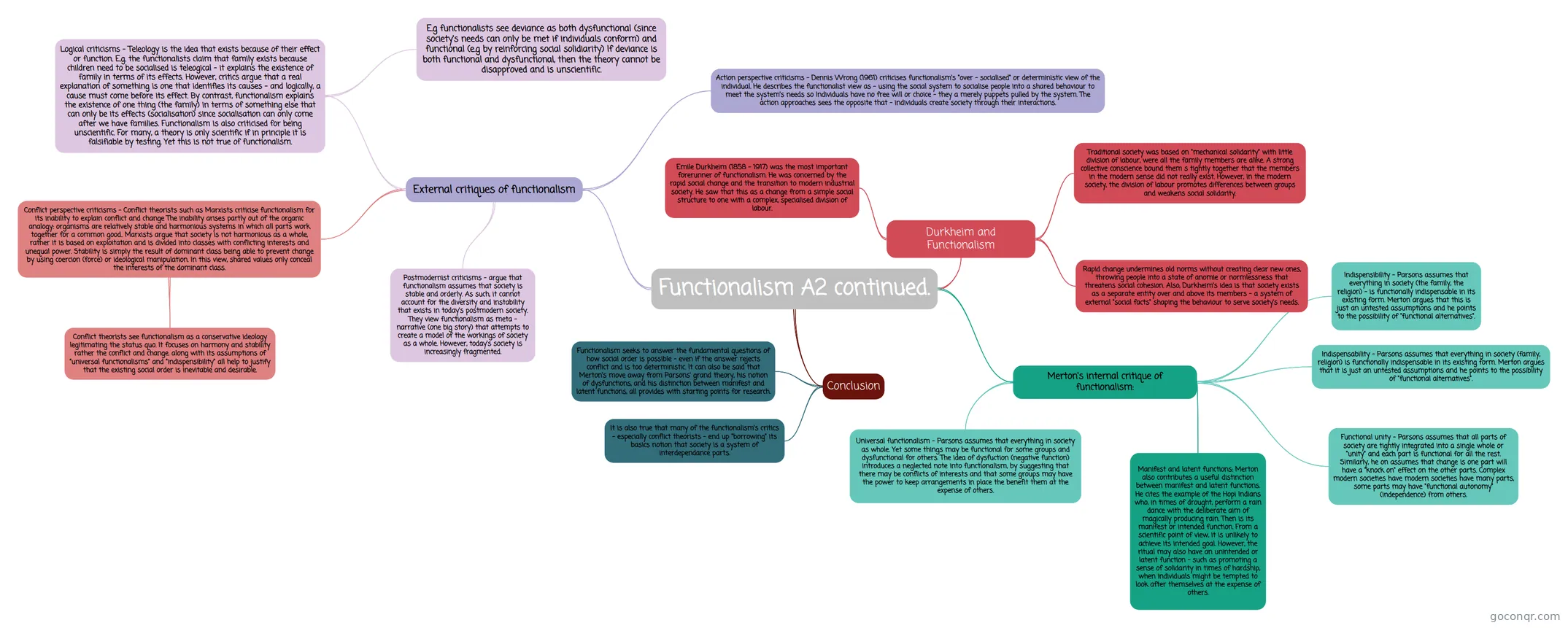
Mind map: Functionalism A2 sociology
Map content
Functionalism A2 continued.
Merton's internal critique of functionalism:
- Indispensability - Parsons assumes that everything in society (family, religion) is functionally indispensable in its existing form. Merton argues that it is just an untested assumptions and he points to the possibility of "functional alternatives".
- Indispensibility - Parsons assumes that everything in society (the family, the religion) - is functionally indispensable in its existing form. Merton argues that this is just an untested assumptions and he points to the possibility of "functional alternatives".
- Functional unity - Parsons assumes that all parts of society are tightly integrated into a single whole or "unity" and each part is functional for all the rest. Similarly, he on assumes that change is one part will have a "knock on" effect on the other parts. Complex modern societies have modern societies have many parts, some parts may have "functional autonomy" (independence) from others.
- Universal functionalism - Parsons assumes that everything in society as whole. Yet some things may be functional for some groups and dysfunctional for others. The idea of dysfuction (negative function) introduces a neglected note into functionalism, by suggesting that there may be conflicts of interests and that some groups may have the power to keep arrangements in place the benefit them at the expense of others.
- Manifest and latent functions: Merton also contributes a useful distinction between manifest and latent functions. He cites the example of the Hopi Indians who, in times of drought, perform a rain dance with the deliberate aim of magically producing rain. Then is its manifest or intended function. From a scientific point of view, it is unlikely to achieve its intended goal. However, the ritual may also have an unintended or latent function - such as promoting a sense of solidarity in times of hardship, when individuals might be tempted to look after themselves at the expense of others.
External critiques of functionalism
- Logical criticisms - Teleology is the idea that exists because of their effect or function. E.g. the functionalists claim that family exists because children need to be socialised is teleogical - it explains the existence of family in terms of its effects. However, critics argue that a real explanation of something is one that identifies its causes - and logically, a cause must come before its effect. By contrast, functionalism explains the existence of one thing (the family) in terms of something else that can only be its effects (socialisation) since socialisation can only come after we have families. Functionalism is also criticised for being unscientific. For many, a theory is only scientific if in principle it is falsifiable by testing. Yet this is not true of functionalism.
- E.g functionalists see deviance as both dysfunctional (since society's needs can only be met if individuals conform) and functional (e.g by reinforcing social solidiarity) If deviance is both functional and dysfunctional, then the theory cannot be disapproved and is unscientific.
- Conflict perspective criticisms - Conflict theorists such as Marxists criticise functionalism for its inability to explain conflict and change The inability arises partly out of the organic analogy: organisms are relatively stable and harmonious systems in which all parts work together for a common good.. Marxists argue that society is not harmonious as a whole, rather it is based on exploitation and is divided into classes with conflicting interests and unequal power. Stability is simply the result of dominant class being able to prevent change by using coercion (force) or ideological manipulation. In this view, shared values only conceal the interests of the dominant class.
- Conflict theorists see functionalism as a conservative ideology legitimating the status quo. It focuses on harmony and stability rather the conflict and change. along with its assumptions of "universal functionalisms" and "indispensibility" all help to justify that the existing social order is inevitable and desirable.
- Postmodernist criticisms - argue that functionalism assumes that society is stable and orderly. As such, it cannot account for the diversity and instability that exists in today's postmodern society. They view functionalism as meta - narrative (one big story) that attempts to create a model of the workings of society as a whole. However, today's society is increasingly fragmented.
- Action perspective criticisms - Dennis Wrong (1961) criticises functionalism's "over - socialised" or deterministic view of the individual. He describes the functionalist view as - using the social system to socialise people into a shared behaviour to meet the system's needs so Individuals have no free will or choice - they a merely puppets pulled by the system. The action approaches sees the opposite that - individuals create society through their interactions.
- Logical criticisms - Teleology is the idea that exists because of their effect or function. E.g. the functionalists claim that family exists because children need to be socialised is teleogical - it explains the existence of family in terms of its effects. However, critics argue that a real explanation of something is one that identifies its causes - and logically, a cause must come before its effect. By contrast, functionalism explains the existence of one thing (the family) in terms of something else that can only be its effects (socialisation) since socialisation can only come after we have families. Functionalism is also criticised for being unscientific. For many, a theory is only scientific if in principle it is falsifiable by testing. Yet this is not true of functionalism.
Conclusion
- Functionalism seeks to answer the fundamental questions of how social order is possible - even if the answer rejects conflict and is too deterministic. It can also be said that Merton's move away from Parsons' grand theory, his notion of dysfunctions, and his distinction between manifest and latent functions, all provides with starting points for research.
- It is also true that many of the functionalism's critics - especially conflict theorists - end up "borrowing" its basics notion that society is a system of interdependance parts.
Durkheim and Functionalism
- Emile Durkheim (1858 - 1917) was the most important forerunner of functionalism. He was concerned by the rapid social change and the transition to modern industrial society. He saw that this as a change from a simple social structure to one with a complex, specialised division of labour.
- Traditional society was based on "mechanical solidarity" with little division of labour, were all the family members are alike. A strong collective conscience bound them s tightly together that the members in the modern sense did not really exist. However, in the modern society, the division of labour promotes differences between groups and weakens social solidarity.
- Rapid change undermines old norms without creating clear new ones, throwing people into a state of anomie or normlessness that threatens social cohesion. Also, Durkheim's idea is that society exists as a separate entity over and above its members - a system of external "social facts" shaping the behaviour to serve society's needs.
Information
- Description
- Mind Map on Functionalism A2 continued., created by romena98 on 24/09/2015.
- Created by
- romena98
- Views
- 0
- Rating