
Mind map
4. Trusts
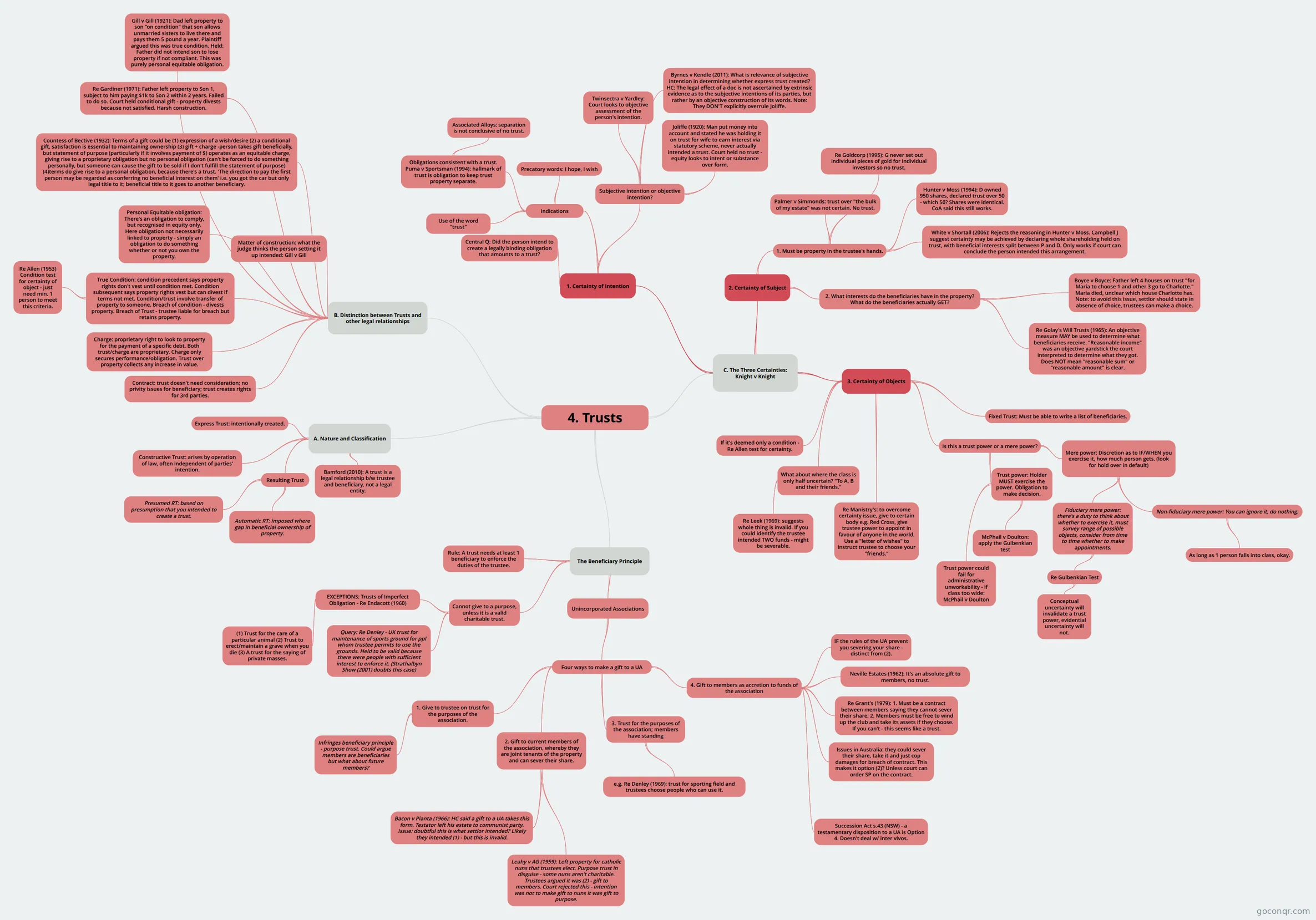
Mind map: Trusts
Map content
4. Trusts
A. Nature and Classification
- Express Trust: intentionally created.
- Resulting Trust
- Presumed RT: based on presumption that you intended to create a trust.
- Automatic RT: imposed where gap in beneficial ownership of property.
- Constructive Trust: arises by operation of law, often independent of parties' intention.
- Bamford (2010): A trust is a legal relationship b/w trustee and beneficiary, not a legal entity.
B. Distinction between Trusts and other legal relationships
- Contract: trust doesn't need consideration; no privity issues for beneficiary; trust creates rights for 3rd parties.
- Charge: proprietary right to look to property for the payment of a specific debt. Both trust/charge are proprietary. Charge only secures performance/obligation. Trust over property collects any increase in value.
- True Condition: condition precedent says property rights don't vest until condition met. Condition subsequent says property rights vest but can divest if terms not met. Condition/trust involve transfer of property to someone. Breach of condition - divests property. Breach of Trust - trustee liable for breach but retains property.
- Re Allen (1953) Condition test for certainty of object - just need min. 1 person to meet this criteria.
- Personal Equitable obligation: There's an obligation to comply, but recognised in equity only. Here obligation not necessarily linked to property - simply an obligation to do something whether or not you own the property.
- Countess of Bective (1932): Terms of a gift could be (1) expression of a wish/desire (2) a conditional gift, satisfaction is essential to maintaining ownership (3) gift + charge -person takes gift beneficially, but statement of purpose (particularly if it involves payment of $) operates as an equitable charge, giving rise to a proprietary obligation but no personal obligation (can't be forced to do something personally, but someone can cause the gift to be sold if I don't fulfill the statement of purpose) (4)terms do give rise to a personal obligation, because there's a trust. 'The direction to pay the first person may be regarded as conferring no beneficial interest on them' i.e. you got the car but only legal title to it; beneficial title to it goes to another beneficiary.
- Re Gardiner (1971): Father left property to Son 1, subject to him paying $1k to Son 2 within 2 years. Failed to do so. Court held conditional gift - property divests because not satisfied. Harsh construction.
- Gill v Gill (1921): Dad left property to son "on condition" that son allows unmarried sisters to live there and pays them 5 pound a year. Plaintiff argued this was true condition. Held: Father did not intend son to lose property if not compliant. This was purely personal equitable obligation.
- Matter of construction: what the judge thinks the person setting it up intended: Gill v Gill
C. The Three Certainties: Knight v Knight
- 1. Certainty of Intention
- Central Q: Did the person intend to create a legally binding obligation that amounts to a trust?
- Indications
- Use of the word "trust"
- Obligations consistent with a trust. Puma v Sportsman (1994): hallmark of trust is obligation to keep trust property separate.
- Associated Alloys: separation is not conclusive of no trust.
- Precatory words: I hope, I wish
- Subjective intention or objective intention?
- Byrnes v Kendle (2011): What is relevance of subjective intention in determining whether express trust created? HC: The legal effect of a doc is not ascertained by extrinsic evidence as to the subjective intentions of its parties, but rather by an objective construction of its words. Note: They DON'T explicitly overrule Joliffe.
- Joliffe (1920): Man put money into account and stated he was holding it on trust for wife to earn interest via statutory scheme, never actually intended a trust. Court held no trust - equity looks to intent or substance over form.
- Twinsectra v Yardley: Court looks to objective assessment of the person's intention.
- 2. Certainty of Subject
- 1. Must be property in the trustee's hands.
- Palmer v Simmonds: trust over "the bulk of my estate" was not certain. No trust.
- Re Goldcorp (1995): G never set out individual pieces of gold for individual investors so no trust.
- Hunter v Moss (1994): D owned 950 shares, declared trust over 50 - which 50? Shares were identical. CoA said this still works.
- White v Shortall (2006): Rejects the reasoning in Hunter v Moss. Campbell J suggest certainty may be achieved by declaring whole shareholding held on trust, with beneficial interests split between P and D. Only works if court can conclude the person intended this arrangement.
- 2. What interests do the beneficiaries have in the property? What do the beneficiaries actually GET?
- Boyce v Boyce: Father left 4 houses on trust "for Maria to choose 1 and other 3 go to Charlotte." Maria died, unclear which house Charlotte has. Note: to avoid this issue, settlor should state in absence of choice, trustees can make a choice.
- Re Golay's Will Trusts (1965): An objective measure MAY be used to determine what beneficiaries receive. "Reasonable income" was an objective yardstick the court interpreted to determine what they got. Does NOT mean "reasonable sum" or "reasonable amount" is clear.
- 1. Must be property in the trustee's hands.
- 3. Certainty of Objects
- Fixed Trust: Must be able to write a list of beneficiaries.
- Is this a trust power or a mere power?
- Mere power: Discretion as to IF/WHEN you exercise it, how much person gets. (look for hold over in default)
- Fiduciary mere power: there's a duty to think about whether to exercise it, must survey range of possible objects, consider from time to time whether to make appointments.
- Re Gulbenkian Test
- Conceptual uncertainty will invalidate a trust power, evidential uncertainty will not.
- Re Gulbenkian Test
- Non-fiduciary mere power: You can ignore it, do nothing.
- As long as 1 person falls into class, okay.
- Fiduciary mere power: there's a duty to think about whether to exercise it, must survey range of possible objects, consider from time to time whether to make appointments.
- Trust power: Holder MUST exercise the power. Obligation to make decision.
- McPhail v Doulton: apply the Gulbenkian test
- Trust power could fail for administrative unworkability - if class too wide: McPhail v Doulton
- Mere power: Discretion as to IF/WHEN you exercise it, how much person gets. (look for hold over in default)
- What about where the class is only half uncertain? "To A, B and their friends."
- Re Leek (1969): suggests whole thing is invalid. If you could identify the trustee intended TWO funds - might be severable.
- Re Manistry's: to overcome certainty issue, give to certain body e.g. Red Cross, give trustee power to appoint in favour of anyone in the world. Use a "letter of wishes" to instruct trustee to choose your "friends."
- If it's deemed only a condition - Re Allen test for certainty.
- 1. Certainty of Intention
The Beneficiary Principle
- Rule: A trust needs at least 1 beneficiary to enforce the duties of the trustee.
- Cannot give to a purpose, unless it is a valid charitable trust.
- EXCEPTIONS: Trusts of Imperfect Obligation - Re Endacott (1960)
- (1) Trust for the care of a particular animal (2) Trust to erect/maintain a grave when you die (3) A trust for the saying of private masses.
- Query: Re Denley - UK trust for maintenance of sports ground for ppl whom trustee permits to use the grounds. Held to be valid because there were people with sufficient interest to enforce it. (Strathalbyn Show (2001) doubts this case)
- EXCEPTIONS: Trusts of Imperfect Obligation - Re Endacott (1960)
- Unincorporated Associations
- Four ways to make a gift to a UA
- 1. Give to trustee on trust for the purposes of the association.
- Infringes beneficiary principle - purpose trust. Could argue members are beneficiaries but what about future members?
- 2. Gift to current members of the association, whereby they are joint tenants of the property and can sever their share.
- Bacon v Pianta (1966): HC said a gift to a UA takes this form. Testator left his estate to communist party. Issue: doubtful this is what settlor intended? Likely they intended (1) - but this is invalid.
- Leahy v AG (1959): Left property for catholic nuns that trustees elect. Purpose trust in disguise - some nuns aren't charitable. Trustees argued it was (2) - gift to members. Court rejected this - intention was not to make gift to nuns it was gift to purpose.
- 3. Trust for the purposes of the association; members have standing
- e.g. Re Denley (1969): trust for sporting field and trustees choose people who can use it.
- 4. Gift to members as accretion to funds of the association
- IF the rules of the UA prevent you severing your share - distinct from (2).
- Neville Estates (1962): It's an absolute gift to members, no trust.
- Re Grant's (1979): 1. Must be a contract between members saying they cannot sever their share; 2. Members must be free to wind up the club and take its assets if they choose. If you can't - this seems like a trust.
- Issues in Australia: they could sever their share, take it and just cop damages for breach of contract. This makes it option (2)? Unless court can order SP on the contract.
- Succession Act s.43 (NSW) - a testamentary disposition to a UA is Option 4. Doesn't deal w/ inter vivos.
- 1. Give to trustee on trust for the purposes of the association.
- Four ways to make a gift to a UA
Information
- Description
- Universität EQUITY Mind Map on 4. Trusts, created by georgiafeltis on 06/11/2015.
- Created by
- georgiafeltis
- Views
- 20
- Rating