
Mind map
Late Adulthood
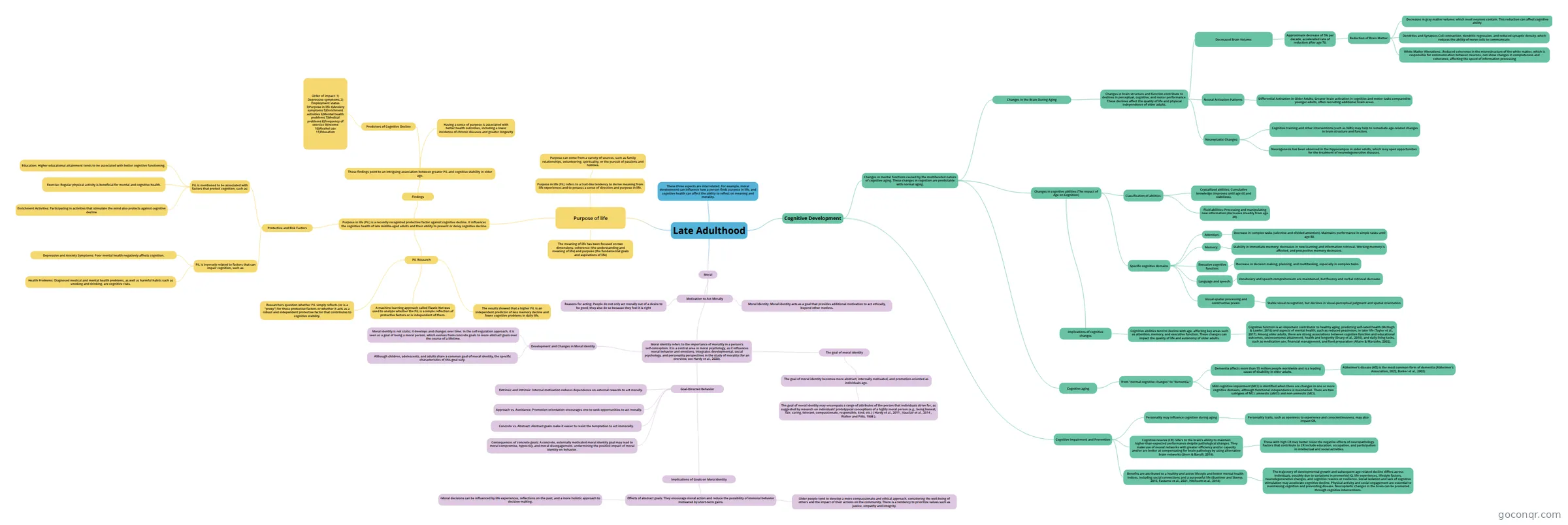
Mind map: Late adulthood
Map content
Late Adulthood
Cognitive Development
- Changes in mental functions caused by the multifaceted nature of cognitive aging. These changes in cognition are predictable with normal aging.
- Changes in the Brain During Aging
- Changes in brain structure and function contribute to declines in perceptual, cognitive, and motor performance. These declines affect the quality of life and physical independence of older adults.
- Decreased Brain Volume:
- Approximate decrease of 5% per decade, accelerated rate of reduction after age 70.
- Reduction of Brain Matter:
- Decreases in gray matter volume: which most neurons contain. This reduction can affect cognitive ability.
- White Matter Alterations: .Reduced coherence in the microstructure of the white matter, which is responsible for communication between neurons, can show changes in completeness and coherence, affecting the speed of information processing
- Dendrites and Synapses:Cell contraction, dendritic regression, and reduced synaptic density, which reduces the ability of nerve cells to communicate.
- Reduction of Brain Matter:
- Approximate decrease of 5% per decade, accelerated rate of reduction after age 70.
- Neural Activation Patterns
- Differential Activation in Older Adults: Greater brain activation in cognitive and motor tasks compared to younger adults, often recruiting additional brain areas.
- Neuroplastic Changes:
- Cognitive training and other interventions (such as NiBS) may help to remediate age-related changes in brain structure and function.
- Neurogenesis has been observed in the hippocampus in older adults, which may open opportunities for the treatment of neurodegenerative diseases.
- Decreased Brain Volume:
- Changes in brain structure and function contribute to declines in perceptual, cognitive, and motor performance. These declines affect the quality of life and physical independence of older adults.
- Changes in cognitive abilities (The Impact of Age on Cognition)
- Classification of abilities:
- Crystallized abilities: Cumulative knowledge (improves until age 60 and stabilizes).
- Fluid abilities: Processing and manipulating new information (decreases steadily from age 20).
- Specific cognitive domains
- Attention:
- Decrease in complex tasks (selective and divided attention). Maintains performance in simple tasks until age 80.
- Memory:
- Stability in immediate memory; decreases in new learning and information retrieval. Working memory is affected, and prospective memory decreases.
- Executive cognitive function:
- Decrease in decision making, planning, and multitasking, especially in complex tasks.
- Language and speech:
- Vocabulary and speech comprehension are maintained, but fluency and verbal retrieval decrease.
- Visual-spatial processing and constructive praxis:
- Stable visual recognition, but declines in visual-perceptual judgment and spatial orientation.
- Attention:
- Implications of cognitive changes
- Cognitive abilities tend to decline with age, affecting key areas such as attention, memory, and executive function. These changes can impact the quality of life and autonomy of older adults.
- Cognitive function is an important contributor to healthy aging, predicting self-rated health (McHugh & Lawlor, 2016) and aspects of mental health, such as reduced pessimism, in later life (Taylor et al., 2017). Among older adults, there are strong associations between cognitive function and educational outcomes, socioeconomic attainment, health and longevity (Deary et al., 2010), and daily living tasks, such as medication use, financial management, and food preparation (Allaire & Marsiske, 2002).
- Cognitive abilities tend to decline with age, affecting key areas such as attention, memory, and executive function. These changes can impact the quality of life and autonomy of older adults.
- Classification of abilities:
- Cognitive aging
- from "normal cognitive changes" to "dementia,"
- Dementia affects more than 55 million people worldwide and is a leading cause of disability in older adults.
- Alzheimer's disease (AD) is the most common form of dementia (Alzheimer's Association, 2022, Barker et al., 2002)
- Mild cognitive impairment (MCI) is identified when there are changes in one or more cognitive domains, although functional independence is maintained. There are two subtypes of MCI: amnestic (aMCI) and non-amnestic (MCI).
- Dementia affects more than 55 million people worldwide and is a leading cause of disability in older adults.
- from "normal cognitive changes" to "dementia,"
- Changes in the Brain During Aging
- Cognitive Impairment and Prevention
- Personality may influence cognition during aging
- Personality traits, such as openness to experience and conscientiousness, may also impact CR.
- Cognitive reserve (CR) refers to the brain's ability to maintain higher-than-expected performance despite pathological changes. They make use of neural networks with greater efficiency and/or capacity and/or are better at compensating for brain pathology by using alternative brain networks (Stern & Barulli, 2019).
- Those with high CR may better resist the negative effects of neuropathology. Factors that contribute to CR include education, occupation, and participation in intellectual and social activities.
- Benefits are attributed to a healthy and active lifestyle and better mental health indices, including social connections and a purposeful life (Buettner and Skemp, 2016, Fastame et al., 2021, Hitchcott et al., 2018)
- The trajectory of developmental growth and subsequent age-related decline differs across individuals, possibly due to variations in premorbid IQ, life experiences, lifestyle factors, neurodegenerative changes, and cognitive reserve or resilience. Social isolation and lack of cognitive stimulation may accelerate cognitive decline. Physical activity and social engagement are essential to maintaining cognition and preventing disease. Neuroplastic changes in the brain can be promoted through cognitive interventions.
- Personality may influence cognition during aging
- Changes in mental functions caused by the multifaceted nature of cognitive aging. These changes in cognition are predictable with normal aging.
Purpose of life
- Purpose in life (PiL) is a recently recognized protective factor against cognitive decline. It influences the cognitive health of late middle-aged adults and their ability to prevent or delay cognitive decline.
- Findings
- These findings point to an intriguing association between greater PiL and cognitive stability in older age.
- Predictors of Cognitive Decline
- Order of impact: 1) Depressive symptoms 2) Employment status 3)Purpose in life 4)Anxiety symptoms 5)Enrichment activities 6)Mental health problems 7)Medical problems 8)Frequency of exercise 9)Income 10)Alcohol use 11)Education
- Having a sense of purpose is associated with better health outcomes, including a lower incidence of chronic diseases and greater longevity
- Predictors of Cognitive Decline
- These findings point to an intriguing association between greater PiL and cognitive stability in older age.
- Protective and Risk Factors
- PiL is mentioned to be associated with factors that protect cognition, such as:
- Education: Higher educational attainment tends to be associated with better cognitive functioning.
- Exercise: Regular physical activity is beneficial for mental and cognitive health.
- Enrichment Activities: Participating in activities that stimulate the mind also protects against cognitive decline
- PiL is inversely related to factors that can impair cognition, such as:
- Depressive and Anxiety Symptoms: Poor mental health negatively affects cognition.
- Health Problems: Diagnosed medical and mental health problems, as well as harmful habits such as smoking and drinking, are cognitive risks.
- PiL is mentioned to be associated with factors that protect cognition, such as:
- PiL Research
- Researchers question whether PiL simply reflects (or is a "proxy") for these protective factors or whether it acts as a robust and independent protective factor that contributes to cognitive stability.
- A machine learning approach called Elastic Net was used to analyze whether the PiL is a simple reflection of protective factors or is independent of them.
- The results showed that a higher PiL is an independent predictor of less memory decline and fewer cognitive problems in daily life.
- Findings
- The meaning of life has been focused on two dimensions: coherence (the understanding and meaning of life) and purpose (the fundamental goals and aspirations of life)
- Purpose in life (PiL) refers to a trait-like tendency to derive meaning from life experiences and to possess a sense of direction and purpose in life.
- Purpose can come from a variety of sources, such as family relationships, volunteering, spirituality, or the pursuit of passions and hobbies.
- Purpose in life (PiL) is a recently recognized protective factor against cognitive decline. It influences the cognitive health of late middle-aged adults and their ability to prevent or delay cognitive decline.
Moral
- Moral identity refers to the importance of morality in a person's self-conception. It is a central area in moral psychology, as it influences moral behavior and emotions. integrates developmental, social psychology, and personality perspectives in the study of morality (for an overview, see Hardy et al., 2020).
- Development and Changes in Moral Identity
- Moral identity is not static; it develops and changes over time. In the self-regulation approach, it is seen as a goal of being a moral person, which evolves from concrete goals to more abstract goals over the course of a lifetime.
- Although children, adolescents, and adults share a common goal of moral identity, the specific characteristics of this goal vary.
- The goal of moral identity
- The goal of moral identity becomes more abstract, internally motivated, and promotion-oriented as individuals age.
- The goal of moral identity may encompass a range of attributes of the person that individuals strive for, as suggested by research on individuals’ prototypical conceptions of a highly moral person (e.g., being honest, fair, caring, tolerant, compassionate, responsible, kind, etc.) ( Hardy et al., 2011 , Vauclair et al., 2014 , Walker and Pitts, 1998 ).
- The goal of moral identity becomes more abstract, internally motivated, and promotion-oriented as individuals age.
- Goal-Directed Behavior
- Concrete vs. Abstract: Abstract goals make it easier to resist the temptation to act immorally.
- Extrinsic and Intrinsic: Internal motivation reduces dependence on external rewards to act morally.
- Approach vs. Avoidance: Promotion orientation encourages one to seek opportunities to act morally.
- Implications of Goals on Mora Identity
- Effects of abstract goals: They encourage moral action and reduce the possibility of immoral behavior motivated by short-term gains.
- •Moral decisions can be influenced by life experiences, reflections on the past, and a more holistic approach to decision-making.
- Older people tend to develop a more compassionate and ethical approach, considering the well-being of others and the impact of their actions on the community. There is a tendency to prioritize values such as justice, empathy and integrity.
- Effects of abstract goals: They encourage moral action and reduce the possibility of immoral behavior motivated by short-term gains.
- Consequences of concrete goals: A concrete, externally motivated moral identity goal may lead to moral compromise, hypocrisy, and moral disengagement, undermining the positive impact of moral identity on behavior.
- Development and Changes in Moral Identity
- Motivation to Act Morally
- Reasons for acting: People do not only act morally out of a desire to be good; they also do so because they feel it is right
- Moral Identity: Moral identity acts as a goal that provides additional motivation to act ethically, beyond other motives.
- Moral identity refers to the importance of morality in a person's self-conception. It is a central area in moral psychology, as it influences moral behavior and emotions. integrates developmental, social psychology, and personality perspectives in the study of morality (for an overview, see Hardy et al., 2020).
These three aspects are interrelated. For example, moral development can influence how a person finds purpose in life, and cognitive health can affect the ability to reflect on meaning and morality.
Information
- Description
- Mind Map on Late Adulthood, created by Luisa G B on 04/10/2024.
- Created by
- Luisa G B
- Views
- 1
- Rating