
Mind map
Certainty of Objects
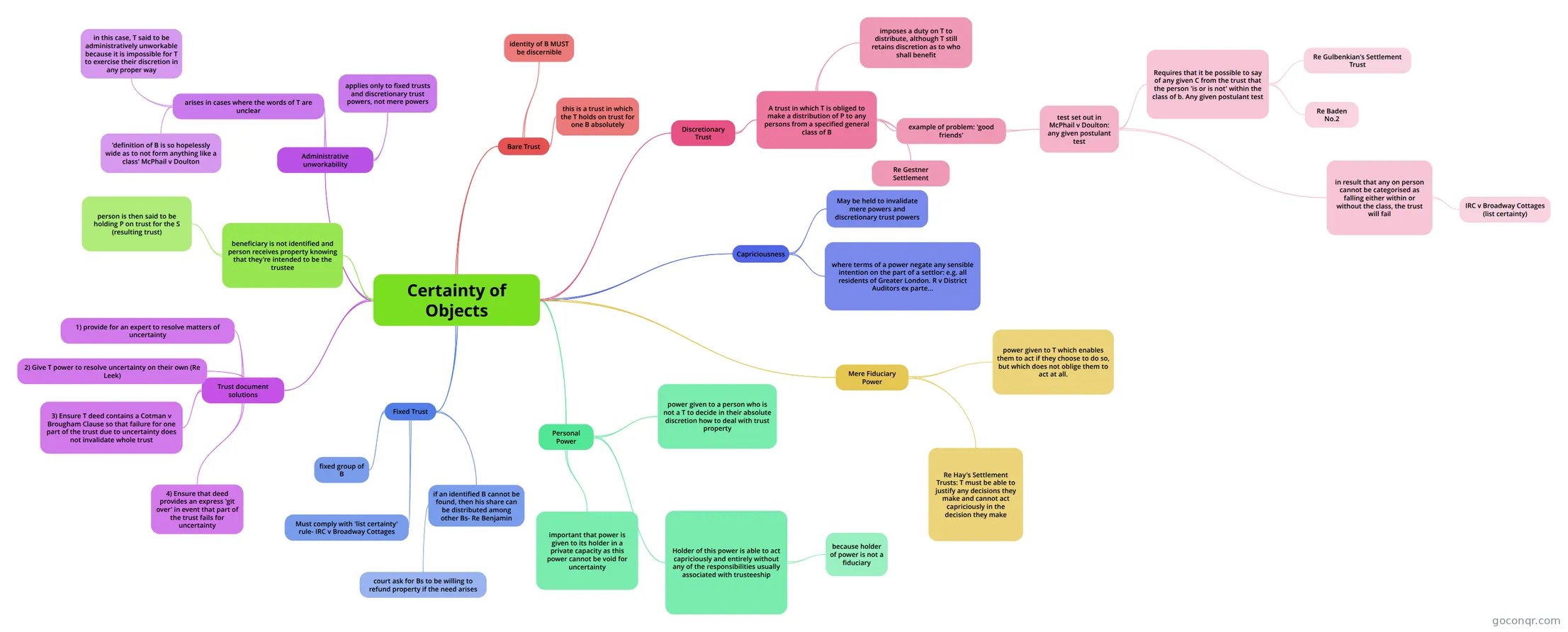
Mind map: certainty of objects trust law
Map content
Certainty of Objects
beneficiary is not identified and person receives property knowing that they're intended to be the trustee
- person is then said to be holding P on trust for the S (resulting trust)
Bare Trust
- this is a trust in which the T holds on trust for one B absolutely
- identity of B MUST be discernible
Fixed Trust
- fixed group of B
- Must comply with 'list certainty' rule- IRC v Broadway Cottages
- if an identified B cannot be found, then his share can be distributed among other Bs- Re Benjamin
- court ask for Bs to be willing to refund property if the need arises
Discretionary Trust
- A trust in which T is obliged to make a distribution of P to any persons from a specified general class of B
- imposes a duty on T to distribute, although T still retains discretion as to who shall benefit
- example of problem: 'good friends'
- test set out in McPhail v Doulton: any given postulant test
- Requires that it be possible to say of any given C from the trust that the person 'is or is not' within the class of b. Any given postulant test
- Re Gulbenkian's Settlement Trust
- Re Baden No.2
- in result that any on person cannot be categorised as falling either within or without the class, the trust will fail
- IRC v Broadway Cottages (list certainty)
- Requires that it be possible to say of any given C from the trust that the person 'is or is not' within the class of b. Any given postulant test
- test set out in McPhail v Doulton: any given postulant test
- Re Gestner Settlement
- A trust in which T is obliged to make a distribution of P to any persons from a specified general class of B
Mere Fiduciary Power
- power given to T which enables them to act if they choose to do so, but which does not oblige them to act at all.
- Re Hay's Settlement Trusts: T must be able to justify any decisions they make and cannot act capriciously in the decision they make
Personal Power
- power given to a person who is not a T to decide in their absolute discretion how to deal with trust property
- important that power is given to its holder in a private capacity as this power cannot be void for uncertainty
- Holder of this power is able to act capriciously and entirely without any of the responsibilities usually associated with trusteeship
- because holder of power is not a fiduciary
Administrative unworkability
- arises in cases where the words of T are unclear
- 'definition of B is so hopelessly wide as to not form anything like a class' McPhail v Doulton
- in this case, T said to be administratively unworkable because it is impossible for T to exercise their discretion in any proper way
- applies only to fixed trusts and discretionary trust powers, not mere powers
- arises in cases where the words of T are unclear
Capriciousness
- May be held to invalidate mere powers and discretionary trust powers
- where terms of a power negate any sensible intention on the part of a settlor: e.g. all residents of Greater London. R v District Auditors ex parte...
Trust document solutions
- 1) provide for an expert to resolve matters of uncertainty
- 2) Give T power to resolve uncertainty on their own (Re Leek)
- 3) Ensure T deed contains a Cotman v Brougham Clause so that failure for one part of the trust due to uncertainty does not invalidate whole trust
- 4) Ensure that deed provides an express 'git over' in event that part of the trust fails for uncertainty
Information
- Description
- (Equity and Trusts) Mind Map on Certainty of Objects, created by scott.james.smit on 16/04/2013.
- Created by
- scott.james.smit
- Views
- 315
- Tags
- Rating