
Mind map
13.3 & 13.4 Reactions of Alkenes and Electrophillic Addition
Map content
13.3 & 13.4 Reactions of Alkenes and Electrophillic Addition
Addition reactions of the alkenes
- Hydrogen Halides
- Alkenes react with gaseous hydrogen halides at room temp to form haloalkanes
- If alkene is gaseous, reaction take place when two gases are mixed
- If alkene is liquid, the the hydrogen halide is bubbled through it
- Alkenes can also react with concentrated HCl or HBr (which are solution of the hydrogen halides in water)
- Alkenes react with gaseous hydrogen halides at room temp to form haloalkanes
- Each of these reactions involves the ADDITION of a small molecule across the double bond, causing the pi bond to break, and new bonds to form
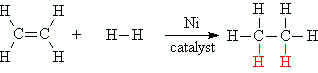
- Hydrogenation of Alkenes
- Nickel Catalyst
- 423K
- Alkene + Hydrogen = Alkane
- Hydrogenation of Propene >>
- Hydration reactions of Alkenes
- Alkene + Water (steam) --> Alcohol
- Requires the presence of a phosphoric acid catalyst (H3PO4)
- Can form a Primary or secondary alcohol
- Alkene + Water (steam) --> Alcohol
- Halogenation
- Rapid addition reaction with the halogens: Cl or Br at room temperature
- Haloalkane
- Rapid addition reaction with the halogens: Cl or Br at room temperature
- Hydrogen Halides
Electrophilic addition in Alkenes
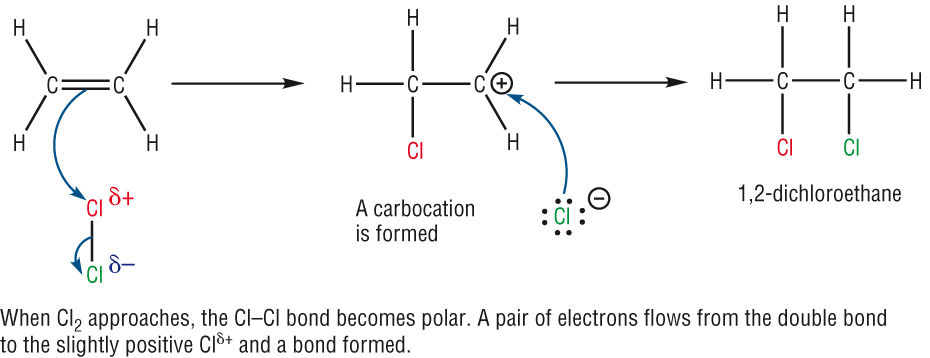
- Alkenes usually take part in addition reactions to form saturated compounds = ELECTROPHILLIC ADDITION
- Double bond in an alkene represents region of high electron density due ton presence of pi-electrons
- High electron density attracts electrophiles
- Electrophile = An atom that is attracted to an electron-rich centre and accepts an electron pair. Usually a positive ion or molecule containing an atom with a partial positive charge.
- High electron density attracts electrophiles
- ^^ The mechanism
- Double bond in an alkene represents region of high electron density due ton presence of pi-electrons
- Alkenes usually take part in addition reactions to form saturated compounds = ELECTROPHILLIC ADDITION
Markownikoff's Rule
- You can have a primary or secondary carbocation. This is similar to a primary or secondary alcohol.
- Carbocation Stability
- The stability increases as you go from primary carbocation, through to tertiary carbocation.
- Carbocation Stability
- You can have a primary or secondary carbocation. This is similar to a primary or secondary alcohol.
Images and files in the map
Information
- Description
- AS - Level Chemistry (13 - Alkenes) Mind Map on 13.3 & 13.4 Reactions of Alkenes and Electrophillic Addition, created by Bee Brittain on 10/03/2016.
- Created by
- Bee Brittain
- Views
- 156
- Tags
- Rating