
Mind map
Sales Forecasting
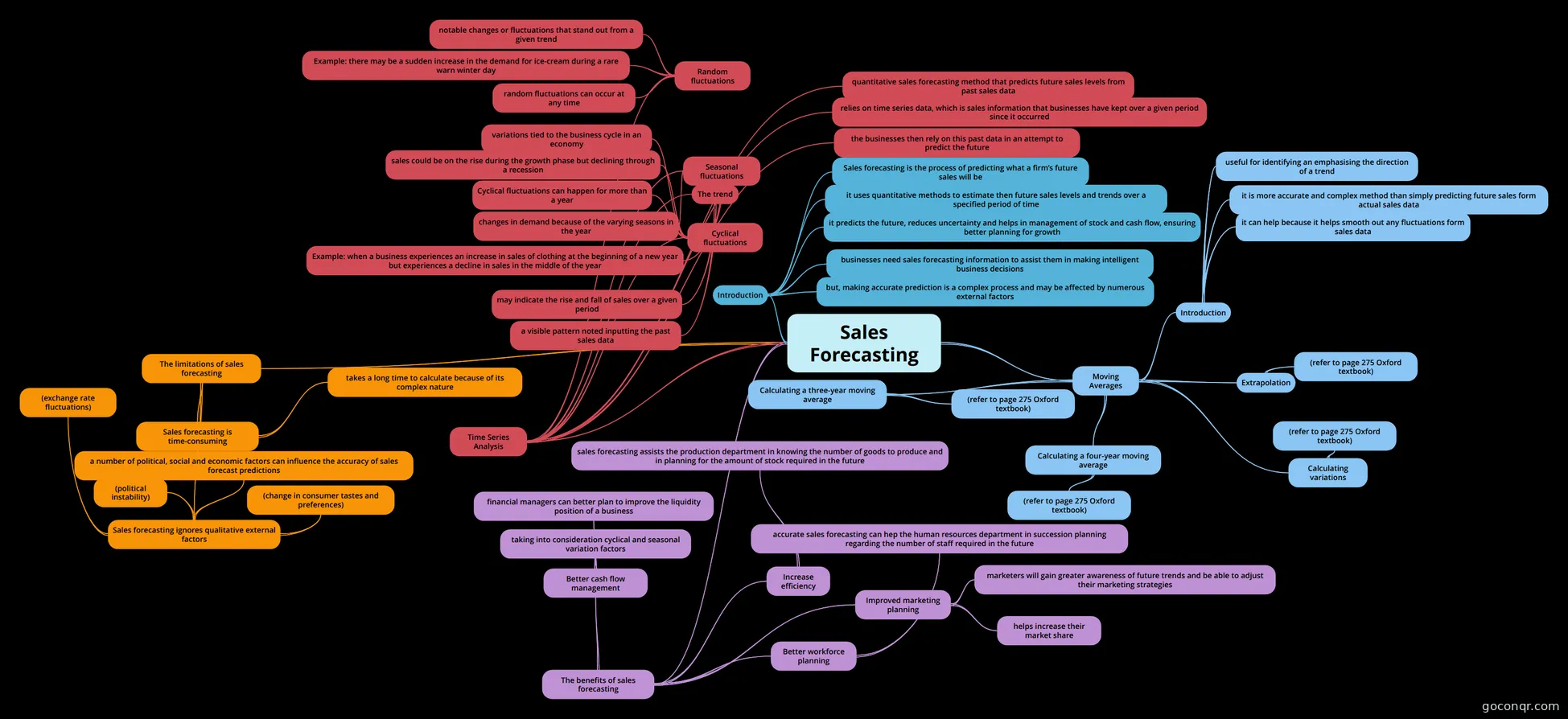
Mind map: Sales forecasting
Map content
Sales Forecasting
Introduction
- Sales forecasting is the process of predicting what a firm’s future sales will be
- it uses quantitative methods to estimate then future sales levels and trends over a specified period of time
- it predicts the future, reduces uncertainty and helps in management of stock and cash flow, ensuring better planning for growth
- businesses need sales forecasting information to assist them in making intelligent business decisions
- but, making accurate prediction is a complex process and may be affected by numerous external factors
Time Series Analysis
- quantitative sales forecasting method that predicts future sales levels from past sales data
- relies on time series data, which is sales information that businesses have kept over a given period since it occurred
- the businesses then rely on this past data in an attempt to predict the future
- The trend
- a visible pattern noted inputting the past sales data
- may indicate the rise and fall of sales over a given period
- Seasonal fluctuations
- changes in demand because of the varying seasons in the year
- Example: when a business experiences an increase in sales of clothing at the beginning of a new year but experiences a decline in sales in the middle of the year
- Cyclical fluctuations
- variations tied to the business cycle in an economy
- sales could be on the rise during the growth phase but declining through a recession
- Cyclical fluctuations can happen for more than a year
- Random fluctuations
- notable changes or fluctuations that stand out from a given trend
- Example: there may be a sudden increase in the demand for ice-cream during a rare warn winter day
- random fluctuations can occur at any time
Moving Averages
- Introduction
- useful for identifying an emphasising the direction of a trend
- it is more accurate and complex method than simply predicting future sales form actual sales data
- it can help because it helps smooth out any fluctuations form sales data
- Calculating a three-year moving average
- (refer to page 275 Oxford textbook)
- Calculating a four-year moving average
- (refer to page 275 Oxford textbook)
- Extrapolation
- (refer to page 275 Oxford textbook)
- Calculating variations
- (refer to page 275 Oxford textbook)
- Introduction
The benefits of sales forecasting
- Better cash flow management
- taking into consideration cyclical and seasonal variation factors
- financial managers can better plan to improve the liquidity position of a business
- Increase efficiency
- sales forecasting assists the production department in knowing the number of goods to produce and in planning for the amount of stock required in the future
- Better workforce planning
- accurate sales forecasting can hep the human resources department in succession planning regarding the number of staff required in the future
- Improved marketing planning
- marketers will gain greater awareness of future trends and be able to adjust their marketing strategies
- helps increase their market share
- Better cash flow management
The limitations of sales forecasting
- Sales forecasting is time-consuming
- takes a long time to calculate because of its complex nature
- Sales forecasting ignores qualitative external factors
- a number of political, social and economic factors can influence the accuracy of sales forecast predictions
- (political instability)
- (change in consumer tastes and preferences)
- (exchange rate fluctuations)
- Sales forecasting is time-consuming
Information
- Description
- IB Business Management HL (Unit 4- Marketing) Mind Map on Sales Forecasting, created by Nathalia Maria Veit on 11/03/2016.
- Created by
- Nathalia Maria Veit
- Views
- 6
- Rating