
Mind map
Rivers
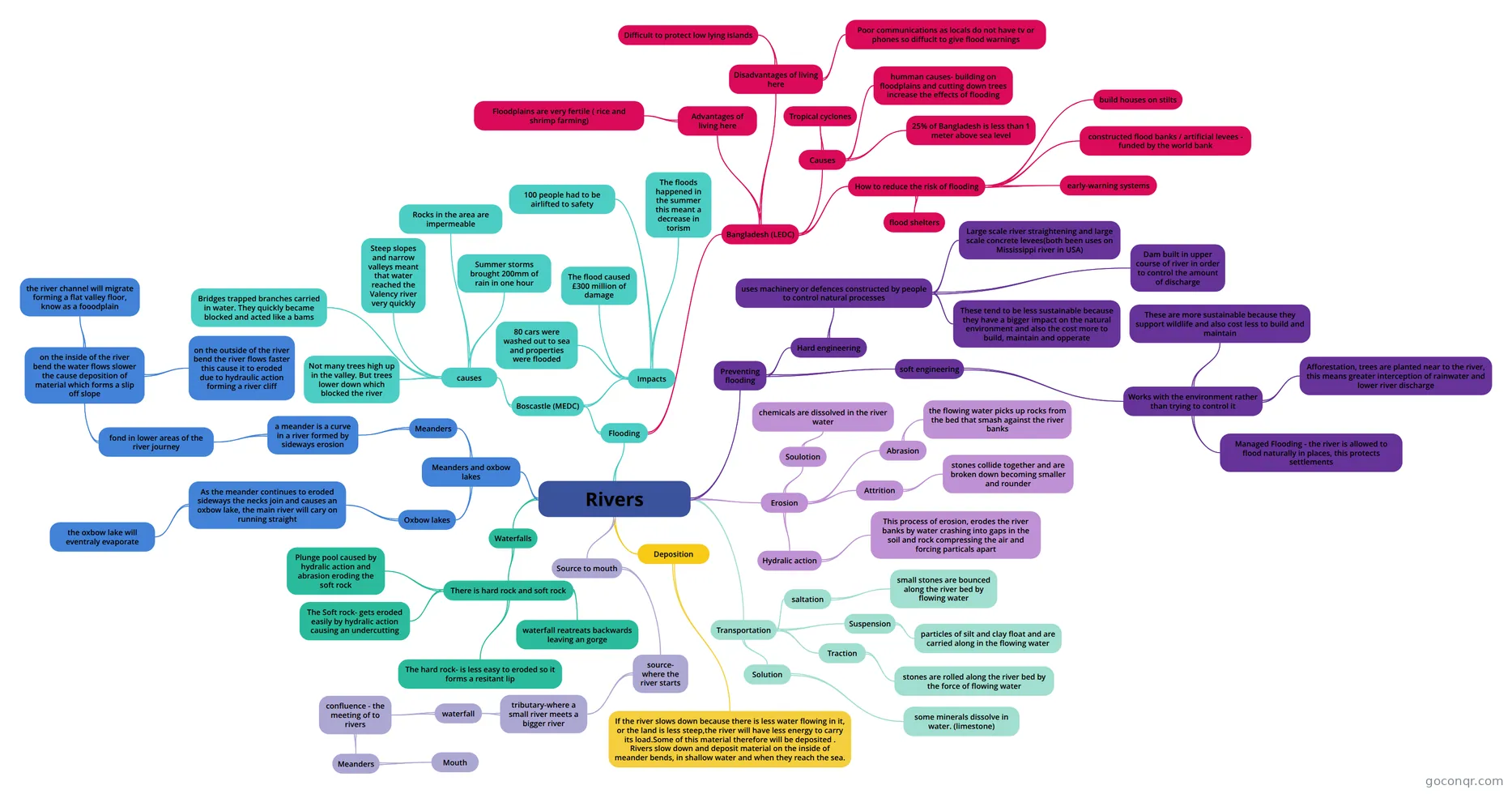
Mind map: Rivers
Map content
Rivers
Flooding
- Bangladesh (LEDC)
- Causes
- 25% of Bangladesh is less than 1 meter above sea level
- humman causes- building on floodplains and cutting down trees increase the effects of flooding
- Tropical cyclones
- Advantages of living here
- Floodplains are very fertile ( rice and shrimp farming)
- Disadvantages of living here
- Poor communications as locals do not have tv or phones so diffuclt to give flood warnings
- Difficult to protect low lying islands
- How to reduce the risk of flooding
- build houses on stilts
- constructed flood banks / artificial levees - funded by the world bank
- flood shelters
- early-warning systems
- Causes
- Boscastle (MEDC)
- causes
- Summer storms brought 200mm of rain in one hour
- Not many trees high up in the valley. But trees lower down which blocked the river
- Bridges trapped branches carried in water. They quickly became blocked and acted like a bams
- Steep slopes and narrow valleys meant that water reached the Valency river very quickly
- Rocks in the area are impermeable
- Impacts
- 80 cars were washed out to sea and properties were flooded
- 100 people had to be airlifted to safety
- The flood caused £300 million of damage
- The floods happened in the summer this meant a decrease in torism
- causes
- Bangladesh (LEDC)
Source to mouth
- source- where the river starts
- tributary-where a small river meets a bigger river
- waterfall
- confluence - the meeting of to rivers
- Meanders
- Mouth
- Meanders
- confluence - the meeting of to rivers
- waterfall
- tributary-where a small river meets a bigger river
- source- where the river starts
Meanders and oxbow lakes
- Meanders
- a meander is a curve in a river formed by sideways erosion
- fond in lower areas of the river journey
- on the inside of the river bend the water flows slower the cause deposition of material which forms a slip off slope
- on the outside of the river bend the river flows faster this cause it to eroded due to hydraulic action forming a river cliff
- the river channel will migrate forming a flat valley floor, know as a fooodplain
- on the inside of the river bend the water flows slower the cause deposition of material which forms a slip off slope
- fond in lower areas of the river journey
- a meander is a curve in a river formed by sideways erosion
- Oxbow lakes
- As the meander continues to eroded sideways the necks join and causes an oxbow lake, the main river will cary on running straight
- the oxbow lake will eventraly evaporate
- As the meander continues to eroded sideways the necks join and causes an oxbow lake, the main river will cary on running straight
- Meanders
Preventing flooding
- Hard engineering
- uses machinery or defences constructed by people to control natural processes
- Dam built in upper course of river in order to control the amount of discharge
- These tend to be less sustainable because they have a bigger impact on the natural environment and also the cost more to build, maintain and opperate
- Large scale river straightening and large scale concrete levees(both been uses on Mississippi river in USA)
- uses machinery or defences constructed by people to control natural processes
- soft engineering
- Works with the environment rather than trying to control it
- These are more sustainable because they support wildlife and also cost less to build and maintain
- Afforestation, trees are planted near to the river, this means greater interception of rainwater and lower river discharge
- Managed Flooding - the river is allowed to flood naturally in places, this protects settlements
- Works with the environment rather than trying to control it
- Hard engineering
Waterfalls
- There is hard rock and soft rock
- The Soft rock- gets eroded easily by hydralic action causing an undercutting
- The hard rock- is less easy to eroded so it forms a resitant lip
- Plunge pool caused by hydralic action and abrasion eroding the soft rock
- waterfall reatreats backwards leaving an gorge
- There is hard rock and soft rock
Erosion
- Soulotion
- chemicals are dissolved in the river water
- Hydralic action
- This process of erosion, erodes the river banks by water crashing into gaps in the soil and rock compressing the air and forcing particals apart
- Abrasion
- the flowing water picks up rocks from the bed that smash against the river banks
- Attrition
- stones collide together and are broken down becoming smaller and rounder
- Soulotion
Transportation
- Solution
- some minerals dissolve in water. (limestone)
- Traction
- stones are rolled along the river bed by the force of flowing water
- saltation
- small stones are bounced along the river bed by flowing water
- Suspension
- particles of silt and clay float and are carried along in the flowing water
- Solution
Deposition
- If the river slows down because there is less water flowing in it, or the land is less steep,the river will have less energy to carry its load.Some of this material therefore will be deposited . Rivers slow down and deposit material on the inside of meander bends, in shallow water and when they reach the sea.
Information
- Description
- GCSE Geography Mind Map on Rivers, created by Sarah Marsh on 15/05/2016.
- Created by
- Sarah Marsh
- Views
- 1
- Rating