
Mind map
INTONATION:
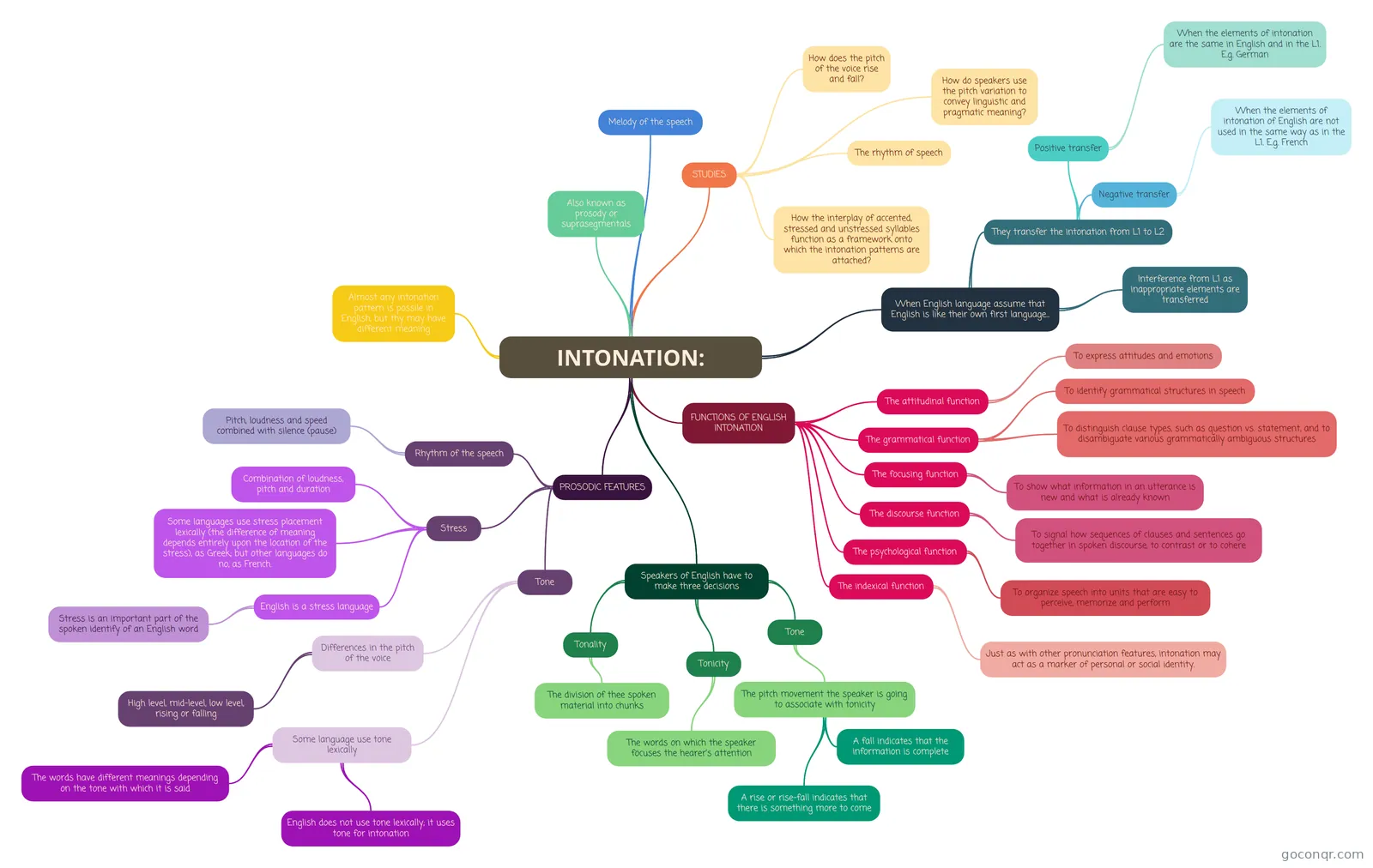
Mind map: English intonation
Map content
INTONATION:
Also known as prosody or suprasegmentals
Melody of the speech
STUDIES
- How does the pitch of the voice rise and fall?
- How do speakers use the pitch variation to convey linguistic and pragmatic meaning?
- The rhythm of speech
- How the interplay of accented, stressed and unstressed syllables function as a framework onto which the intonation patterns are attached?
Almost any intonation pattern is possile in English, but thy may have different meaning
PROSODIC FEATURES
- Rhythm of the speech
- Pitch, loudness and speed combined with silence (pause)
- Stress
- Combination of loudness, pitch and duration
- Some languages use stress placement lexically (the difference of meaning depends entirely upon the location of the stress), as Greek; but other languages do no, as French.
- English is a stress language
- Stress is an important part of the spoken identify of an English word
- Tone
- Differences in the pitch of the voice
- High level, mid-level, low level, rising or falling
- Some language use tone lexically
- The words have different meanings depending on the tone with which it is said
- English does not use tone lexically; it uses tone for intonation
- Differences in the pitch of the voice
- Rhythm of the speech
Speakers of English have to make three decisions
- Tonality
- The division of thee spoken material into chunks
- Tonicity
- The words on which the speaker focuses the hearer's attention
- Tone
- The pitch movement the speaker is going to associate with tonicity
- A fall indicates that the information is complete
- A rise or rise-fall indicates that there is something more to come
- The pitch movement the speaker is going to associate with tonicity
- Tonality
FUNCTIONS OF ENGLISH INTONATION
- The attitudinal function
- To express attitudes and emotions
- The grammatical function
- To identify grammatical structures in speech
- To distinguish clause types, such as question vs. statement, and to disambiguate various grammatically ambiguous structures
- The focusing function
- To show what information in an utterance is new and what is already known
- The discourse function
- To signal how sequences of clauses and sentences go together in spoken discourse, to contrast or to cohere
- The psychological function
- To organize speech into units that are easy to perceive, memorize and perform
- The indexical function
- Just as with other pronunciation features, intonation may act as a marker of personal or social identity.
- The attitudinal function
When English language assume that English is like their own first language...
- They transfer the intonation from L1 to L2
- Positive transfer
- When the elements of intonation are the same in English and in the L1. E.g. German
- Negative transfer
- When the elements of intonation of English are not used in the same way as in the L1. E.g. French
- Positive transfer
- Interference from L1 as inappropriate elements are transferred
- They transfer the intonation from L1 to L2