
Mind map
Biological explanations of SZ
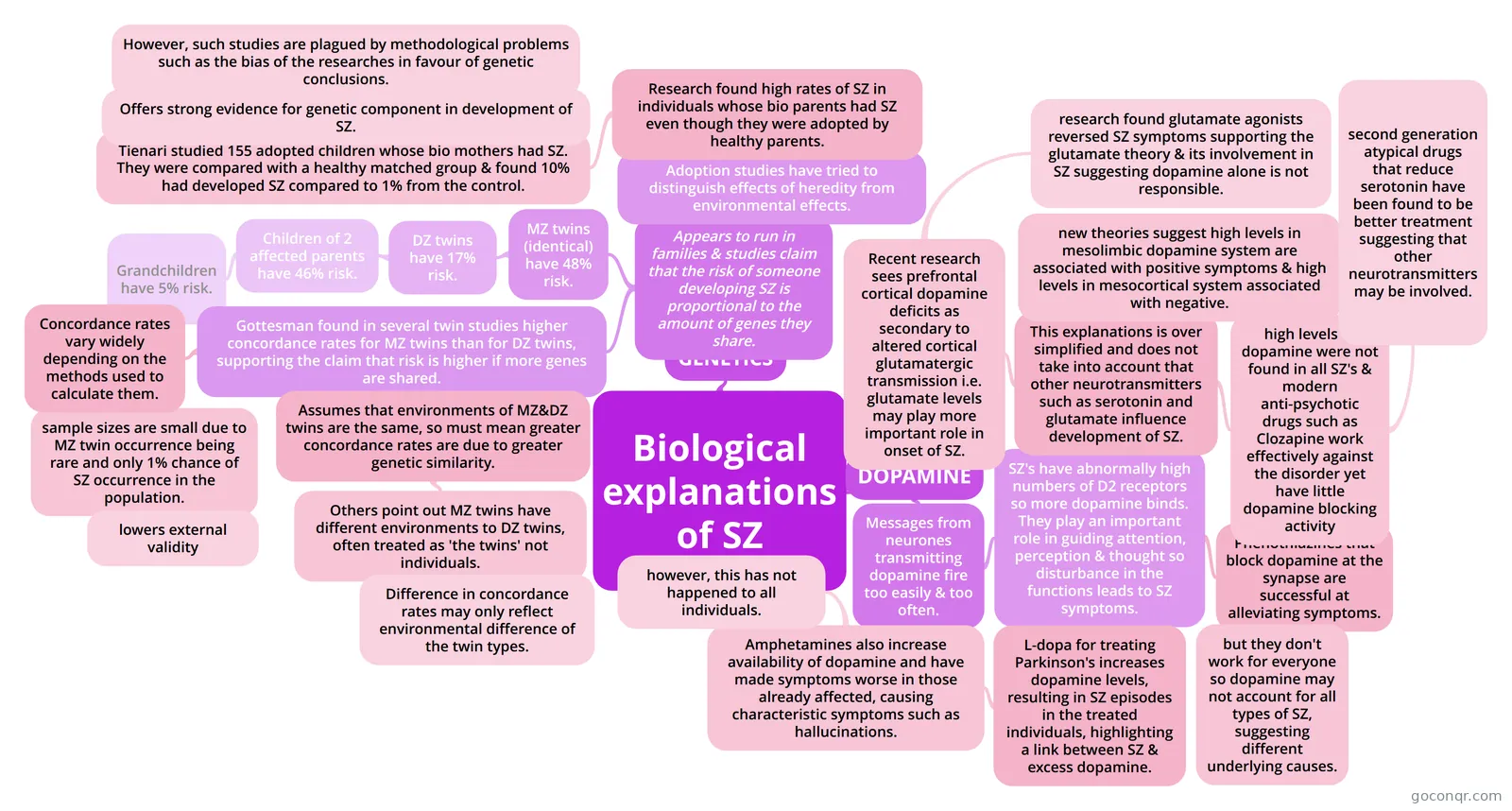
Mind map: Biological explanations of schizophrenia
Map content
Biological explanations of SZ
GENETICS
- Appears to run in families & studies claim that the risk of someone developing SZ is proportional to the amount of genes they share.
- MZ twins (identical) have 48% risk.
- DZ twins have 17% risk.
- Children of 2 affected parents have 46% risk.
- Grandchildren have 5% risk.
- Children of 2 affected parents have 46% risk.
- DZ twins have 17% risk.
- Gottesman found in several twin studies higher concordance rates for MZ twins than for DZ twins, supporting the claim that risk is higher if more genes are shared.
- Concordance rates vary widely depending on the methods used to calculate them.
- sample sizes are small due to MZ twin occurrence being rare and only 1% chance of SZ occurrence in the population.
- lowers external validity
- sample sizes are small due to MZ twin occurrence being rare and only 1% chance of SZ occurrence in the population.
- Assumes that environments of MZ&DZ twins are the same, so must mean greater concordance rates are due to greater genetic similarity.
- Others point out MZ twins have different environments to DZ twins, often treated as 'the twins' not individuals.
- Difference in concordance rates may only reflect environmental difference of the twin types.
- Others point out MZ twins have different environments to DZ twins, often treated as 'the twins' not individuals.
- Concordance rates vary widely depending on the methods used to calculate them.
- Adoption studies have tried to distinguish effects of heredity from environmental effects.
- Research found high rates of SZ in individuals whose bio parents had SZ even though they were adopted by healthy parents.
- Tienari studied 155 adopted children whose bio mothers had SZ. They were compared with a healthy matched group & found 10% had developed SZ compared to 1% from the control.
- Offers strong evidence for genetic component in development of SZ.
- However, such studies are plagued by methodological problems such as the bias of the researches in favour of genetic conclusions.
- Offers strong evidence for genetic component in development of SZ.
- Tienari studied 155 adopted children whose bio mothers had SZ. They were compared with a healthy matched group & found 10% had developed SZ compared to 1% from the control.
- Research found high rates of SZ in individuals whose bio parents had SZ even though they were adopted by healthy parents.
- MZ twins (identical) have 48% risk.
- Appears to run in families & studies claim that the risk of someone developing SZ is proportional to the amount of genes they share.
DOPAMINE
- Messages from neurones transmitting dopamine fire too easily & too often.
- SZ's have abnormally high numbers of D2 receptors so more dopamine binds. They play an important role in guiding attention, perception & thought so disturbance in the functions leads to SZ symptoms.
- Phenothiazines that block dopamine at the synapse are successful at alleviating symptoms.
- but they don't work for everyone so dopamine may not account for all types of SZ, suggesting different underlying causes.
- L-dopa for treating Parkinson's increases dopamine levels, resulting in SZ episodes in the treated individuals, highlighting a link between SZ & excess dopamine.
- Amphetamines also increase availability of dopamine and have made symptoms worse in those already affected, causing characteristic symptoms such as hallucinations.
- however, this has not happened to all individuals.
- Amphetamines also increase availability of dopamine and have made symptoms worse in those already affected, causing characteristic symptoms such as hallucinations.
- This explanations is over simplified and does not take into account that other neurotransmitters such as serotonin and glutamate influence development of SZ.
- Recent research sees prefrontal cortical dopamine deficits as secondary to altered cortical glutamatergic transmission i.e. glutamate levels may play more important role in onset of SZ.
- research found glutamate agonists reversed SZ symptoms supporting the glutamate theory & its involvement in SZ suggesting dopamine alone is not responsible.
- high levels of dopamine were not found in all SZ's & modern anti-psychotic drugs such as Clozapine work effectively against the disorder yet have little dopamine blocking activity
- second generation atypical drugs that reduce serotonin have been found to be better treatment suggesting that other neurotransmitters may be involved.
- new theories suggest high levels in mesolimbic dopamine system are associated with positive symptoms & high levels in mesocortical system associated with negative.
- Recent research sees prefrontal cortical dopamine deficits as secondary to altered cortical glutamatergic transmission i.e. glutamate levels may play more important role in onset of SZ.
- Phenothiazines that block dopamine at the synapse are successful at alleviating symptoms.
- SZ's have abnormally high numbers of D2 receptors so more dopamine binds. They play an important role in guiding attention, perception & thought so disturbance in the functions leads to SZ symptoms.
- Messages from neurones transmitting dopamine fire too easily & too often.
Information
- Description
- GCE Schizophrenia Mind Map on Biological explanations of SZ, created by diana.m1629 on 21/02/2014.
- Created by
- diana.m1629
- Views
- 79
- Tags
- Rating