
Mind map
Small-n
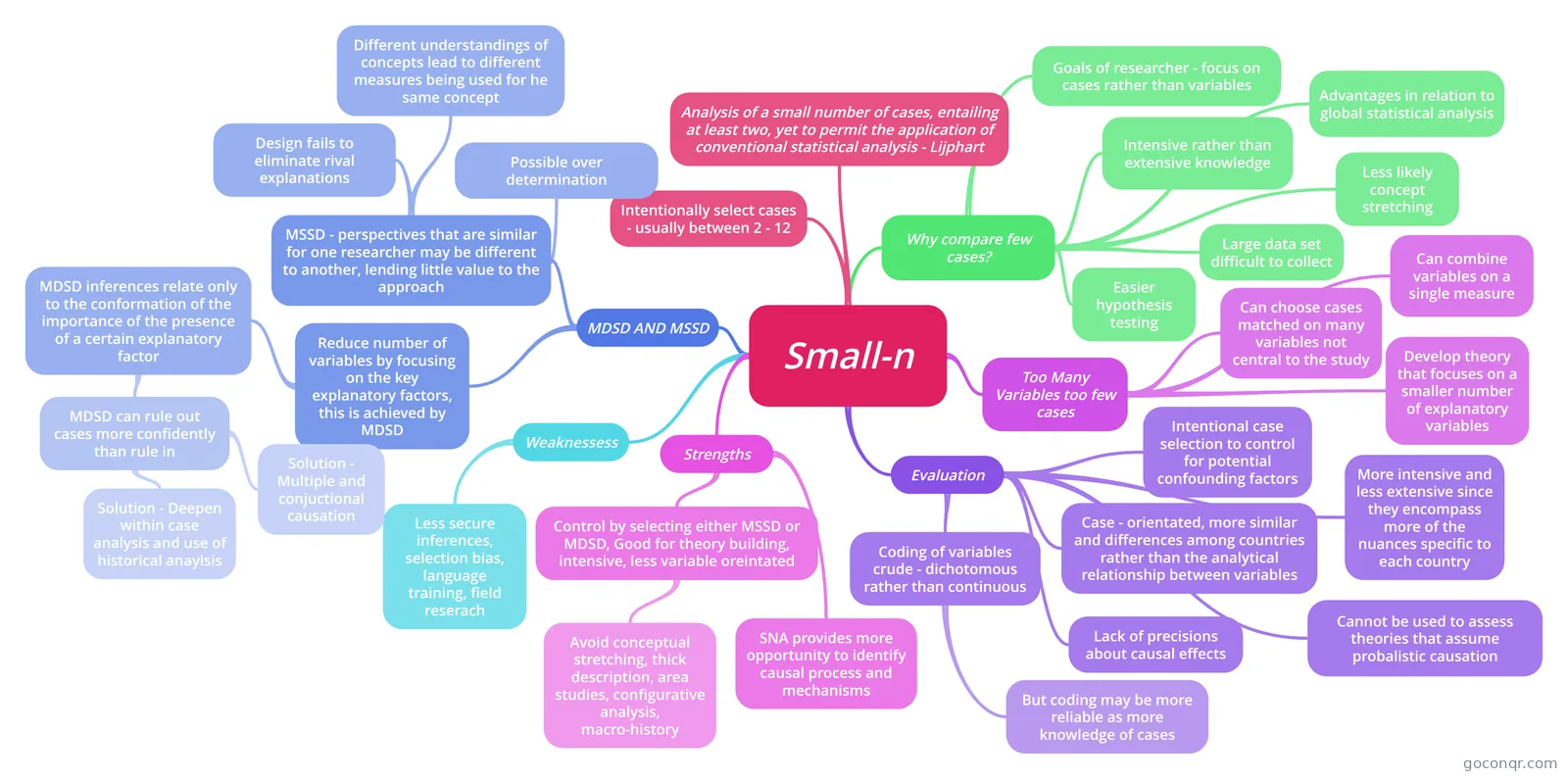
Mind map: Small-n comparative method
Map content
Small-n
Analysis of a small number of cases, entailing at least two, yet to permit the application of conventional statistical analysis - Lijphart
Intentionally select cases - usually between 2 - 12
Why compare few cases?
- Goals of researcher - focus on cases rather than variables
- Intensive rather than extensive knowledge
- Advantages in relation to global statistical analysis
- Less likely concept stretching
- Large data set difficult to collect
- Easier hypothesis testing
Too Many Variables too few cases
- Can choose cases matched on many variables not central to the study
- Can combine variables on a single measure
- Develop theory that focuses on a smaller number of explanatory variables
Evaluation
- Intentional case selection to control for potential confounding factors
- More intensive and less extensive since they encompass more of the nuances specific to each country
- Case - orientated, more similar and differences among countries rather than the analytical relationship between variables
- Cannot be used to assess theories that assume probalistic causation
- Coding of variables crude - dichotomous rather than continuous
- But coding may be more reliable as more knowledge of cases
- Lack of precisions about causal effects
Strengths
- Control by selecting either MSSD or MDSD, Good for theory building, intensive, less variable oreintated
- Avoid conceptual stretching, thick description, area studies, configurative analysis, macro-history
- SNA provides more opportunity to identify causal process and mechanisms
- Control by selecting either MSSD or MDSD, Good for theory building, intensive, less variable oreintated
Weaknessess
- Less secure inferences, selection bias, language training, field reserach
MDSD AND MSSD
- MSSD - perspectives that are similar for one researcher may be different to another, lending little value to the approach
- Possible over determination
- Design fails to eliminate rival explanations
- Different understandings of concepts lead to different measures being used for he same concept
- Reduce number of variables by focusing on the key explanatory factors, this is achieved by MDSD
- MDSD inferences relate only to the conformation of the importance of the presence of a certain explanatory factor
- MDSD can rule out cases more confidently than rule in
- Solution - Multiple and conjuctional causation
- Solution - Deepen within case analysis and use of historical anaylsis
- MDSD can rule out cases more confidently than rule in
- MDSD inferences relate only to the conformation of the importance of the presence of a certain explanatory factor
- MSSD - perspectives that are similar for one researcher may be different to another, lending little value to the approach
Information
- Description
- Mind Map on Small-n, created by iainajniven on 01/05/2013.
- Created by
- iainajniven
- Views
- 32
- Rating