
Mind map
stationary and progressive waves
Map content
stationary and progressive waves
formation
- when two progressive waves pass through each other
- achieved by fixing both ends and making the middle part vibrate, so progressive waves travel
- stationary waves that vibrate freely don't transfer energy
- when two progressive waves pass through each other
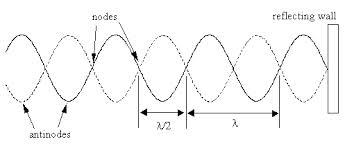
node
- point of no displacement
- distance bewteen adjacent nodes = 1/2λ
antinodes
- maximum amplitude midway between the nodes
explanation of stationary waves
- waves in phase
- they reinforce each other to produce a large wave
- quarter of cycle later
- the two waves has moved one quarter of a wavelength in opposite directions
- waves in antiphase so they cancel out each other
- the two waves has moved one quarter of a wavelength in opposite directions
- further quarter cycle
- waves back in phase
- resultant is a large wave but reversed
- waves back in phase
- waves in phase
stationary wave pattern
- the amplitude
- varies with position from zero at a node to max amplitude at an antinode
- phase difference
- zero if two particles are between adjacent nodes
- 180° if two particles are separated by an odd number of nodes
- the amplitude
examples
- sound in a pipe
- if pipe closed at one end
- the antinode is at the open end
- node at the close end
- if pipe closed at one end
- using microwaves
- sound in a pipe
Images and files in the map
Information
- Description
- Mind Map on stationary and progressive waves, created by prisillajohnson9 on 23/03/2014.
- Created by
- prisillajohnson9
- Views
- 26
- Rating