
Mind map
Differentiated Instruction
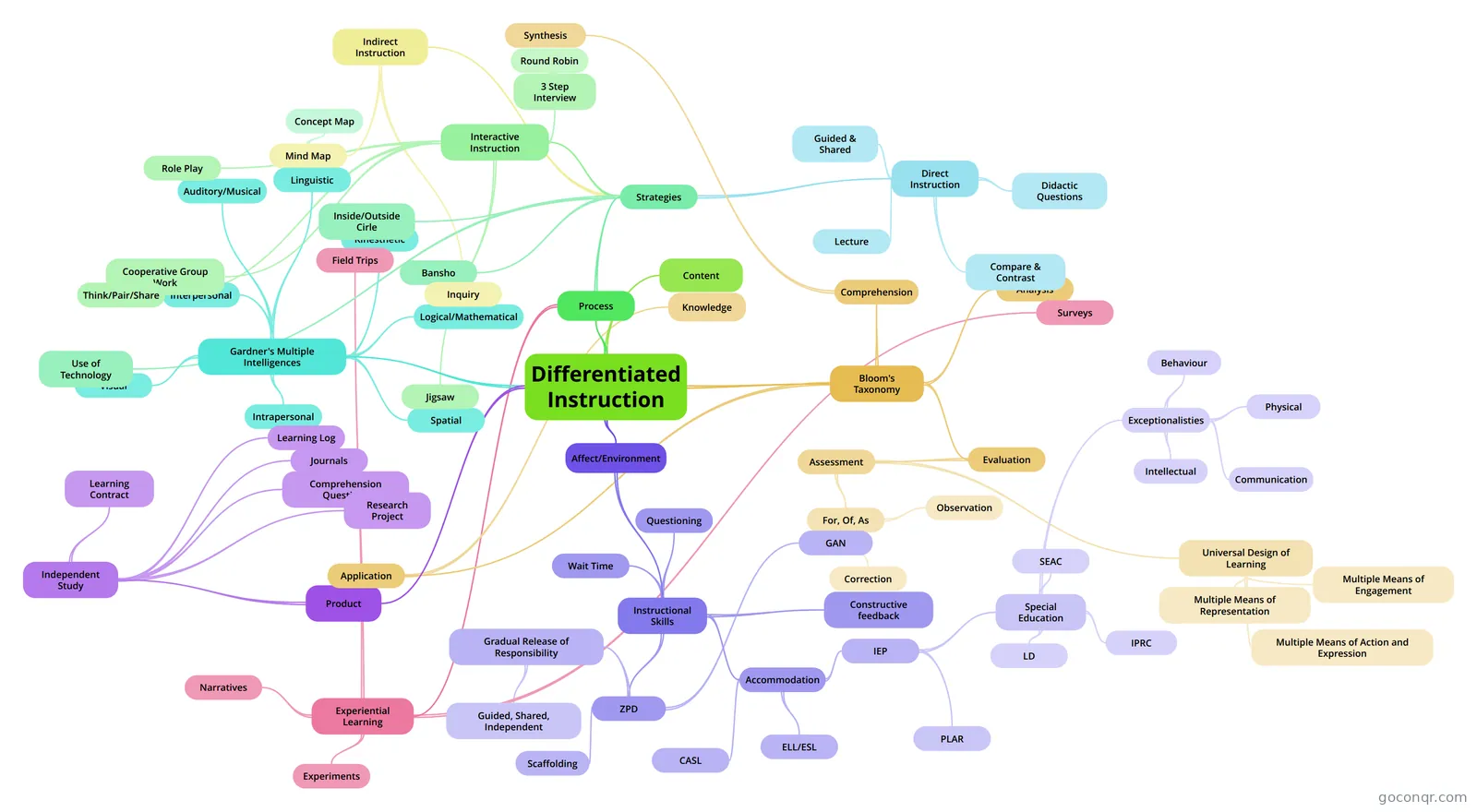
Mind map: differentiated instruction
Map content
Differentiated Instruction
- effective teaching that involves providing different students with different avenues to learning in terms of: acquiring content; processing, constructing, or making sense of ideas; and developing teaching materials and assessment measures so that all students within a classroom can learn effectively, regardless of differences in ability
Affect/Environment
- the climate or tone of the classroom
- Instructional Skills
- knowing how to structure appropriate learning experiences for students
- Wait Time
- pausing between asking a question and soliciting a response; allows time to reflect and for higher quality/confident answers
- Constructive feedback
- providing students with next steps in order to help them reach their learning goals
- Questioning
- student's thinking is stimulated, directed, and extended with guiding/prompting questions
- Accommodation
- an alteration of environment, curriculum format, or equipment that allows an individual with a disability to gain access to content and/or complete assigned tasks
- ELL/ESL
- English Language Learner; English as a Second Language - course for English learning
- IEP
- the individualized education program; describes the goals the team sets for a child during the school year, as well as any special support needed to help achieve them
- PLAR
- prior learning assessment and recognition; used to assess an individual's knowledge and skills in relation to specific criteria
- Special Education
- educating students with special needs in a way that addresses their individual differences and needs
- LD
- significant learning problems in an academic area
- SEAC
- Special Education Advisory Committee; a committee of a school board or a school authority that provides important advice on special education - make recommendations to the board on any matter affecting the establishment, development and delivery of special education programs and services for exceptional students in a board
- IPRC
- Identification, Placement, and Review Committee; identify exceptional pupils
- Exceptionalisties
- patterns of strengths and needs common to groups of students
- Behaviour
- characterized by specific behaviour problems over such a period of time, and to such a marked degree, and of such a nature, as to adversely affect educational performance
- Communication
- communicative limitation or deficiency as to require special assistance in learning situations to provide the opportunity for educational achievement
- Physical
- physical limitation or deficiency as to require special assistance in learning situations to provide the opportunity for educational achievement
- Intellectual
- intellectual limitation or deficiency as to require special assistance in learning situations to provide the opportunity for educational achievement
- CASL
- Classroom Assessment for Student Learning; assessing to meet needs
- ZPD
- the distance between the actual developmental level and the level of potential development
- Gradual Release of Responsibility
- I do, we do, you do; scaffolding for the student
- Guided, Shared, Independent
- allowing students to observe how it is done, trying it together, and then performing on their own; taking students form "knowing about" to "being able to"
- Scaffolding
- Scaffolding is an instructional technique whereby the teacher models the desired learning strategy or task, then gradually shifts responsibility to the students
- GAN
- Greatest Area of Need; area where student shows most weakness and needs to be developed
Process
- how students take in and make sense of the content
- Strategies
- learning experiences appropriately designed of learners of different needs
- Bansho
- process of organizing, displaying, annotating and discussing solutions for mathematical problems
- Inside/Outside Cirle
- technique that gets students up and moving; one of the circles remains stationary while the other moves, stoping when prompted to discuss content/have a discussion about what was learned
- Use of Technology
- active engagement and participation
- Direct Instruction
- highly teacher-directed; effective for providing information; most commonly used
- Lecture
- lecture is teacher-centred and student activity is mainly passive; the attention span of students may be limited
- Compare & Contrast
- used to highlight similarities and differences between to things; classification
- Didactic Questions
- questions tend to be convergent, factual, and often begin with "what," "where," "when," and "how." They can be effectively used to diagnose recall and comprehension skills, to draw on prior learning experiences, to determine the extent to which lesson objectives were achieved, to provide practice, and to aid retention of information or processes.
- Guided & Shared
- reading, listening, viewing, thinking
- Interactive Instruction
- discussion and sharing among participants; students can learn from peers and teachers to develop social skills and abilities, to organize their thoughts, and to develop rational arguments
- 3 Step Interview
- a strategy where students take turns conducting interviews with peers in order to review content learned and synthesize
- Round Robin
- a strategy where students synthesize information to determine most important points/facts
- Cooperative Group Work
- promotes academic and social learning
- Think/Pair/Share
- enables students to formulate individual ideas about a topic and share these ideas with another student
- Jigsaw
- Jigsaw is a cooperative learning strategy that enables each student of a “home” group to specialize in one aspect of a learning unit. Students meet with members from other groups who are assigned the same aspect, and after mastering the material, return to the “home” group and teach the material to their group members
- Role Play
- acting out characters in a predetermined situation
- Indirect Instruction
- indirect instruction is mainly student-centered; high level of student involvement in observing, investigating, drawing inferences from data, or forming hypotheses
- Mind Map
- diagram used to visually outline information - can be used as a strategy for linguistic learners in order to organize thoughts
- Concept Map
- graphical tool that shows relationships between concepts; can be used as a strategy for linguistic learners in order to organize thoughts
- Inquiry
- Experiential Learning
- Experiential learning is inductive, learner centered, and activity oriented; the emphasis in experiential learning is on the process of learning and not on the product
- Narratives
- defined point of view
- Field Trips
- observational activity; structured and occurs outside of the classroom
- Experiments
- experiencing an activity as it occurs; making predictions and observations about the process
- Surveys
- questioning that allows students to determine how others might identify with a certain subject
Product
- how students show what they know, understand, and can do
- Independent Study
- method intended to foster development of individual student initiative and self reliance; guided by the teacher
- Learning Log
- integrates content, process, and personal feelings
- Journals
- students write to learn; write about topics of personal interest
- Learning Contract
- developing student responsibility by allowing them to pace themselvesaccording to the rate at which they can master the material
- Comprehension Questions
- used as a form of checking for understanding to ensure mastery of content before moving
- Research Project
- effective for for developing and extending language arts skills; practice reading for specific purposes, recording info, sequencing, organizing
Content
- the information and ideas students tackle to reach their learning goals
Bloom's Taxonomy
- is a classification system used to define and distinguish different levels of human cognition; used in the classroom to inform or guide the development of assessments(tests and other evaluations of student learning), curriculum (units, lessons, projects, and other learning activities), and instructional methods such as questioning strategies.
- Application
- using and applying knowledge; problem solving methods
- Knowledge
- recall of information; discovery, observation, naming, locating information
- Comprehension
- using old concepts to create new ideas; composing, imagining, predicting, combining
- Synthesis
- using old concepts to create new ideas; composing, imagining, predicting, combining
- Analysis
- Identifying and analyzing patterns; organizing ideas and recognizing trends
- Evaluation
- Assessing theories; comparing ideas, solving, judging, rating
- Assessment
- students are assessed before, during, and after learning- this informs of teaching and learning; within the UDL, assessment is
- For, Of, As
- Observation
- bobservational notes can me made during the learning process to help guide student and to give the teacher an idea of where the student greatest area of need may be
- Correction
- Observation
- Universal Design of Learning
- a set of principles for curriculum development that give all individuals equal opportunities to learn
- Multiple Means of Representation
- the “what” of learning; earners differ in the ways that they perceive and comprehend information that is presented to them - provide options for representation
- Multiple Means of Action and Expression
- the “how” of learning; earners differ in the ways that they can navigate a learning environment and express what they know - providing options for action and expression is essential
- Multiple Means of Engagement
- the “why” of learning; learners differ markedly in the ways in which they can be engaged or motivated to learn - providing multiple options for engagement is essential.
Gardner's Multiple Intelligences
- 7 distinct intelligences that learn in different ways; students learn in ways that are identifiably distinctive
- Spatial
- individuals who think in pictures rather than in words; learn better visually
- Auditory/Musical
- Auditory learners would rather listen to things being explained than read about them. Reciting information out loud and having music in the background may be a common study method. Other noises may become a distraction resulting in a need for a relatively quiet place.
- Interpersonal
- understanding, interacting with others. These students learn through interaction. They have many friends, empathy for others, street smarts. They can be taught through group activities, seminars, dialogues. Tools include the telephone, audio conferencing, time and attention from the instructor, video conferencing, writing, computer conferencing, E-mail.
- Intrapersonal
- understanding one's own interests, goals. These learners tend to shy away from others. They're in tune with their inner feelings; they have wisdom, intuition and motivation, as well as a strong will, confidence and opinions. They can be taught through independent study and introspection. Tools include books, creative materials, diaries, privacy and time. They are the most independent of the learners.
- Kinesthetic
- Kinesthetic learners process information best through a "hands-on" experience. Actually doing an activity can be the easiest way for them to learn. Sitting still while studying may be difficult, but writing things down makes it easier to understand.
- Logical/Mathematical
- a person's ability to reason, solve problems, and learn using numbers, abstract visual information, and analysis of cause and effect relationships
- Linguistic
- refers to a person's ability to reason, solve problems, and learn using language.
- Visual
- Visual learners learn best by looking at graphics, watching a demonstration, or reading. For them, it's easy to look at charts and graphs, but they may have difficulty focusing while listening to an explanation.
Information
- Description
- Mind Map on Differentiated Instruction, created by amiguelo on 31/03/2014.
- Created by
- amiguelo
- Views
- 46
- Rating