
Mind map
Proteomics (1)
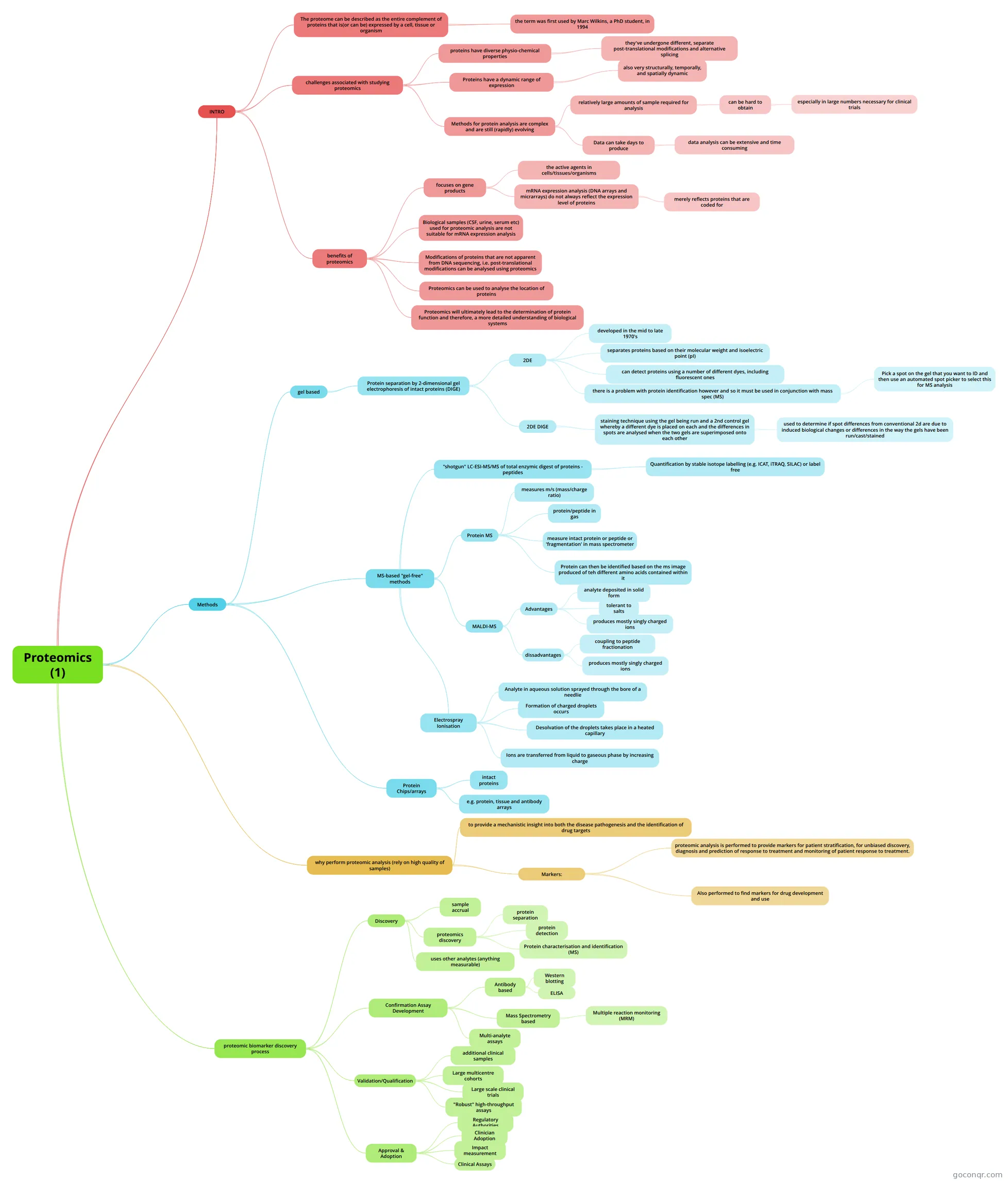
Mind map: Proteomics
Map content
Proteomics (1)
INTRO
- The proteome can be described as the entire complement of proteins that is(or can be) expressed by a cell, tissue or organism
- the term was first used by Marc Wilkins, a PhD student, in 1994
- challenges associated with studying proteomics
- proteins have diverse physio-chemical properties
- they've undergone different, separate post-translational modifications and alternative splicing
- Proteins have a dynamic range of expression
- also very structurally, temporally, and spatially dynamic
- Methods for protein analysis are complex and are still (rapidly) evolving
- relatively large amounts of sample required for analysis
- can be hard to obtain
- especially in large numbers necessary for clinical trials
- can be hard to obtain
- Data can take days to produce
- data analysis can be extensive and time consuming
- relatively large amounts of sample required for analysis
- proteins have diverse physio-chemical properties
- benefits of proteomics
- focuses on gene products
- the active agents in cells/tissues/organisms
- mRNA expression analysis (DNA arrays and micrarrays) do not always reflect the expression level of proteins
- merely reflects proteins that are coded for
- Biological samples (CSF, urine, serum etc) used for proteomic analysis are not suitable for mRNA expression analysis
- Modifications of proteins that are not apparent from DNA sequencing, i.e. post-translational modifications can be analysed using proteomics
- Proteomics can be used to analyse the location of proteins
- Proteomics will ultimately lead to the determination of protein function and therefore, a more detailed understanding of biological systems
- focuses on gene products
- The proteome can be described as the entire complement of proteins that is(or can be) expressed by a cell, tissue or organism
Methods
- gel based
- Protein separation by 2-dimensional gel electrophoresis of intact proteins (DIGE)
- 2DE
- developed in the mid to late 1970's
- separates proteins based on their molecular weight and isoelectric point (pI)
- can detect proteins using a number of different dyes, including fluorescent ones
- there is a problem with protein identification however and so it must be used in conjunction with mass spec (MS)
- Pick a spot on the gel that you want to ID and then use an automated spot picker to select this for MS analysis
- 2DE DIGE
- staining technique using the gel being run and a 2nd control gel whereby a different dye is placed on each and the differences in spots are analysed when the two gels are superimposed onto each other
- used to determine if spot differences from conventional 2d are due to induced biological changes or differences in the way the gels have been run/cast/stained
- staining technique using the gel being run and a 2nd control gel whereby a different dye is placed on each and the differences in spots are analysed when the two gels are superimposed onto each other
- 2DE
- Protein separation by 2-dimensional gel electrophoresis of intact proteins (DIGE)
- MS-based "gel-free" methods
- "shotgun" LC-ESI-MS/MS of total enzymic digest of proteins - peptides
- Quantification by stable isotope labelling (e.g. ICAT, iTRAQ, SILAC) or label free
- Protein MS
- measures m/s (mass/charge ratio)
- protein/peptide in gas
- measure intact protein or peptide or 'fragmentation' in mass spectrometer
- Protein can then be identified based on the ms image produced of teh different amino acids contained within it
- MALDI-MS
- Advantages
- analyte deposited in solid form
- tolerant to salts
- produces mostly singly charged ions
- dissadvantages
- coupling to peptide fractionation
- produces mostly singly charged ions
- Advantages
- Electrospray Ionisation
- Analyte in aqueous solution sprayed through the bore of a needlie
- Formation of charged droplets occurs
- Desolvation of the droplets takes place in a heated capillary
- Ions are transferred from liquid to gaseous phase by increasing charge
- "shotgun" LC-ESI-MS/MS of total enzymic digest of proteins - peptides
- Protein Chips/arrays
- intact proteins
- e.g. protein, tissue and antibody arrays
- gel based
why perform proteomic analysis (rely on high quality of samples)
- to provide a mechanistic insight into both the disease pathogenesis and the identification of drug targets
- Markers:
- proteomic analysis is performed to provide markers for patient stratification, for unbiased discovery, diagnosis and prediction of response to treatment and monitoring of patient response to treatment.
- Also performed to find markers for drug development and use
proteomic biomarker discovery process
- Discovery
- sample accrual
- proteomics discovery
- protein separation
- protein detection
- Protein characterisation and identification (MS)
- uses other analytes (anything measurable)
- Confirmation Assay Development
- Antibody based
- Western blotting
- ELISA
- Mass Spectrometry based
- Multiple reaction monitoring (MRM)
- Multi-analyte assays
- Antibody based
- Validation/Qualification
- additional clinical samples
- Large multicentre cohorts
- Large scale clinical trials
- "Robust" high-throughput assays
- Approval & Adoption
- Regulatory Authorities
- Clinician Adoption
- Impact measurement
- Clinical Assays
- Discovery
Information
- Description
- 4th year Adv Pharmacology of Cancer Mind Map on Proteomics (1), created by aoife.lacey.1 on 04/05/2013.
- Created by
- aoife.lacey.1
- Views
- 183
- Tags
- Rating