
Mind map
Physics P2B - The Atom
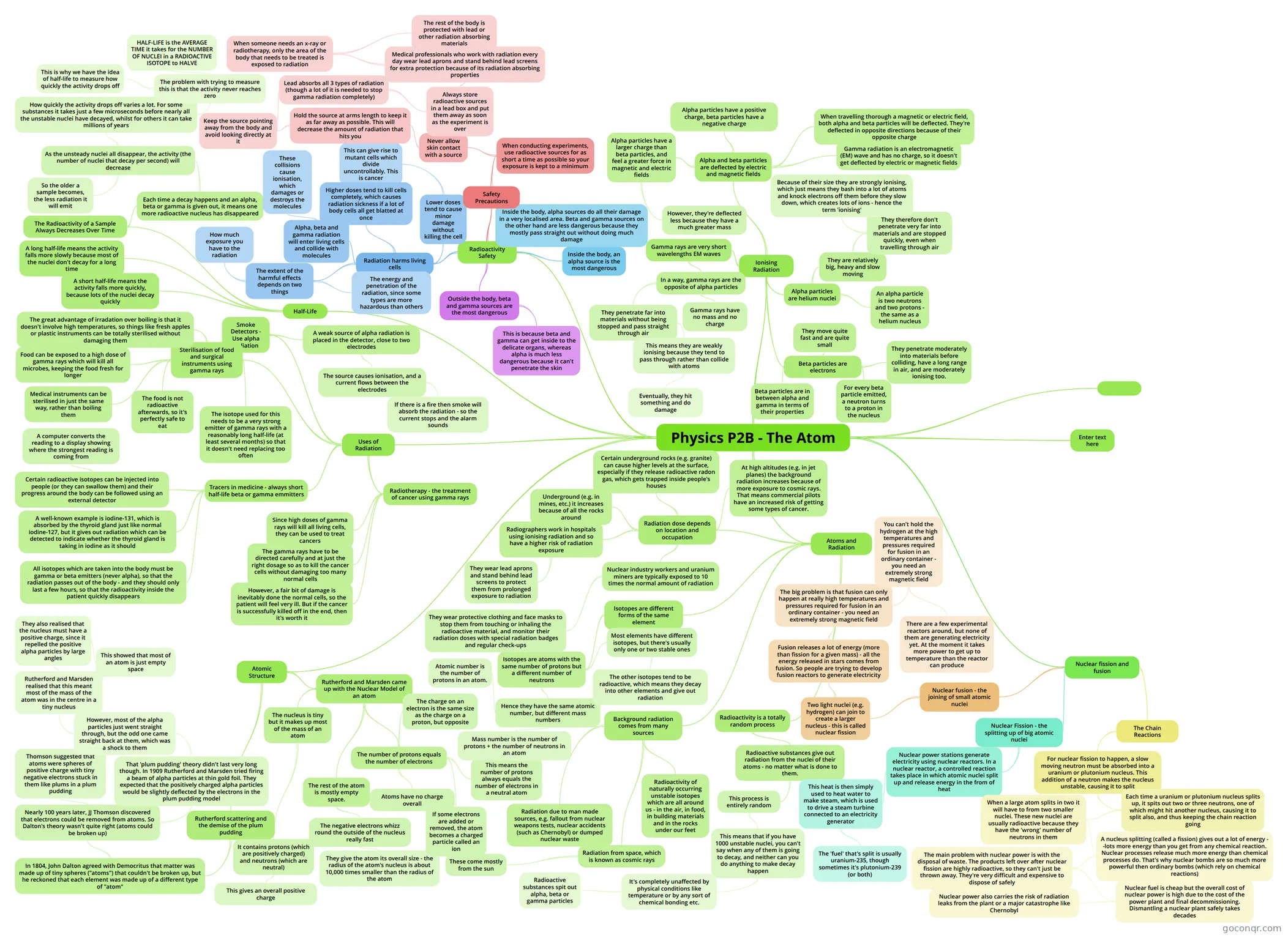
Mind map: The atom physics
Map content
Physics P2B - The Atom
Atomic Structure
- Rutherford scattering and the demise of the plum pudding
- In 1804, John Dalton agreed with Democritus that matter was made up of tiny spheres ("atoms") that couldn't be broken up, but he reckoned that each element was made up of a different type of "atom"
- Nearly 100 years later, JJ Thomson discovered that electrons could be removed from atoms. So Dalton's theory wasn't quite right (atoms could be broken up)
- Thomson suggested that atoms were spheres of positive charge with tiny negative electrons stuck in them like plums in a plum pudding
- That 'plum pudding' theory didn't last very long though. In 1909 Rutherford and Marsden tried firing a beam of alpha particles at thin gold foil. They expected that the positively charged alpha particles would be slightly deflected by the electrons in the plum pudding model
- However, most of the alpha particles just went straight through, but the odd one came straight back at them, which was a shock to them
- Rutherford and Marsden realised that this meant most of the mass of the atom was in the centre in a tiny nucleus
- They also realised that the nucleus must have a positive charge, since it repelled the positive alpha particles by large angles
- This showed that most of an atom is just empty space
- They also realised that the nucleus must have a positive charge, since it repelled the positive alpha particles by large angles
- Rutherford and Marsden realised that this meant most of the mass of the atom was in the centre in a tiny nucleus
- However, most of the alpha particles just went straight through, but the odd one came straight back at them, which was a shock to them
- Nearly 100 years later, JJ Thomson discovered that electrons could be removed from atoms. So Dalton's theory wasn't quite right (atoms could be broken up)
- In 1804, John Dalton agreed with Democritus that matter was made up of tiny spheres ("atoms") that couldn't be broken up, but he reckoned that each element was made up of a different type of "atom"
- Rutherford and Marsden came up with the Nuclear Model of an atom
- The nucleus is tiny but it makes up most of the mass of an atom
- It contains protons (which are positively charged) and neutrons (which are neutral)
- This gives an overall positive charge
- It contains protons (which are positively charged) and neutrons (which are neutral)
- The rest of the atom is mostly empty space.
- The negative electrons whizz round the outside of the nucleus really fast
- They give the atom its overall size - the radius of the atom's nucleus is about 10,000 times smaller than the radius of the atom
- The negative electrons whizz round the outside of the nucleus really fast
- The number of protons equals the number of electrons
- Atoms have no charge overall
- The charge on an electron is the same size as the charge on a proton, but opposite
- This means the number of protons always equals the number of electrons in a neutral atom
- If some electrons are added or removed, the atom becomes a charged particle called an ion
- The nucleus is tiny but it makes up most of the mass of an atom
- Rutherford scattering and the demise of the plum pudding
Atoms and Radiation
- Isotopes are different forms of the same element
- Isotopes are atoms with the same number of protons but a different number of neutrons
- Hence they have the same atomic number, but different mass numbers
- Atomic number is the number of protons in an atom.
- Mass number is the number of protons + the number of neutrons in an atom
- Most elements have different isotopes, but there's usually only one or two stable ones
- The other isotopes tend to be radioactive, which means they decay into other elements and give out radiation
- Hence they have the same atomic number, but different mass numbers
- Isotopes are atoms with the same number of protons but a different number of neutrons
- Radioactivity is a totally random process
- Radioactive substances give out radiation from the nuclei of their atoms - no matter what is done to them.
- This process is entirely random
- This means that if you have 1000 unstable nuclei, you can't say when any of them is going to decay, and neither can you do anything to make decay happen
- It's completely unaffected by physical conditions like temperature or by any sort of chemical bonding etc.
- Radioactive substances spit out alpha, beta or gamma particles
- It's completely unaffected by physical conditions like temperature or by any sort of chemical bonding etc.
- This means that if you have 1000 unstable nuclei, you can't say when any of them is going to decay, and neither can you do anything to make decay happen
- This process is entirely random
- Radioactive substances give out radiation from the nuclei of their atoms - no matter what is done to them.
- Background radiation comes from many sources
- Radioactivity of naturally occurring unstable isotopes which are all around us - in the air, in food, in building materials and in the rocks under our feet
- Radiation from space, which is known as cosmic rays
- These come mostly from the sun
- Radiation due to man made sources, e.g. fallout from nuclear weapons tests, nuclear accidents (such as Chernobyl) or dumped nuclear waste
- Radiation dose depends on location and occupation
- Certain underground rocks (e.g. granite) can cause higher levels at the surface, especially if they release radioactive radon gas, which gets trapped inside people's houses
- At high altitudes (e.g. in jet planes) the background radiation increases because of more exposure to cosmic rays. That means commercial pilots have an increased risk of getting some types of cancer.
- Underground (e.g. in mines, etc.) it increases because of all the rocks around
- Nuclear industry workers and uranium miners are typically exposed to 10 times the normal amount of radiation
- They wear protective clothing and face masks to stop them from touching or inhaling the radioactive material, and monitor their radiation doses with special radiation badges and regular check-ups
- Radiographers work in hospitals using ionising radiation and so have a higher risk of radiation exposure
- They wear lead aprons and stand behind lead screens to protect them from prolonged exposure to radiation
- Isotopes are different forms of the same element
Ionising Radiation
- Alpha particles are helium nuclei
- An alpha particle is two neutrons and two protons - the same as a helium nucleus
- They are relatively big, heavy and slow moving
- They therefore don't penetrate very far into materials and are stopped quickly, even when travelling through air
- Because of their size they are strongly ionising, which just means they bash into a lot of atoms and knock electrons off them before they slow down, which creates lots of ions - hence the term 'ionising'
- They therefore don't penetrate very far into materials and are stopped quickly, even when travelling through air
- Beta particles are electrons
- Beta particles are in between alpha and gamma in terms of their properties
- They move quite fast and are quite small
- They penetrate moderately into materials before colliding, have a long range in air, and are moderately ionising too.
- For every beta particle emitted, a neutron turns to a proton in the nucleus
- Gamma rays are very short wavelengths EM waves
- In a way, gamma rays are the opposite of alpha particles
- They penetrate far into materials without being stopped and pass straight through air
- This means they are weakly ionising because they tend to pass through rather than collide with atoms
- Eventually, they hit something and do damage
- This means they are weakly ionising because they tend to pass through rather than collide with atoms
- Gamma rays have no mass and no charge
- They penetrate far into materials without being stopped and pass straight through air
- In a way, gamma rays are the opposite of alpha particles
- Alpha and beta particles are deflected by electric and magnetic fields
- Alpha particles have a positive charge, beta particles have a negative charge
- When travelling thorough a magnetic or electric field, both alpha and beta particles will be deflected. They're deflected in opposite directions because of their opposite charge
- Alpha particles have a larger charge than beta particles, and feel a greater force in magnetic and electric fields
- However, they're deflected less because they have a much greater mass
- Gamma radiation is an electromagnetic (EM) wave and has no charge, so it doesn't get deflected by electric or magnetic fields
- Alpha particles are helium nuclei
Half-Life
- The Radioactivity of a Sample Always Decreases Over Time
- Each time a decay happens and an alpha, beta or gamma is given out, it means one more radioactive nucleus has disappeared
- As the unsteady nuclei all disappear, the activity (the number of nuclei that decay per second) will decrease
- So the older a sample becomes, the less radiation it will emit
- How quickly the activity drops off varies a lot. For some substances it takes just a few microseconds before nearly all the unstable nuclei have decayed, whilst for others it can take millions of years
- The problem with trying to measure this is that the activity never reaches zero
- This is why we have the idea of half-life to measure how quickly the activity drops off
- HALF-LIFE is the AVERAGE TIME it takes for the NUMBER OF NUCLEI in a RADIOACTIVE ISOTOPE to HALVE
- The problem with trying to measure this is that the activity never reaches zero
- As the unsteady nuclei all disappear, the activity (the number of nuclei that decay per second) will decrease
- Each time a decay happens and an alpha, beta or gamma is given out, it means one more radioactive nucleus has disappeared
- A short half-life means the activity falls more quickly, because lots of the nuclei decay quickly
- A long half-life means the activity falls more slowly because most of the nuclei don't decay for a long time
- The Radioactivity of a Sample Always Decreases Over Time
Uses of Radiation
- Smoke Detectors - Use alpha radiation
- A weak source of alpha radiation is placed in the detector, close to two electrodes
- The source causes ionisation, and a current flows between the electrodes
- If there is a fire then smoke will absorb the radiation - so the current stops and the alarm sounds
- The source causes ionisation, and a current flows between the electrodes
- A weak source of alpha radiation is placed in the detector, close to two electrodes
- Tracers in medicine - always short half-life beta or gamma emmitters
- Certain radioactive isotopes can be injected into people (or they can swallow them) and their progress around the body can be followed using an external detector
- A computer converts the reading to a display showing where the strongest reading is coming from
- A well-known example is iodine-131, which is absorbed by the thyroid gland just like normal iodine-127, but it gives out radiation which can be detected to indicate whether the thyroid gland is taking in iodine as it should
- All isotopes which are taken into the body must be gamma or beta emitters (never alpha), so that the radiation passes out of the body - and they should only last a few hours, so that the radioactivity inside the patient quickly disappears
- Certain radioactive isotopes can be injected into people (or they can swallow them) and their progress around the body can be followed using an external detector
- Radiotherapy - the treatment of cancer using gamma rays
- Since high doses of gamma rays will kill all living cells, they can be used to treat cancers
- The gamma rays have to be directed carefully and at just the right dosage so as to kill the cancer cells without damaging too many normal cells
- However, a fair bit of damage is inevitably done the normal cells, so the patient will feel very ill. But if the cancer is successfully killed off in the end, then it's worth it
- Sterilisation of food and surgical instruments using gamma rays
- Food can be exposed to a high dose of gamma rays which will kill all microbes, keeping the food fresh for longer
- Medical instruments can be sterilised in just the same way, rather than boiling them
- The great advantage of irradation over boiling is that it doesn't involve high temperatures, so things like fresh apples or plastic instruments can be totally sterilised without damaging them
- The food is not radioactive afterwards, so it's perfectly safe to eat
- The isotope used for this needs to be a very strong emitter of gamma rays with a reasonably long half-life (at least several months) so that it doesn't need replacing too often
- Smoke Detectors - Use alpha radiation
Radioactivity Safety
- Radiation harms living cells
- Alpha, beta and gamma radiation will enter living cells and collide with molecules
- These collisions cause ionisation, which damages or destroys the molecules
- Lower doses tend to cause minor damage without killing the cell
- This can give rise to mutant cells which divide uncontrollably. This is cancer
- Higher doses tend to kill cells completely, which causes radiation sickness if a lot of body cells all get blatted at once
- The extent of the harmful effects depends on two things
- How much exposure you have to the radiation
- The energy and penetration of the radiation, since some types are more hazardous than others
- Alpha, beta and gamma radiation will enter living cells and collide with molecules
- Outside the body, beta and gamma sources are the most dangerous
- This is because beta and gamma can get inside to the delicate organs, whereas alpha is much less dangerous because it can't penetrate the skin
- Inside the body, an alpha source is the most dangerous
- Inside the body, alpha sources do all their damage in a very localised area. Beta and gamma sources on the other hand are less dangerous because they mostly pass straight out without doing much damage
- Safety Precautions
- When conducting experiments, use radioactive sources for as short a time as possible so your exposure is kept to a minimum
- Never allow skin contact with a source
- Hold the source at arms length to keep it as far away as possible. This will decrease the amount of radiation that hits you
- Keep the source pointing away from the body and avoid looking directly at it
- Lead absorbs all 3 types of radiation (though a lot of it is needed to stop gamma radiation completely)
- Always store radioactive sources in a lead box and put them away as soon as the experiment is over
- Medical professionals who work with radiation every day wear lead aprons and stand behind lead screens for extra protection because of its radiation absorbing properties
- When someone needs an x-ray or radiotherapy, only the area of the body that needs to be treated is exposed to radiation
- The rest of the body is protected with lead or other radiation absorbing materials
- When someone needs an x-ray or radiotherapy, only the area of the body that needs to be treated is exposed to radiation
- Medical professionals who work with radiation every day wear lead aprons and stand behind lead screens for extra protection because of its radiation absorbing properties
- Always store radioactive sources in a lead box and put them away as soon as the experiment is over
- Lead absorbs all 3 types of radiation (though a lot of it is needed to stop gamma radiation completely)
- Keep the source pointing away from the body and avoid looking directly at it
- Hold the source at arms length to keep it as far away as possible. This will decrease the amount of radiation that hits you
- Never allow skin contact with a source
- When conducting experiments, use radioactive sources for as short a time as possible so your exposure is kept to a minimum
- Radiation harms living cells
Nuclear fission and fusion
- Nuclear Fission - the splitting up of big atomic nuclei
- Nuclear power stations generate electricity using nuclear reactors. In a nuclear reactor, a controlled reaction takes place in which atomic nuclei split up and release energy in the from of heat
- This heat is then simply used to heat water to make steam, which is used to drive a steam turbine connected to an electricity generator
- The 'fuel' that's split is usually uranium-235, though sometimes it's plutonium-239 (or both)
- This heat is then simply used to heat water to make steam, which is used to drive a steam turbine connected to an electricity generator
- Nuclear power stations generate electricity using nuclear reactors. In a nuclear reactor, a controlled reaction takes place in which atomic nuclei split up and release energy in the from of heat
- The Chain Reactions
- For nuclear fission to happen, a slow moving neutron must be absorbed into a uranium or plutonium nucleus. This addition of a neutron makes the nucleus unstable, causing it to split
- Each time a uranium or plutonium nucleus splits up, it spits out two or three neutrons, one of which might hit another nucleus, causing it to split also, and thus keeping the chain reaction going
- When a large atom splits in two it will have to from two smaller nuclei. These new nuclei are usually radioactive because they have the 'wrong' number of neutrons in them
- A nucleus splitting (called a fission) gives out a lot of energy - -lots more energy than you get from any chemical reaction. Nuclear processes release much more energy than chemical processes do. That's why nuclear bombs are so much more powerful then ordinary bombs (which rely on chemical reactions)
- The main problem with nuclear power is with the disposal of waste. The products left over after nuclear fission are highly radioactive, so they can't just be thrown away. They're very difficult and expensive to dispose of safely
- Nuclear fuel is cheap but the overall cost of nuclear power is high due to the cost of the power plant and final decommissioning. Dismantling a nuclear plant safely takes decades
- Nuclear power also carries the risk of radiation leaks from the plant or a major catastrophe like Chernobyl
- Nuclear fuel is cheap but the overall cost of nuclear power is high due to the cost of the power plant and final decommissioning. Dismantling a nuclear plant safely takes decades
- The main problem with nuclear power is with the disposal of waste. The products left over after nuclear fission are highly radioactive, so they can't just be thrown away. They're very difficult and expensive to dispose of safely
- A nucleus splitting (called a fission) gives out a lot of energy - -lots more energy than you get from any chemical reaction. Nuclear processes release much more energy than chemical processes do. That's why nuclear bombs are so much more powerful then ordinary bombs (which rely on chemical reactions)
- When a large atom splits in two it will have to from two smaller nuclei. These new nuclei are usually radioactive because they have the 'wrong' number of neutrons in them
- Each time a uranium or plutonium nucleus splits up, it spits out two or three neutrons, one of which might hit another nucleus, causing it to split also, and thus keeping the chain reaction going
- For nuclear fission to happen, a slow moving neutron must be absorbed into a uranium or plutonium nucleus. This addition of a neutron makes the nucleus unstable, causing it to split
- Nuclear fusion - the joining of small atomic nuclei
- Two light nuclei (e.g. hydrogen) can join to create a larger nucleus - this is called nuclear fission
- Fusion releases a lot of energy (more than fission for a given mass) - all the energy released in stars comes from fusion. So people are trying to develop fusion reactors to generate electricity
- The big problem is that fusion can only happen at really high temperatures and pressures required for fusion in an ordinary container - you need an extremely strong magnetic field
- You can't hold the hydrogen at the high temperatures and pressures required for fusion in an ordinary container - you need an extremely strong magnetic field
- There are a few experimental reactors around, but none of them are generating electricity yet. At the moment it takes more power to get up to temperature than the reactor can produce
- You can't hold the hydrogen at the high temperatures and pressures required for fusion in an ordinary container - you need an extremely strong magnetic field
- The big problem is that fusion can only happen at really high temperatures and pressures required for fusion in an ordinary container - you need an extremely strong magnetic field
- Fusion releases a lot of energy (more than fission for a given mass) - all the energy released in stars comes from fusion. So people are trying to develop fusion reactors to generate electricity
- Two light nuclei (e.g. hydrogen) can join to create a larger nucleus - this is called nuclear fission
- Nuclear Fission - the splitting up of big atomic nuclei
Enter text here
Information
- Description
- GCSE Science (Physics) Mind Map on Physics P2B - The Atom, created by Katieee:) on 16/04/2014.
- Created by
- Katieee:)
- Views
- 10
- Tags
- History
-
- Created by Katieee:) · Apr 16, 2014
- Copied by Katieee:) · Apr 16, 2014
- Rating