
Mind map
DISCIPLINE AND PIETY
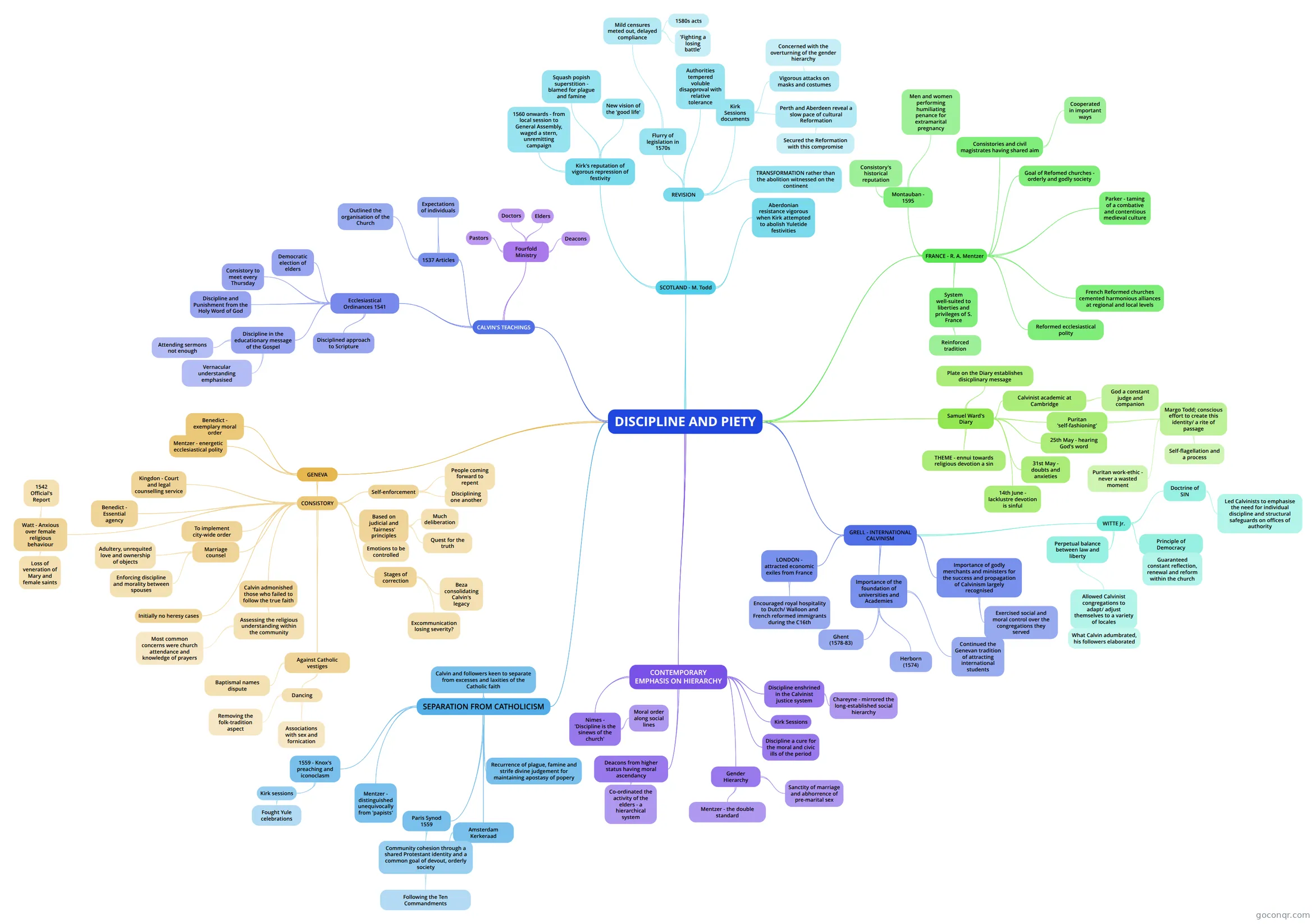
Mind map: discipline and piety
Map content
DISCIPLINE AND PIETY
CALVIN'S TEACHINGS
- Ecclesiastical Ordinances 1541
- Democratic election of elders
- 2 from Narrow Council, 4 from Council of Sixty, and 6 from Council of Two-Hundred
- Men who are fearful of God and have good spiritual discretion
- Consistory to meet every Thursday
- Discipline and Punishment from the Holy Word of God
- Discipline in the educationary message of the Gospel
- People living uprightly will influence others to do the same
- Attending sermons not enough
- Must understand and follow the Scripture in their entirety - interpreting the message with the preacher
- Vernacular understanding emphasised
- Disciplined approach to Scripture
- One belief and limitations of personal interpretation of Christian belief argued by the Consistory
- Democratic election of elders
- 1537 Articles
- Outlined the organisation of the Church
- Expectations of individuals
- Persons of upright life, and needing to master sacramental knowledge
- Fourfold Ministry
- Pastors
- Proclaim the Word of God and to administer the sacraments as well as admonish, instruct and censure the populace
- Doctors
- Masters of Theology, Hebrew - for spiritual and learned education
- Elders
- Oversee lives of everyone in the community and to admonish those who were erring/ leading a disorderly life
- Deacons
- Provision of charity and poor-relief to the less fortunate members of society
- Pastors
- Ecclesiastical Ordinances 1541
Samuel Ward's Diary
- Puritan 'self-fashioning'
- Margo Todd; conscious effort to create this identity/ a rite of passage
- Self-flagellation and a process
- Parallels with Calvin's own musings, and a fashion of self-deprecation and modesty to make one's efforts seem greater
- Puritan work-ethic - never a wasted moment
- Self-flagellation and a process
- Margo Todd; conscious effort to create this identity/ a rite of passage
- 25th May - hearing God's word
- Nothing conduceth more to the true service and glory of God than often to hear his Word, to call upon him and such Christian exercise
- A man must therefore labour above all things for alacrity in God's service
- Calvinist academic at Cambridge
- God a constant judge and companion
- 31st May - doubts and anxieties
- "Not feeling of the reverance which I ought to have in the sight of God" - need for DISCIPLINED control of the faith.
- Constant reflection on God's majesty and in seeking the truth - God's Word is above all
- 14th June - lacklustre devotion is sinful
- Not taking in the sermons or fulfilling Christian practice means you are not following God's path.
- God's omnipresence means nothing you do will go unnoticed, and he is a continual judge of your actions.
- While you have no control of your election, you must live as uprightly as possible to prove you are one of the elect - receiving a sign of your election - keeping society morally disciplined
- THEME - ennui towards religious devotion a sin
- Needing to be extirpated from humanity and society
- Plate on the Diary establishes disicplinary message
- III. To give all glory to God. IV. To bear crosses patiently V. To do good works
- Puritan 'self-fashioning'
GENEVA
- Benedict - exemplary moral order
- Assertions of a proper church discipline attracted godly visitors to Calvin's Geneva to rhapsodise about the exemplary moral order established there (Knox)
- Mentzer - energetic ecclesiastical polity
- Which centred on the local church and consistory
- CONSISTORY
- To implement city-wide order
- Marriage counsel
- Adultery, unrequited love and ownership of objects
- Enforcing discipline and morality between spouses
- Based on judicial and 'fairness' principles
- Quest for the truth
- Case of Jane and Bertin Vulliens in 1542 - "examine them better and learn the truth better from the parties on Monday"
- Much deliberation
- Evidence for claims brought forward a necessity
- Emotions to be controlled
- Place of humility, and no place for anger towards others
- Quest for the truth
- Calvin admonished those who failed to follow the true faith
- 1542 - Donne Janne Pertennez - not following Scriptural guidelines and needing greater education
- Assessing the religious understanding within the community
- Most common concerns were church attendance and knowledge of prayers
- Self-enforcement
- People coming forward to repent
- Seeking spiritual guidance and counsel, or vindication
- Disciplining one another
- Similar to Catholic confession, but for civic morality at large - upholding Calvinist ideals
- People coming forward to repent
- Kingdon - Court and legal counselling service
- Trying to instruct Genevan residents in the new religious obligations they had to follow
- Watt - Anxious over female religious behaviour
- Perhaps explained by Calvin's emphasis on women as moral examples for their children and husbands to follow - disciplined house leads to disciplined society
- Religious education to shift from the church to the home a common Reformer's concern
- 1542 Official's Report
- Women were more easily led astray or more ignorant with regard to Reformed practices
- More frequently practising 'popish' doctrines
- Loss of veneration of Mary and female saints
- Women losing important religious role models
- Benedict - Essential agency
- For effecting the communal moral regeneration that appeared so attractive to so many, and the initial excitement of the Reformation
- Initially no heresy cases
- Not preaching conflicting views, but on the Scriptural knowledge of the populace
- Against Catholic vestiges
- Baptismal names dispute
- Dancing
- Removing the folk-tradition aspect
- Associations with sex and fornication
- Upholding pious lifestyle and 'upright' behaviour
- Stages of correction
- Excommunication final; inability to resolve the issue of sin
- Beza consolidating Calvin's legacy
- Issue of control and censuring the populace remained - carrying through with Calvin's vision with gusto
- Excommunication losing severity?
- 1 in 8 were excommunicated - multitude of cases and thus the moral judgement perhaps diminishes
- Benedict - exemplary moral order
SEPARATION FROM CATHOLICISM
- Calvin and followers keen to separate from excesses and laxities of the Catholic faith
- 1559 - Knox's preaching and iconoclasm
- Inspires an iconoclastic rampage in Perth to destroy all Catholic vestments and idols
- Kirk sessions
- Keen to commit to the central Protestant focus on the sermon and the godly life of moral DISCIPLINE and prayer
- Fought Yule celebrations
- Mentzer - distinguished unequivocally from 'papists'
- Vigorous concept of election reinforced the penchant for arranging and defining the community
- Paris Synod 1559
- Establishes explicit, mutually agreed-upon rules for excommunication throughout the French Reformed churches
- Polarity to Catholicism
- Community cohesion through a shared Protestant identity and a common goal of devout, orderly society
- Catholic clergy increasingly seen as corrupt by all Reformed communities
- Following the Ten Commandments
- Duties to God and duties to one's kindred human beings
- Amsterdam Kerkeraad
- Warned members against the fellowship of Catholics.
- Recurrence of plague, famine and strife divine judgement for maintaining apostasy of popery
CONTEMPORARY EMPHASIS ON HIERARCHY
- Discipline enshrined in the Calvinist justice system
- Chareyne - mirrored the long-established social hierarchy
- Kirk Sessions
- Established a justice system of punishment to be meted out to those breaching moral codes, similar to Geneva's
- Nimes - 'Discipline is the sinews of the church'
- Moral order along social lines
- Deacons from higher status having moral ascendancy
- Co-ordinated the activity of the elders - a hierarchical system
- Discipline a cure for the moral and civic ills of the period
- Gender Hierarchy
- Sanctity of marriage and abhorrence of pre-marital sex
- Mentzer - the double standard
- Officials prosecuting women for fornication, whereas men committing the same crime often ignored, or dealt a lesser punishment
- Yet equal punishment for men and women committing adultery
- Discipline enshrined in the Calvinist justice system
SCOTLAND - M. Todd
- Kirk's reputation of vigorous repression of festivity
- 1560 onwards - from local session to General Assembly, waged a stern, unremitting campaign
- Squash popish superstition - blamed for plague and famine
- New vision of the 'good life'
- Community cohesion through a shared Protestant identity
- REVISION
- Flurry of legislation in 1570s
- Spurred by the Reformer's recognition that thus far, Protestantism had made little dent in popular 'supersititous' celebration
- Mild censures meted out, delayed compliance
- 1580s acts
- Lacked the severity that would have assured compliance - punishment weak in context
- 'Fighting a losing battle'
- Fines and admonitions having little effect
- 1580s acts
- Kirk Sessions documents
- Elders chose their battles carefully, and with the priorities of the larger church and community in mind
- Vigorous attacks on masks and costumes
- Principle concern with the wearing of disguises; gender inversion in dress - fundamental dishonesty
- Ideas of misrule feared by civil and ecclesiastical authorities all across Europe
- Concerned with the overturning of the gender hierarchy
- Perth and Aberdeen reveal a slow pace of cultural Reformation
- Secured the Reformation with this compromise
- Less likely to face retaliation of vindication from over-punished locals unused to the new religous regime
- Authorities behaved not most sternly but with most discrimination - multiple hues of compromise
- Secured the Reformation with this compromise
- Authorities tempered voluble disapproval with relative tolerance
- TRANSFORMATION rather than the abolition witnessed on the continent
- Flurry of legislation in 1570s
- Aberdonian resistance vigorous when Kirk attempted to abolish Yuletide festivities
- Kirk's reputation of vigorous repression of festivity
FRANCE - R. A. Mentzer
- Montauban - 1595
- Strongly Protestant French town - consistory with pastors, lay elders and lay deacons; moral issues their chief concern
- Consistory's historical reputation
- Tireless efforts toward identification and correction of fornication and adultery
- Men and women performing humiliating penance for extramarital pregnancy
- Consistories and civil magistrates having shared aim
- Collusion of moral ideal
- Cooperated in important ways
- Cases coming to the Consistory's attention due to municipal justice
- Ecclesiastical courts granted access to criminal court records and collaborative efforts existed in other Protestant towns
- Goal of Refomed churches - orderly and godly society
- Closely observing scriptural directives; especially the ethical code of the Decalogue
- Parker - taming of a combative and contentious medieval culture
- French Reformed churches cemented harmonious alliances at regional and local levels
- Reformed ecclesiastical polity
- Granted a substantial measure of authority and autonomy, while maintaining an elaborate presbyterian-synodal organisation
- Pastors and elders assembled periodically in regional colloquies, and provincial and national synods to clarify dogma, institute policy and resolve disagreements
- System well-suited to liberties and privileges of S. France
- Consular governments long associated with such liberties etc
- Reinforced tradition
- Of municipal self-governance and strengthened the local elite's control over its own affairs
- Montauban - 1595
GRELL - INTERNATIONAL CALVINISM
- Importance of godly merchants and ministers for the success and propagation of Calvinism largely recognised
- Exercised social and moral control over the congregations they served
- LONDON - attracted economic exiles from France
- Encouraged royal hospitality to Dutch/ Walloon and French reformed immigrants during the C16th
- Importance of the foundation of universities and Academies
- Ghent (1578-83)
- Herborn (1574)
- Continued the Genevan tradition of attracting international students
- WITTE Jr.
- Principle of Democracy
- Guaranteed constant reflection, renewal and reform within the church
- Semper reformanda ecclesiae
- Guaranteed constant reflection, renewal and reform within the church
- Perpetual balance between law and liberty
- Allowed Calvinist congregations to adapt/ adjust themselves to a variety of locales
- Could accommodate local spiritual and cultural flavours without losing their core religious identity
- What Calvin adumbrated, his followers elaborated
- Allowed Calvinist congregations to adapt/ adjust themselves to a variety of locales
- Doctrine of SIN
- Led Calvinists to emphasise the need for individual discipline and structural safeguards on offices of authority
- Principle of Democracy
- Importance of godly merchants and ministers for the success and propagation of Calvinism largely recognised
Information
- Description
- Calvinism Mind Map on DISCIPLINE AND PIETY, created by tompoad on 09/05/2013.
- Created by
- tompoad
- Views
- 87
- Tags
- Rating