
Mind map
Utilitarianism
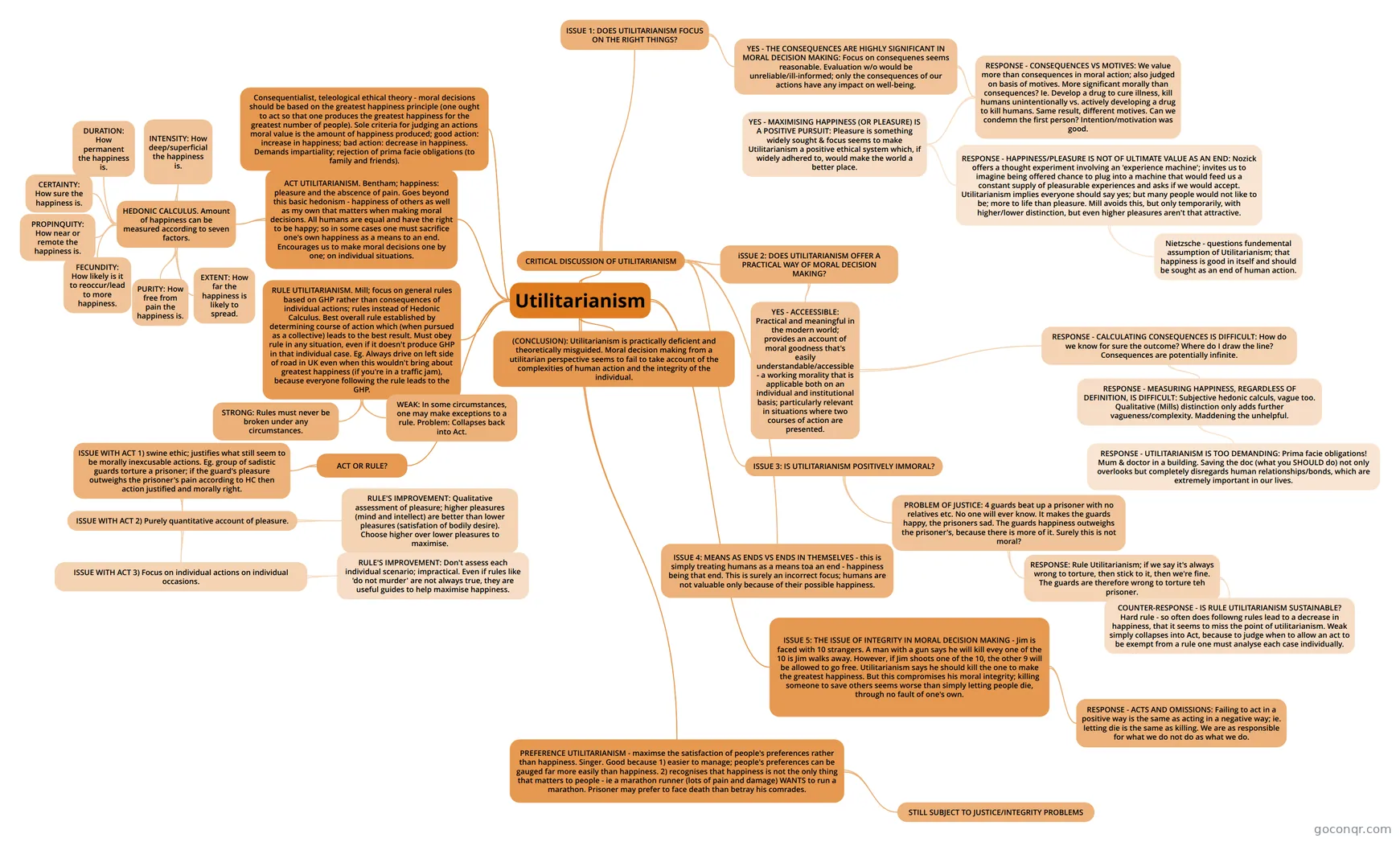
Mind map: Utilitarianism
Map content
Utilitarianism
Consequentialist, teleological ethical theory - moral decisions should be based on the greatest happiness principle (one ought to act so that one produces the greatest happiness for the greatest number of people). Sole criteria for judging an actions moral value is the amount of happiness produced; good action: increase in happiness; bad action: decrease in happiness. Demands impartiality; rejection of prima facie obligations (to family and friends).
ACT UTILITARIANISM. Bentham; happiness: pleasure and the abscence of pain. Goes beyond this basic hedonism - happiness of others as well as my own that matters when making moral decisions. All humans are equal and have the right to be happy; so in some cases one must sacrifice one's own happiness as a means to an end. Encourages us to make moral decisions one by one; on individual situations.
- HEDONIC CALCULUS. Amount of happiness can be measured according to seven factors.
- INTENSITY: How deep/superficial the happiness is.
- DURATION: How permanent the happiness is.
- CERTAINTY: How sure the happiness is.
- PROPINQUITY: How near or remote the happiness is.
- FECUNDITY: How likely is it to reoccur/lead to more happiness.
- PURITY: How free from pain the happiness is.
- EXTENT: How far the happiness is likely to spread.
- HEDONIC CALCULUS. Amount of happiness can be measured according to seven factors.
RULE UTILITARIANISM. Mill; focus on general rules based on GHP rather than consequences of individual actions; rules instead of Hedonic Calculus. Best overall rule established by determining course of action which (when pursued as a collective) leads to the best result. Must obey rule in any situation, even if it doesn't produce GHP in that individual case. Eg. Always drive on left side of road in UK even when this wouldn't bring about greatest happiness (if you're in a traffic jam), because everyone following the rule leads to the GHP.
- STRONG: Rules must never be broken under any circumstances.
- WEAK: In some circumstances, one may make exceptions to a rule. Problem: Collapses back into Act.
ACT OR RULE?
- ISSUE WITH ACT 1) swine ethic; justifies what still seem to be morally inexcusable actions. Eg. group of sadistic guards torture a prisoner; if the guard's pleasure outweighs the prisoner's pain according to HC then action justified and morally right.
- ISSUE WITH ACT 2) Purely quantitative account of pleasure.
- RULE'S IMPROVEMENT: Qualitative assessment of pleasure; higher pleasures (mind and intellect) are better than lower pleasures (satisfation of bodily desire). Choose higher over lower pleasures to maximise.
- ISSUE WITH ACT 3) Focus on individual actions on individual occasions.
- RULE'S IMPROVEMENT: Don't assess each individual scenario; impractical. Even if rules like 'do not murder' are not always true, they are useful guides to help maximise happiness.
- ISSUE WITH ACT 2) Purely quantitative account of pleasure.
- ISSUE WITH ACT 1) swine ethic; justifies what still seem to be morally inexcusable actions. Eg. group of sadistic guards torture a prisoner; if the guard's pleasure outweighs the prisoner's pain according to HC then action justified and morally right.
CRITICAL DISCUSSION OF UTILITARIANISM
- ISSUE 1: DOES UTILITARIANISM FOCUS ON THE RIGHT THINGS?
- YES - THE CONSEQUENCES ARE HIGHLY SIGNIFICANT IN MORAL DECISION MAKING: Focus on consequenes seems reasonable. Evaluation w/o would be unreliable/ill-informed; only the consequences of our actions have any impact on well-being.
- RESPONSE - CONSEQUENCES VS MOTIVES: We value more than consequences in moral action; also judged on basis of motives. More significant morally than consequences? Ie. Develop a drug to cure illness, kill humans unintentionally vs. actively developing a drug to kill humans. Same result, different motives. Can we condemn the first person? Intention/motivation was good.
- YES - MAXIMISING HAPPINESS (OR PLEASURE) IS A POSITIVE PURSUIT: Pleasure is something widely sought & focus seems to make Utilitarianism a positive ethical system which, if widely adhered to, would make the world a better place.
- RESPONSE - HAPPINESS/PLEASURE IS NOT OF ULTIMATE VALUE AS AN END: Nozick offers a thought experiment involving an 'experience machine'; invites us to imagine being offered chance to plug into a machine that would feed us a constant supply of pleasurable experiences and asks if we would accept. Utilitarianism implies everyone should say yes; but many people would not like to be; more to life than pleasure. Mill avoids this, but only temporarily, with higher/lower distinction, but even higher pleasures aren't that attractive.
- Nietzsche - questions fundemental assumption of Utilitarianism; that happiness is good in itself and should be sought as an end of human action.
- RESPONSE - HAPPINESS/PLEASURE IS NOT OF ULTIMATE VALUE AS AN END: Nozick offers a thought experiment involving an 'experience machine'; invites us to imagine being offered chance to plug into a machine that would feed us a constant supply of pleasurable experiences and asks if we would accept. Utilitarianism implies everyone should say yes; but many people would not like to be; more to life than pleasure. Mill avoids this, but only temporarily, with higher/lower distinction, but even higher pleasures aren't that attractive.
- YES - MAXIMISING HAPPINESS (OR PLEASURE) IS A POSITIVE PURSUIT: Pleasure is something widely sought & focus seems to make Utilitarianism a positive ethical system which, if widely adhered to, would make the world a better place.
- RESPONSE - CONSEQUENCES VS MOTIVES: We value more than consequences in moral action; also judged on basis of motives. More significant morally than consequences? Ie. Develop a drug to cure illness, kill humans unintentionally vs. actively developing a drug to kill humans. Same result, different motives. Can we condemn the first person? Intention/motivation was good.
- YES - THE CONSEQUENCES ARE HIGHLY SIGNIFICANT IN MORAL DECISION MAKING: Focus on consequenes seems reasonable. Evaluation w/o would be unreliable/ill-informed; only the consequences of our actions have any impact on well-being.
- iSSUE 2: DOES UTILITARIANISM OFFER A PRACTICAL WAY OF MORAL DECISION MAKING?
- YES - ACCEESSIBLE: Practical and meaningful in the modern world; provides an account of moral goodness that's easily understandable/accessible - a working morality that is applicable both on an individual and institutional basis; particularly relevant in situations where two courses of action are presented.
- RESPONSE - CALCULATING CONSEQUENCES IS DIFFICULT: How do we know for sure the outcome? Where do I draw the line? Consequences are potentially infinite.
- RESPONSE - MEASURING HAPPINESS, REGARDLESS OF DEFINITION, IS DIFFICULT: Subjective hedonic calculs, vague too. Qualitative (Mills) distinction only adds further vagueness/complexity. Maddening the unhelpful.
- RESPONSE - UTILITARIANISM IS TOO DEMANDING: Prima facie obligations! Mum & doctor in a building. Saving the doc (what you SHOULD do) not only overlooks but completely disregards human relationships/bonds, which are extremely important in our lives.
- RESPONSE - MEASURING HAPPINESS, REGARDLESS OF DEFINITION, IS DIFFICULT: Subjective hedonic calculs, vague too. Qualitative (Mills) distinction only adds further vagueness/complexity. Maddening the unhelpful.
- RESPONSE - CALCULATING CONSEQUENCES IS DIFFICULT: How do we know for sure the outcome? Where do I draw the line? Consequences are potentially infinite.
- YES - ACCEESSIBLE: Practical and meaningful in the modern world; provides an account of moral goodness that's easily understandable/accessible - a working morality that is applicable both on an individual and institutional basis; particularly relevant in situations where two courses of action are presented.
- ISSUE 3: IS UTILITARIANISM POSITIVELY IMMORAL?
- PROBLEM OF JUSTICE: 4 guards beat up a prisoner with no relatives etc. No one will ever know. It makes the guards happy, the prisoners sad. The guards happiness outweighs the prisoner's, because there is more of it. Surely this is not moral?
- RESPONSE: Rule Utilitarianism; if we say it's always wrong to torture, then stick to it, then we're fine. The guards are therefore wrong to torture teh prisoner.
- COUNTER-RESPONSE - IS RULE UTILITARIANISM SUSTAINABLE? Hard rule - so often does followng rules lead to a decrease in happiness, that it seems to miss the point of utilitarianism. Weak simply collapses into Act, because to judge when to allow an act to be exempt from a rule one must analyse each case individually.
- RESPONSE: Rule Utilitarianism; if we say it's always wrong to torture, then stick to it, then we're fine. The guards are therefore wrong to torture teh prisoner.
- PROBLEM OF JUSTICE: 4 guards beat up a prisoner with no relatives etc. No one will ever know. It makes the guards happy, the prisoners sad. The guards happiness outweighs the prisoner's, because there is more of it. Surely this is not moral?
- ISSUE 4: MEANS AS ENDS VS ENDS IN THEMSELVES - this is simply treating humans as a means toa an end - happiness being that end. This is surely an incorrect focus; humans are not valuable only because of their possible happiness.
- ISSUE 1: DOES UTILITARIANISM FOCUS ON THE RIGHT THINGS?
ISSUE 5: THE ISSUE OF INTEGRITY IN MORAL DECISION MAKING - Jim is faced with 10 strangers. A man with a gun says he will kill evey one of the 10 is Jim walks away. However, if Jim shoots one of the 10, the other 9 will be allowed to go free. Utilitarianism says he should kill the one to make the greatest happiness. But this compromises his moral integrity; killing someone to save others seems worse than simply letting people die, through no fault of one's own.
- RESPONSE - ACTS AND OMISSIONS: Failing to act in a positive way is the same as acting in a negative way; ie. letting die is the same as killing. We are as responsible for what we do not do as what we do.
PREFERENCE UTILITARIANISM - maximse the satisfaction of people's preferences rather than happiness. Singer. Good because 1) easier to manage; people's preferences can be gauged far more easily than happiness. 2) recognises that happiness is not the only thing that matters to people - ie a marathon runner (lots of pain and damage) WANTS to run a marathon. Prisoner may prefer to face death than betray his comrades.
- STILL SUBJECT TO JUSTICE/INTEGRITY PROBLEMS
(CONCLUSION): Utilitarianism is practically deficient and theoretically misguided. Moral decision making from a utilitarian perspective seems to fail to take account of the complexities of human action and the integrity of the individual.
Information
- Description
- Alevel Philosophy (Moral Philosophy) Mind Map on Utilitarianism , created by annamiddleton on 01/05/2014.
- Created by
- annamiddleton
- Views
- 17
- Rating