
Mind map
Amnesia

Map content
Amnesia
Types of amnesia
- Memory disorder with preserved intellect and language
Causes
- Alzheimer's disease
- Most common cause > not a pure form
- Korsakoff syndrome
- Chronic alcoholism > pure form
- Herpes simplex encephalitis
- Very rare virus in the brain (Clive Wearing)
- Temporal lobe surgery
- H.M.
- Epileptic seizures at 10 - surgery at 27
- Removal of medial temporal lobes and parts of hippocampi
- No more seizures but became amnesic
- Severe anterograde deficit and retrograde deficit extends back to age 16 (11yrs before surgery)
- H.M.
- Alzheimer's disease
What is preserved?
- STM
- Digit span
- Procedural memory
- Mirror drawing task
- Implicit memory
- A person's behavior is influenced by previous experience
- Handshake
- Can recall words based on images that comes to mind
- A person's behavior is influenced by previous experience
- STM
Episodic memory
- Anterograde amnesia and recollection (free-recall tasks) and familiarity (recognition tasks)
- Jon
- Early born (anoxia) > brain structure abnormalities
- Jon has deficits in recall tasks
- Uses remember/know categories as often as controls > can't explain the basis of R decisions
- Remembers visually
- Deficits in recollection
- Hypoxic (lack of oxygen to the brain) patients
- Yonelinas et al. (2002)
- Deficits in regognition - alike controls in recall
- Yonelinas et al. (2002)
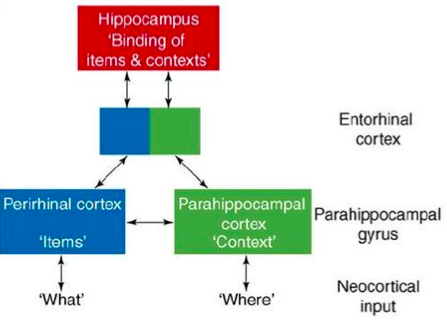
- Dual-process model of memory (Aggleton & Brown, 1999)
- There are hippocampal amnesics who have deficits in recall and recognition
- Jon
- Rertograde amnesia and temporal gradient
- Need to test items learned prior to the onset of amnesia
- Koppelman et al. (1990) developed the Autobiographical Memory Interview (AMI). Ask participants to remember specific information from a range of time periods e.g. the name of their first school. Then recollect a specific personal event from the period
- Temporal retrograde amnesia gradient
- For those with retrograde amnesia memories from earlier in life are easier to recall than those later on (Ribot’s law).
- Butters & Cermak (1986) report the case of P.Z.
- Explanations for RA
- Standard consolidation models e.g. Alvarez & Squire (1994)
- Assume information is consolidated by transferring it from one brain region to another
- Accounts for Ribot’s law
- Assume information is consolidated by transferring it from one brain region to another
- Multiple Trace Hypothesis e.g. Nadel & Moscovitch (1997;1998)
- The hippocampus is not only important in encoding but also in long-term retrieval
- Long-term consolidation results in the creation of redundant traces in the hippocampus, instead of the neocortex
- Predicts that complete hippocampal damage will result in complete RA
- Standard consolidation models e.g. Alvarez & Squire (1994)
- Anterograde amnesia and recollection (free-recall tasks) and familiarity (recognition tasks)
Semantic memory
- H.M. tested on ability to retrieve lexical knowledge (Kensinger et al., 2001). Picture naming, spelling, ability to generate irregular word forms (e.g. Every day I dig a hole. Yesterday I ____ a hole). Performed within 1 SD of matched controls.
- However this knowledge acquired very early in life and generally early childhood memories are found to be well preserved in amnesic patients (Ribot’s law).
- The amount of damage to MTL corresponds to the magnitude of deficits in acquiring new semantic info (Verfaellie et al., 2000).
- A number of early onset hypoxic patients show relatively preserved acquisition of semantic knowledge but profound episodic memory deficits e.g. Jon, Vargha-Khadem et al., 1997.
- H.M. tested on ability to retrieve lexical knowledge (Kensinger et al., 2001). Picture naming, spelling, ability to generate irregular word forms (e.g. Every day I dig a hole. Yesterday I ____ a hole). Performed within 1 SD of matched controls.
Images and files in the map
Information
- Description
- Mind Map on Amnesia, created by Christiana Lucin on 02/05/2014.
- Created by
- Christiana Lucin
- Views
- 9
- Rating