
Mind map
Recognising individual faces
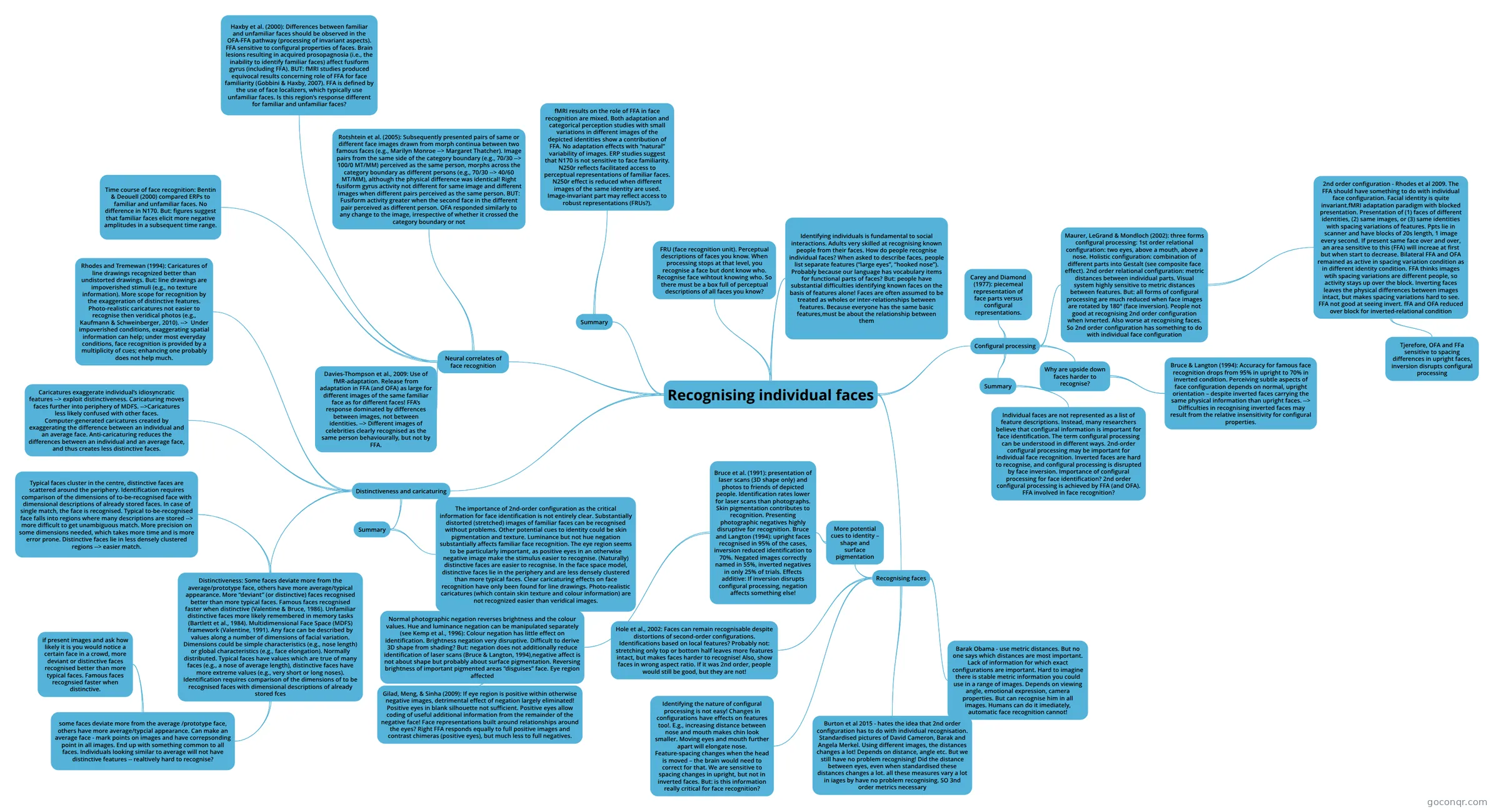
Mind map: Recognising individual faces
Map content
Recognising individual faces
Identifying individuals is fundamental to social interactions. Adults very skilled at recognising known people from their faces. How do people recognise individual faces? When asked to describe faces, people list separate features (“large eyes”, “hooked nose”). Probably because our language has vocabulary items for functional parts of faces? But: people have substantial difficulties identifying known faces on the basis of features alone! Faces are often assumed to be treated as wholes or inter-relationships between features. Because everyone has the same basic features,must be about the relationship between them
FRU (face recognition unit). Perceptual descriptions of faces you know. When processing stops at that level, you recognise a face but dont know who. Recognise face wihtout knowing who. So there must be a box full of perceptual descriptions of all faces you know?
Configural processing
- Carey and Diamond (1977): piecemeal representation of face parts versus configural representations.
- Maurer, LeGrand & Mondloch (2002): three forms configural processing: 1st order relational configuration: two eyes, above a mouth, above a nose. Holistic configuration: combination of different parts into Gestalt (see composite face effect). 2nd order relational configuration: metric distances between individual parts. Visual system highly sensitive to metric distances between features. But: all forms of configural processing are much reduced when face images are rotated by 180° (face inversion). People not good at recognising 2nd order configuration when ivnerted. Also worse at recognising faces. So 2nd order configuration has something to do with individual face configuration
- 2nd order configuration - Rhodes et al 2009. The FFA should have something to do with individual face configuration. Facial identity is quite invariant.fMRI adaptation paradigm with blocked presentation. Presentation of (1) faces of different identities, (2) same images, or (3) same identities with spacing variations of features. Ppts lie in scanner and have blocks of 20s length, 1 image every second. If present same face over and over, an area sensitive to this (FFA) will increae at first but when start to decrease. Bilateral FFA and OFA remained as active in spacing variation condition as in different identity condition. FFA thinks images wtih spacing variations are different people, so activity stays up over the block. Inverting faces leaves the physical differences between images intact, but makes spacing variations hard to see. FFA not good at seeing invert. fFA and OFA reduced over block for inverted-relational condition
- Tjerefore, OFA and FFa sensitive to spacing differences in upright faces, inversion disrupts configural processing
- 2nd order configuration - Rhodes et al 2009. The FFA should have something to do with individual face configuration. Facial identity is quite invariant.fMRI adaptation paradigm with blocked presentation. Presentation of (1) faces of different identities, (2) same images, or (3) same identities with spacing variations of features. Ppts lie in scanner and have blocks of 20s length, 1 image every second. If present same face over and over, an area sensitive to this (FFA) will increae at first but when start to decrease. Bilateral FFA and OFA remained as active in spacing variation condition as in different identity condition. FFA thinks images wtih spacing variations are different people, so activity stays up over the block. Inverting faces leaves the physical differences between images intact, but makes spacing variations hard to see. FFA not good at seeing invert. fFA and OFA reduced over block for inverted-relational condition
- Why are upside down faces harder to recognise?
- Bruce & Langton (1994): Accuracy for famous face recognition drops from 95% in upright to 70% in inverted condition. Perceiving subtle aspects of face configuration depends on normal, upright orientation – despite inverted faces carrying the same physical information than upright faces. --> Difficulties in recognising inverted faces may result from the relative insensitivity for configural properties.
- Summary
- Individual faces are not represented as a list of feature descriptions. Instead, many researchers believe that configural information is important for face identification. The term configural processing can be understood in different ways. 2nd-order configural processing may be important for individual face recognition. Inverted faces are hard to recognise, and configural processing is disrupted by face inversion. Importance of configural processing for face identification? 2nd order configural processing is achieved by FFA (and OFA). FFA involved in face recognition?
Recognising faces
- Barak Obama - use metric distances. But no one says which distances are most important. Lack of information for which exact configurations are important. Hard to imagine there is stable metric information you could use in a range of images. Depends on viewing angle, emotional expression, camera properties. But can recognise him in all images. Humans can do it imediately, automatic face recognition cannot!
- Burton et al 2015 - hates the idea that 2nd order configuration has to do with individual recognisation. Standardised pictures of David Cameron, Barak and Angela Merkel. Using different images, the distances changes a lot! Depends on distance, angle etc. But we still have no problem recognising! Did the distance between eyes, even when standardised these distances changes a lot. all these measures vary a lot in iages by have no problem recognising. SO 3nd order metrics necessary
- Identifying the nature of configural processing is not easy! Changes in configurations have effects on features too!. E.g., increasing distance between nose and mouth makes chin look smaller. Moving eyes and mouth further apart will elongate nose. Feature-spacing changes when the head is moved – the brain would need to correct for that. We are sensitive to spacing changes in upright, but not in inverted faces. But: is this information really critical for face recognition?
- Hole et al., 2002: Faces can remain recognisable despite distortions of second-order configurations. Identifications based on local features? Probably not: stretching only top or bottom half leaves more features intact, but makes faces harder to recognise! Also, show faces in wrong aspect ratio. If it was 2nd order, people would still be good, but they are not!
- More potential cues to identity – shape and surface pigmentation
- Bruce et al. (1991): presentation of laser scans (3D shape only) and photos to friends of depicted people. Identification rates lower for laser scans than photographs. Skin pigmentation contributes to recognition. Presenting photographic negatives highly disruptive for recognition. Bruce and Langton (1994): upright faces recognised in 95% of the cases, inversion reduced identification to 70%. Negated images correctly named in 55%, inverted negatives in only 25% of trials. Effects additive: If inversion disrupts configural processing, negation affects something else!
- Normal photographic negation reverses brightness and the colour values. Hue and luminance negation can be manipulated separately (see Kemp et al., 1996): Colour negation has little effect on identification. Brightness negation very disruptive. Difficult to derive 3D shape from shading? But: negation does not additionally reduce identification of laser scans (Bruce & Langton, 1994),negative affect is not about shape but probably about surface pigmentation. Reversing brightness of important pigmented areas “disguises” face. Eye region affected
- Gilad, Meng, & Sinha (2009): If eye region is positive within otherwise negative images, detrimental effect of negation largely eliminated! Positive eyes in blank silhouette not sufficient. Positive eyes allow coding of useful additional information from the remainder of the negative face! Face representations built around relationships around the eyes? Right FFA responds equally to full positive images and contrast chimeras (positive eyes), but much less to full negatives.
- Normal photographic negation reverses brightness and the colour values. Hue and luminance negation can be manipulated separately (see Kemp et al., 1996): Colour negation has little effect on identification. Brightness negation very disruptive. Difficult to derive 3D shape from shading? But: negation does not additionally reduce identification of laser scans (Bruce & Langton, 1994),negative affect is not about shape but probably about surface pigmentation. Reversing brightness of important pigmented areas “disguises” face. Eye region affected
- Bruce et al. (1991): presentation of laser scans (3D shape only) and photos to friends of depicted people. Identification rates lower for laser scans than photographs. Skin pigmentation contributes to recognition. Presenting photographic negatives highly disruptive for recognition. Bruce and Langton (1994): upright faces recognised in 95% of the cases, inversion reduced identification to 70%. Negated images correctly named in 55%, inverted negatives in only 25% of trials. Effects additive: If inversion disrupts configural processing, negation affects something else!
Distinctiveness and caricaturing
- Distinctiveness: Some faces deviate more from the average/prototype face, others have more average/typical appearance. More “deviant” (or distinctive) faces recognised better than more typical faces. Famous faces recognised faster when distinctive (Valentine & Bruce, 1986). Unfamiliar distinctive faces more likely remembered in memory tasks (Bartlett et al., 1984). Multidimensional Face Space (MDFS) framework (Valentine, 1991). Any face can be described by values along a number of dimensions of facial variation. Dimensions could be simple characteristics (e.g., nose length) or global characteristics (e.g., face elongation). Normally distributed. Typical faces have values which are true of many faces (e.g., a nose of average length), distinctive faces have more extreme values (e.g., very short or long noses). Identification requires comparison of the dimensions of to be recognised faces with dimensional descriptions of already stored fces
- some faces deviate more from the average /prototype face, others have more average/typcial appearance. Can make an average face - mark points on images and have correpsonding point in all images. End up with something common to all faces. Individuals looking similar to average will not have distinctive features -- realtively hard to recognise?
- if present images and ask how likely it is you would notice a certain face in a crowd, more deviant or distinctive faces recognised better than more typical faces. Famous faces recognsied faster when distinctive.
- Typical faces cluster in the centre, distinctive faces are scattered around the periphery. Identification requires comparison of the dimensions of to-be-recognised face with dimensional descriptions of already stored faces. In case of single match, the face is recognised. Typical to-be-recognised face falls into regions where many descriptions are stored --> more difficult to get unambiguous match. More precision on some dimensions needed, which takes more time and is more error prone. Distinctive faces lie in less densely clustered regions --> easier match.
- some faces deviate more from the average /prototype face, others have more average/typcial appearance. Can make an average face - mark points on images and have correpsonding point in all images. End up with something common to all faces. Individuals looking similar to average will not have distinctive features -- realtively hard to recognise?
- Caricatures exaggerate individual’s idiosyncratic features --> exploit distinctiveness. Caricaturing moves faces further into periphery of MDFS. -->Caricatures less likely confused with other faces. Computer-generated caricatures created by exaggerating the difference between an individual and an average face. Anti-caricaturing reduces the differences between an individual and an average face, and thus creates less distinctive faces.
- Rhodes and Tremewan (1994): Caricatures of line drawings recognized better than undistorted drawings. But: line drawings are impoverished stimuli (e.g., no texture information). More scope for recognition by the exaggeration of distinctive features. Photo-realistic caricatures not easier to recognise then veridical photos (e.g., Kaufmann & Schweinberger, 2010). --> Under impoverished conditions, exaggerating spatial information can help; under most everyday conditions, face recognition is provided by a multiplicity of cues; enhancing one probably does not help much.
- Summary
- The importance of 2nd-order configuration as the critical information for face identification is not entirely clear. Substantially distorted (stretched) images of familiar faces can be recognised without problems. Other potential cues to identity could be skin pigmentation and texture. Luminance but not hue negation substantially affects familiar face recognition. The eye region seems to be particularly important, as positive eyes in an otherwise negative image make the stimulus easier to recognise. (Naturally) distinctive faces are easier to recognise. In the face space model, distinctive faces lie in the periphery and are less densely clustered than more typical faces. Clear caricaturing effects on face recognition have only been found for line drawings. Photo-realistic caricatures (which contain skin texture and colour information) are not recognized easier than veridical images.
- Distinctiveness: Some faces deviate more from the average/prototype face, others have more average/typical appearance. More “deviant” (or distinctive) faces recognised better than more typical faces. Famous faces recognised faster when distinctive (Valentine & Bruce, 1986). Unfamiliar distinctive faces more likely remembered in memory tasks (Bartlett et al., 1984). Multidimensional Face Space (MDFS) framework (Valentine, 1991). Any face can be described by values along a number of dimensions of facial variation. Dimensions could be simple characteristics (e.g., nose length) or global characteristics (e.g., face elongation). Normally distributed. Typical faces have values which are true of many faces (e.g., a nose of average length), distinctive faces have more extreme values (e.g., very short or long noses). Identification requires comparison of the dimensions of to be recognised faces with dimensional descriptions of already stored fces
Neural correlates of face recognition
- Time course of face recognition: Bentin & Deouell (2000) compared ERPs to familiar and unfamiliar faces. No difference in N170. But: figures suggest that familiar faces elicit more negative amplitudes in a subsequent time range.
- Haxby et al. (2000): Differences between familiar and unfamiliar faces should be observed in the OFA-FFA pathway (processing of invariant aspects). FFA sensitive to configural properties of faces. Brain lesions resulting in acquired prosopagnosia (i.e., the inability to identify familiar faces) affect fusiform gyrus (including FFA). BUT: fMRI studies produced equivocal results concerning role of FFA for face familiarity (Gobbini & Haxby, 2007). FFA is defined by the use of face localizers, which typically use unfamiliar faces. Is this region’s response different for familiar and unfamiliar faces?
- Davies-Thompson et al., 2009: Use of fMR-adaptation. Release from adaptation in FFA (and OFA) as large for different images of the same familiar face as for different faces! FFA’s response dominated by differences between images, not between identities. --> Different images of celebrities clearly recognised as the same person behaviourally, but not by FFA.
- Rotshtein et al. (2005): Subsequently presented pairs of same or different face images drawn from morph continua between two famous faces (e.g., Marilyn Monroe --> Margaret Thatcher). Image pairs from the same side of the category boundary (e.g., 70/30 --> 100/0 MT/MM) perceived as the same person, morphs across the category boundary as different persons (e.g., 70/30 --> 40/60 MT/MM), although the physical difference was identical! Right fusiform gyrus activity not different for same image and different images when different pairs perceived as the same person. BUT: Fusiform activity greater when the second face in the different pair perceived as different person. OFA responded similarly to any change to the image, irrespective of whether it crossed the category boundary or not
Summary
- fMRI results on the role of FFA in face recognition are mixed. Both adaptation and categorical perception studies with small variations in different images of the depicted identities show a contribution of FFA. No adaptation effects with “natural” variability of images. ERP studies suggest that N170 is not sensitive to face familiarity. N250r reflects facilitated access to perceptual representations of familiar faces. N250r effect is reduced when different images of the same identity are used. Image-invariant part may reflect access to robust representations (FRUs?).
Information
- Description
- Y3 Uni Social Perception - HW Mind Map on Recognising individual faces, created by Issy de Silva on 28/03/2017.
- Created by
- Issy de Silva
- Views
- 2
- Rating