
Mind map
Cold Environments: Fluvioglacial Processes and Landforms
Map content
Cold Environments: Fluvioglacial Processes and Landforms
The Importance of Meltwater
- Melting snow helps to enlarge the shallow nivation hollows that eventually become corries when the snow turns to ice
- Helps to lubricate the base of the glacier.
- Transports moraine beneath the ice, where it provides tools for glacial erosion
- When freezes, can help with plucking.
- Erode channels and form distinctive depositional features - both in front of and beneath the ice.
Fluvioglacial Landforms: Meltwater Related Features
- Meltwater Channels
- Takes the form of a steep-sided , often dry, valley carved into the landscape
- Most commonly results from the overspill of a lake that builds up next to or in front of a glacier
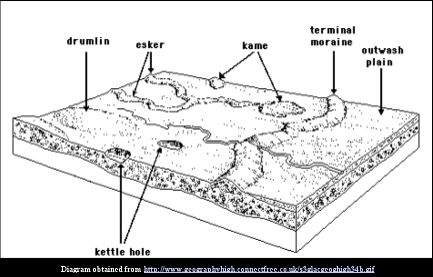
- Eskers
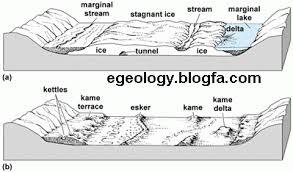
- Long ridges of sand and gravel. They can be up to 30 meters high and usually take the form of meandering hills-often stretching for several kilometres-that run roughly parallel to the valley sides.
- Meandering shape suggests they were formed by subglacial river deposition during the final stages of a glacial period
- Kames
- Kame Terrace: Most extensive type of kame. Results from the infilling or a marginal glacial lake. When the ice finally melts, the kame terrace is abandoned as a ridge on the valley side.
- Kame Delta: A smaller feature that forms when a stream deposits material on entering a marginal lake. Small mound-like hills, and can be identified by their deltaic sedimentation characteristics.
- Crevasse Kame: Some kames arise from the flucial deposition of sediments in surface crevasses. When ice melts, they are deposited on the valley floor to form small hummocks
- Outwash Plain
- A gentle sloping area of sands and gravels that forms in front of the glacier.
- Results from the 'outwash' of sediment carried by meltwater streams and rivers.
- At the end of a glacial period, huge quantities of sediment will be spread out over the outwash plain by great torrents of meltwater.
- Meltwater Channels
Images and files in the map
Information
- Description
- A Levels Geography (Physical Geography-AS) Mind Map on Cold Environments: Fluvioglacial Processes and Landforms, created by Andrew_Ellinas on 09/05/2014.
- Created by
- Andrew_Ellinas
- Views
- 146
- Rating