
Mind map
Macronutrients
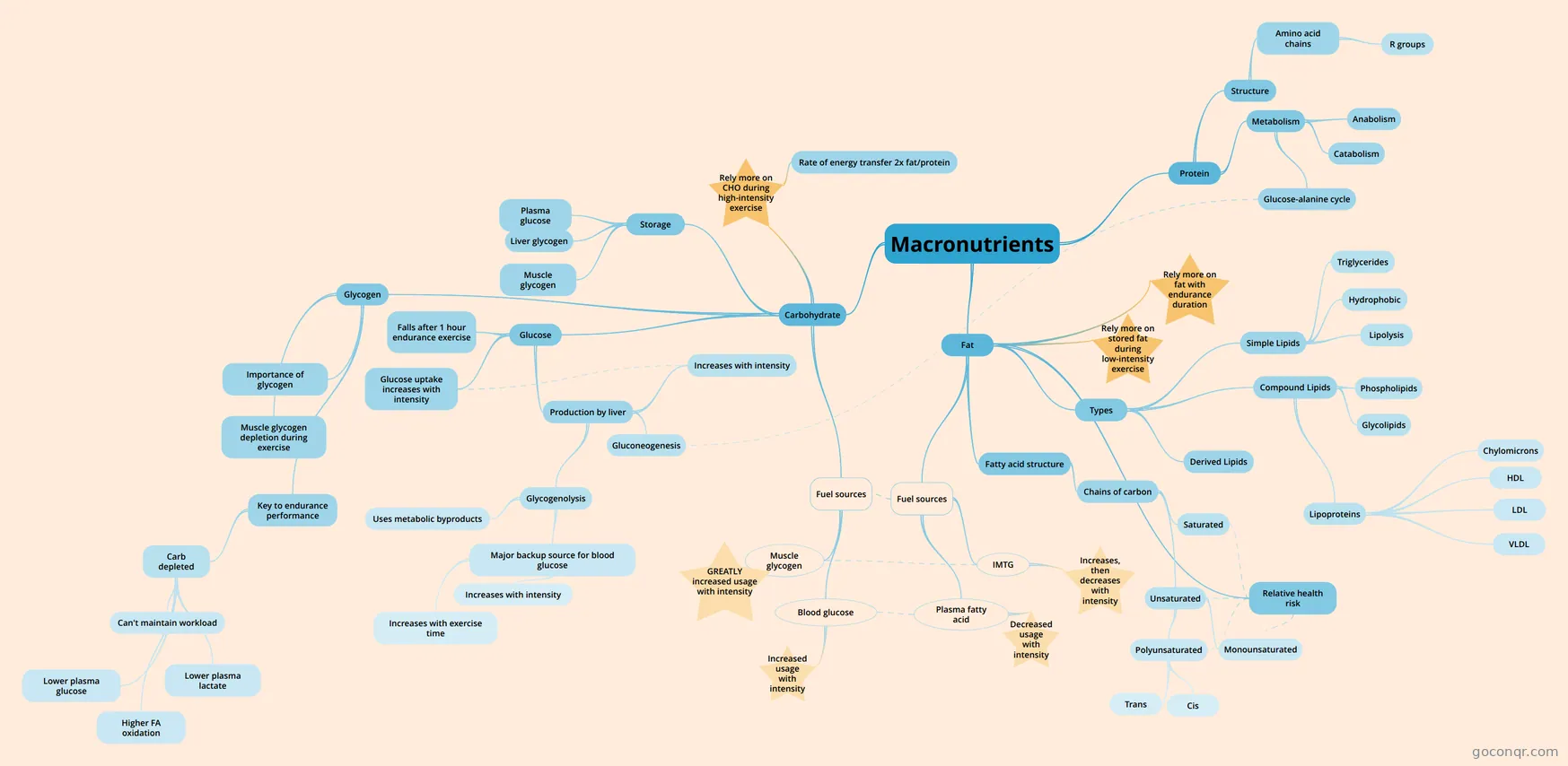
Mind map: Macronutrients
Map content
Macronutrients
Carbohydrate
- Fuel sources
- Blood glucose
- From liver glycogen
- Increased usage with intensity
- Muscle glycogen
- GREATLY increased usage with intensity
- Blood glucose
- Rely more on CHO during high-intensity exercise
- Rate of energy transfer 2x fat/protein
- Storage
- 500 g (2000 kcal)
- Plasma glucose
- 4 g (16 kcal)
- Liver glycogen
- 100 g (400 kcal)
- Muscle glycogen
- 400 g (1600 kcal)
- Glycogen
- Importance of glycogen
- Muscle glycogen depletion during exercise
- Key to endurance performance
- Carb depleted
- Can't maintain workload
- Lower plasma glucose
- Lower plasma lactate
- Higher FA oxidation
- Carb depleted
- Glucose
- Falls after 1 hour endurance exercise
- Production by liver
- Glycogenolysis
- Major backup source for blood glucose
- Increases with exercise time
- Increases with intensity
- Uses metabolic byproducts
- Major backup source for blood glucose
- Increases with intensity
- Gluconeogenesis
- Glycogenolysis
- Glucose uptake increases with intensity
- Fuel sources
Fat
- Fuel sources
- Plasma fatty acid
- From adipose tissue
- Decreased usage with intensity
- IMTG
- Increases, then decreases with intensity
- Plasma fatty acid
- Rely more on stored fat during low-intensity exercise
- Types
- Simple Lipids
- Triglycerides
- Glycerol + 3 Fatty acids Storage form of lipids
- Hydrophobic
- Lipolysis
- Breakdown of triglycerides into glycerol + 3 FA
- Triglycerides
- Compound Lipids
- Lipids + other molecules
- Phospholipids
- Lipid + phosphate Cell membranes
- Glycolipids
- Lipid + carbohydrates Antibody identification, cell function
- Lipoproteins
- Lipid + protein Makes lipids water-soluble Major form of lipid transport in blood
- Chylomicrons
- Packaged triglycerides from diet
- HDL
- “good cholesterol” ~50% is protein (providing greater density)
- LDL
- “bad cholesterol” ~25% is protein (ie. reduced density compared to HDL)
- VLDL
- Mostly triglyceride inside Made (ie. packaged) in the liver
- Derived Lipids
- Simple Lipids
- Fatty acid structure
- Chains of carbon
- usually 12-20 carbons long
- # of carbons and hydrogens determine properties
- Saturated
- Hydrogen attached to all possible binding sites of the Carbon atoms “saturated with Hydrogen” No double bonds between Carbon atoms Animal fat, eggs, & dairySolid at room temp
- Unsaturated
- One or more double bond Can synthesize through hydrogenation
- Monounsaturated
- One double bond Olive oil, canola oil
- Polyunsaturated
- >1 double bond safflower, sunflower, soybean, corn oils
- Trans
- Cis
- Chains of carbon
- Relative health risk
- Rely more on fat with endurance duration
- Fuel sources
Protein
- Structure
- Amino acid chains
- R groups
- Amino acid chains
- Metabolism
- Anabolism
- Catabolism
- Glucose-alanine cycle
- Structure
Information
- Description
- Exercise Physiology (Carbohydrates, Fats, and Protein) Mind Map on Macronutrients, created by Emily Krueger on 14/04/2017.
- Created by
- Emily Krueger
- Views
- 368
- Rating