
Mind map
A Level Physics OCR
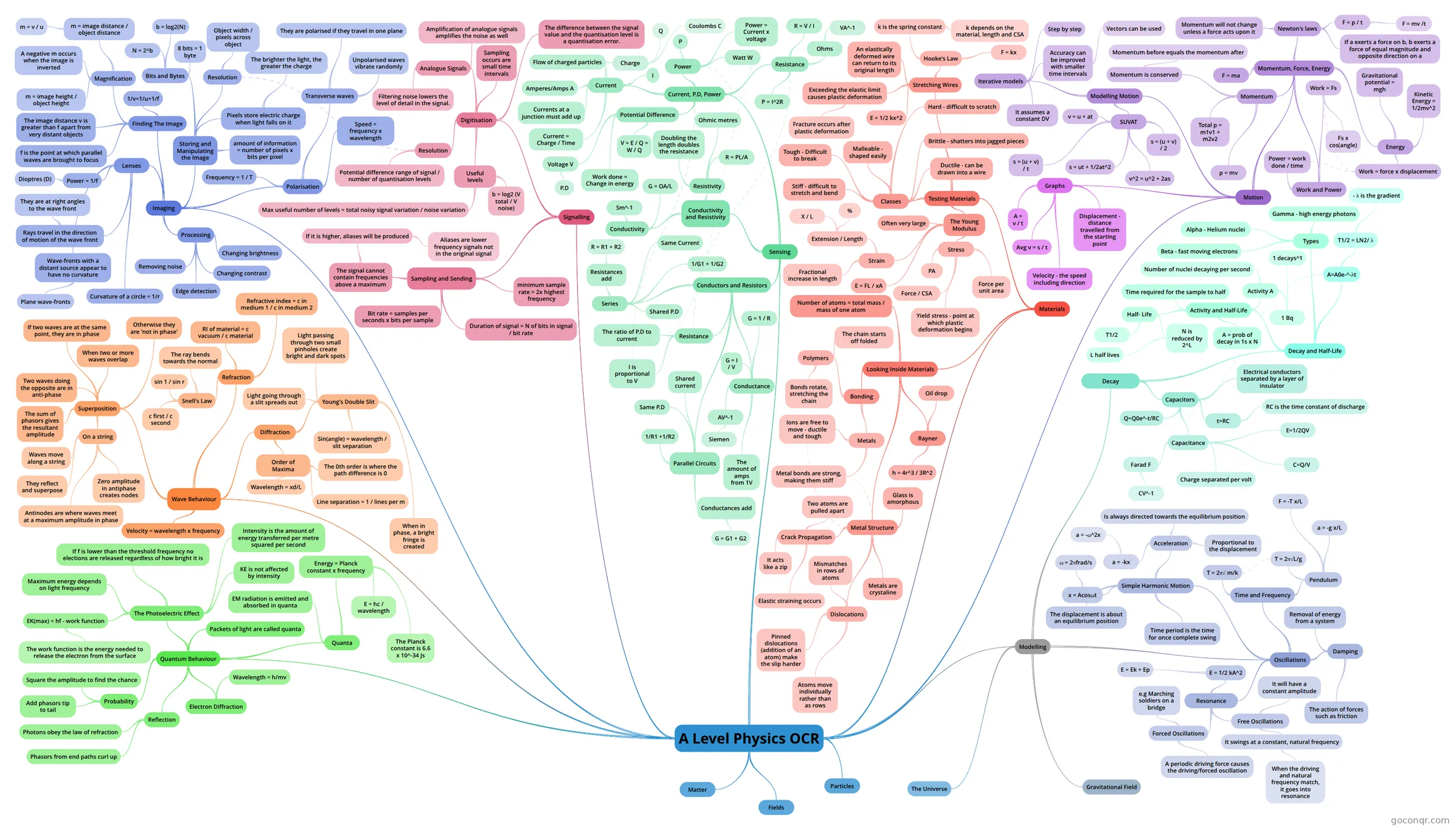
Mind map: A Level Physics OCR
Map content
A Level Physics OCR
Imaging
- Lenses
- Curvature of a circle = 1/r
- Wave-fronts with a distant source appear to have no curvature
- Plane wave-fronts
- Rays travel in the direction of motion of the wave front
- They are at right angles to the wave front
- Power = 1/f
- Dioptres (D)
- Finding The Image
- 1/v=1/u+1/f
- f is the point at which parallel waves are brought to focus
- The image distance v is greater than f apart from very distant objects
- Magnification
- m = image height / object height
- m = image distance / object distance
- m = v / u
- A negative m occurs when the image is inverted
- Storing and Manipulating the Image
- Pixels store electric charge when light falls on it
- The brighter the light, the greater the charge
- Bits and Bytes
- 8 bits = 1 byte
- N = 2^b
- b = log2(N)
- Resolution
- Object width / pixels across object
- amount of information = number of pixels x bits per pixel
- Pixels store electric charge when light falls on it
- Processing
- Changing brightness
- Removing noise
- Edge detection
- Changing contrast
- Polarisation
- Speed = frequency x wavelength
- Frequency = 1 / T
- Transverse waves
- They are polarised if they travel in one plane
- Unpolarised waves vibrate randomly
- Lenses
Signalling
- Digitisation
- Sampling occurs are small time intervals
- Analogue Signals
- Amplification of analogue signals amplifies the noise as well
- Filtering noise lowers the level of detail in the signal.
- The difference between the signal value and the quantisation level is a quantisation error.
- Resolution
- Potential difference range of signal / number of quantisation levels
- Useful levels
- Max useful number of levels = total noisy signal variation / noise variation
- b = log2 (V total / V noise)
- Sampling and Sending
- minimum sample rate > 2x highest frequency
- The signal cannot contain frequencies above a maximum
- If it is higher, aliases will be produced
- Aliases are lower frequency signals not in the original signal
- If it is higher, aliases will be produced
- Bit rate = samples per seconds x bits per sample
- Duration of signal = N of bits in signal / bit rate
- Digitisation
Sensing
- Current, P.D, Power
- Current
- Flow of charged particles
- Charge
- Q
- Coulombs C
- Charge
- Amperes/Amps A
- I
- Current = Charge / Time
- Currents at a junction must add up
- Flow of charged particles
- Potential Difference
- Voltage V
- P.D
- Work done = Change in energy
- V = E / Q = W / Q
- Voltage V
- Power
- Watt W
- P
- Power = Current x voltage
- Resistance
- R = V / I
- Ohms
- VA^-1
- P = I^2R
- Current
- Conductors and Resistors
- Conductance
- G = I / V
- AV^-1
- Siemen
- G = 1 / R
- The amount of amps from 1V
- Resistance
- The ratio of P.D to current
- I is proportional to V
- Parallel Circuits
- 1/R1 +1/R2
- Same P.D
- Shared current
- Conductances add
- G = G1 + G2
- Series
- 1/G1 + 1/G2
- Resistances add
- R = R1 + R2
- Same Current
- Shared P.D
- Conductance
- Conductivity and Resistivity
- Conductivity
- G = OA/L
- Sm^-1
- Resistivity
- Doubling the length doubles the resistance
- R = PL/A
- Ohmic metres
- Conductivity
- Current, P.D, Power
Materials
- Testing Materials
- Classes
- Hard - difficult to scratch
- Tough - Difficult to break
- Brittle - shatters into jagged pieces
- Stiff - difficult to stretch and bend
- Malleable - shaped easily
- Ductile - can be drawn into a wire
- Stretching Wires
- Hooke's Law
- F = kx
- k is the spring constant
- k depends on the material, length and CSA
- An elastically deformed wire can return to its original length
- Exceeding the elastic limit causes plastic deformation
- Fracture occurs after plastic deformation
- E = 1/2 kx^2
- Hooke's Law
- The Young Modulus
- Stress
- Force per unit area
- PA
- Yield stress - point at which plastic deformation begins
- Force / CSA
- Strain
- Extension / Length
- X / L
- %
- Fractional increase in length
- Extension / Length
- E = FL / xA
- Often very large
- Stress
- Classes
- Looking Inside Materials
- Rayner
- Oil drop
- h = 4r^3 / 3R^2
- Number of atoms = total mass / mass of one atom
- Metal Structure
- Metals are crystaline
- Dislocations
- Mismatches in rows of atoms
- Atoms move individually rather than as rows
- Pinned dislocations (addition of an atom) make the slip harder
- Glass is amorphous
- Crack Propagation
- Elastic straining occurs
- Two atoms are pulled apart
- It acts like a zip
- Bonding
- Metals
- Metal bonds are strong, making them stiff
- Ions are free to move - ductile and tough
- Polymers
- Bonds rotate, stretching the chain
- The chain starts off folded
- Metals
- Rayner
- Testing Materials
Wave Behaviour
- Superposition
- If two waves are at the same point, they are in phase
- Two waves doing the opposite are in anti-phase
- Otherwise they are 'not in phase'
- When two or more waves overlap
- The sum of phasors gives the resultant amplitude
- On a string
- Waves move along a string
- They reflect and superpose
- Antinodes are where waves meet at a maximum amplitude in phase
- Zero amplitude in antiphase creates nodes
- Velocity = wavelength x frequency
- Refraction
- Refractive index = c in medium 1 / c in medium 2
- RI of material = c vacuum / c material
- Snell's Law
- The ray bends towards the normal
- sin 1 / sin r
- c first / c second
- Diffraction
- Young's Double Slit
- Light passing through two small pinholes create bright and dark spots
- Light going through a slit spreads out
- When in phase, a bright fringe is created
- Sin(angle) = wavelength / slit separation
- Order of Maxima
- The 0th order is where the path difference is 0
- Wavelength = xd/L
- Line separation = 1 / lines per m
- Young's Double Slit
- Superposition
Quantum Behaviour
- Packets of light are called quanta
- Quanta
- EM radiation is emitted and absorbed in quanta
- Energy = Planck constant x frequency
- The Planck constant is 6.6 x 10^-34 Js
- E = hc / wavelength
- The Photoelectric Effect
- Intensity is the amount of energy transferred per metre squared per second
- KE is not affected by intensity
- If f is lower than the threshold frequency no elections are released regardless of how bright it is
- Maximum energy depends on light frequency
- EK(max) = hf - work function
- The work function is the energy needed to release the electron from the surface
- Probability
- Square the amplitude to find the chance
- Add phasors tip to tail
- Reflection
- Photons obey the law of refraction
- Phasors from end paths curl up
- Electron Diffraction
- Wavelength = h/mv
Motion
- Graphs
- Displacement - distance travelled from the starting point
- Velocity - the speed including direction
- Avg v = s / t
- A = v / t
- Modelling Motion
- Iterative models
- Step by step
- It assumes a constant DV
- Accuracy can be improved with smaller time intervals
- Vectors can be used
- SUVAT
- v = u + at
- s = (u + v) / t
- s = ut + 1/2at^2
- v^2 = u^2 + 2as
- s = (u + v) / 2
- Iterative models
- Momentum, Force, Energy
- Momentum
- p = mv
- Total p = m1v1 + m2v2
- Momentum is conserved
- Momentum before equals the momentum after
- Newton's laws
- Momentum will not change unless a force acts upon it
- F = p / t
- F = mv /t
- If a exerts a force on b, b exerts a force of equal magnitude and opposite direction on a
- F = ma
- Energy
- Work = force x displacement
- Kinetic Energy = 1/2mv^2
- Gravitational potential = mgh
- Work and Power
- Work = Fs
- Fs x cos(angle)
- Power = work done / time
- Work = Fs
- Momentum
- Graphs
Modelling
- Decay
- Decay and Half-Life
- Types
- Alpha - Helium nuclei
- Beta - fast moving electrons
- Gamma - high energy photons
- Activity and Half-Life
- Activity A
- 1 Bq
- 1 decays^1
- Number of nuclei decaying per second
- 1 Bq
- Half- Life
- T1/2
- N is reduced by 2^L
- L half lives
- Time required for the sample to half
- A = prob of decay in 1s x N
- Activity A
- A=A0e-^-λt
- T1/2 = LN2/ λ
- - λ is the gradient
- T1/2 = LN2/ λ
- Types
- Capacitors
- Electrical conductors separated by a layer of insulator
- Capacitance
- C=Q/V
- Charge separated per volt
- Farad F
- CV^-1
- E=1/2QV
- Q=Q0e^-t/RC
- t=RC
- RC is the time constant of discharge
- Decay and Half-Life
- Oscillations
- Simple Harmonic Motion
- Time period is the time for once complete swing
- The displacement is about an equilibrium position
- x = Acosωt
- ω = 2πfrad/s
- Acceleration
- Proportional to the displacement
- Is always directed towards the equilibrium position
- a = -kx
- a = -ω^2x
- Time and Frequency
- T = 2π√ m/k
- Pendulum
- F = -T x/L
- a = -g x/L
- T = 2π√L/g
- Resonance
- Free Oscillations
- It will have a constant amplitude
- It swings at a constant, natural frequency
- When the driving and natural frequency match, it goes into resonance
- Forced Oscillations
- A periodic driving force causes the driving/forced oscillation
- e.g Marching soldiers on a bridge
- E = 1/2 kA^2
- E = Ek + Ep
- Free Oscillations
- Damping
- The action of forces such as friction
- Removal of energy from a system
- Simple Harmonic Motion
- Gravitational Field
- The Universe
- Decay
Matter
Fields
Particles
Information
- Description
- A level Physics Mind Map on A Level Physics OCR, created by Molly Walker on 22/04/2017.
- Created by
- Molly Walker
- Views
- 878
- Rating