
Mind map
False Memory
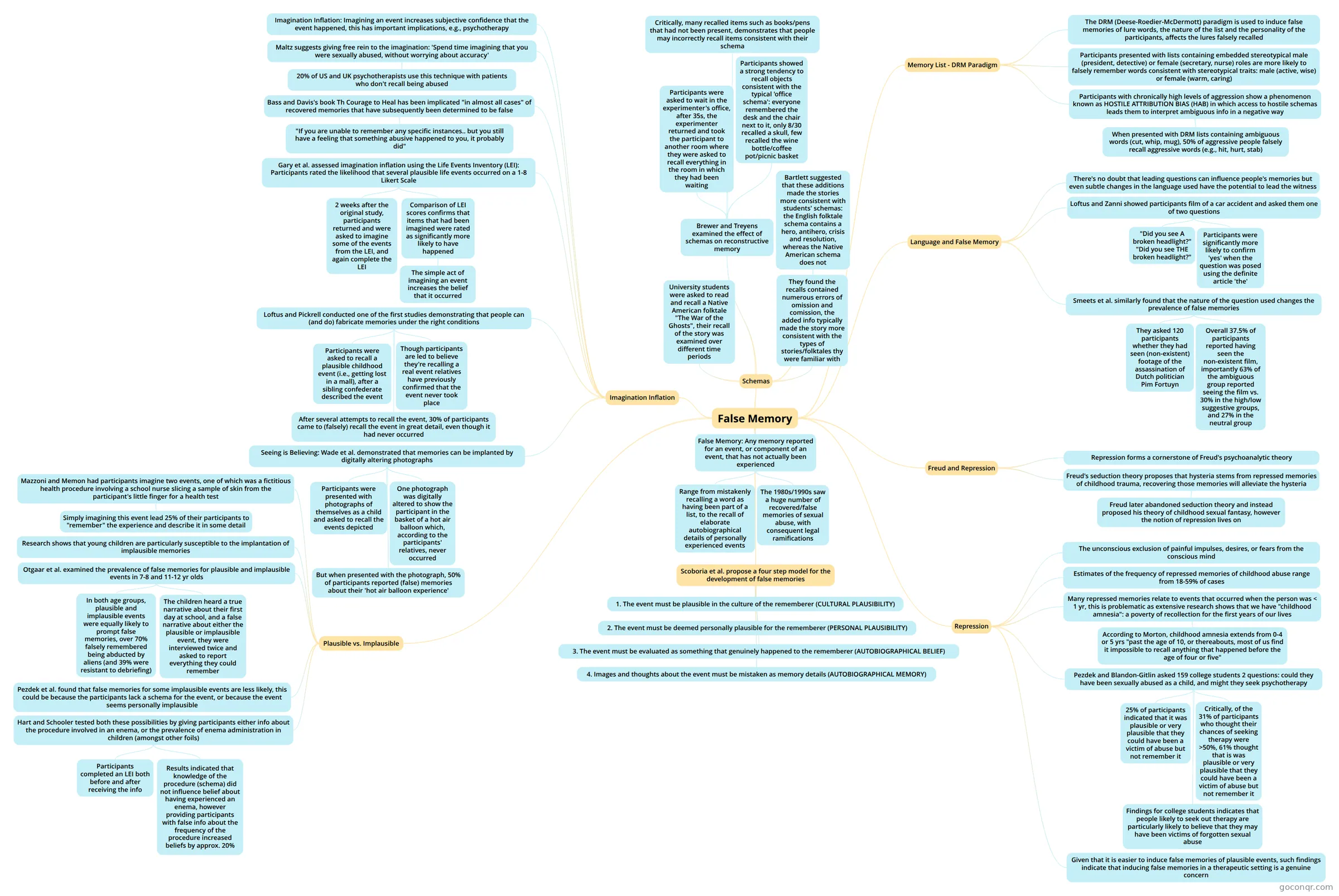
Mind map: False memory
Map content
False Memory
False Memory: Any memory reported for an event, or component of an event, that has not actually been experienced
- Range from mistakenly recalling a word as having been part of a list, to the recall of elaborate autobiographical details of personally experienced events
- The 1980s/1990s saw a huge number of recovered/false memories of sexual abuse, with consequent legal ramifications
Scoboria et al. propose a four step model for the development of false memories
- 1. The event must be plausible in the culture of the rememberer (CULTURAL PLAUSIBILITY)
- 2. The event must be deemed personally plausible for the rememberer (PERSONAL PLAUSIBILITY)
- 3. The event must be evaluated as something that genuinely happened to the rememberer (AUTOBIOGRAPHICAL BELIEF)
- 4. Images and thoughts about the event must be mistaken as memory details (AUTOBIOGRAPHICAL MEMORY)
Schemas
- University students were asked to read and recall a Native American folktale "The War of the Ghosts", their recall of the story was examined over different time periods
- They found the recalls contained numerous errors of omission and comission, the added info typically made the story more consistent with the types of stories/folktales thy were familiar with
- Bartlett suggested that these additions made the stories more consistent with students' schemas: the English folktale schema contains a hero, antihero, crisis and resolution, whereas the Native American schema does not
- Brewer and Treyens examined the effect of schemas on reconstructive memory
- Participants were asked to wait in the experimenter's office, after 35s, the experimenter returned and took the participant to another room where they were asked to recall everything in the room in which they had been waiting
- Participants showed a strong tendency to recall objects consistent with the typical 'office schema': everyone remembered the desk and the chair next to it, only 8/30 recalled a skull, few recalled the wine bottle/coffee pot/picnic basket
- Critically, many recalled items such as books/pens that had not been present, demonstrates that people may incorrectly recall items consistent with their schema
Memory List - DRM Paradigm
- Participants presented with lists containing embedded stereotypical male (president, detective) or female (secretary, nurse) roles are more likely to falsely remember words consistent with stereotypical traits: male (active, wise) or female (warm, caring)
- The DRM (Deese-Roedier-McDermott) paradigm is used to induce false memories of lure words, the nature of the list and the personality of the participants, affects the lures falsely recalled
- Participants with chronically high levels of aggression show a phenomenon known as HOSTILE ATTRIBUTION BIAS (HAB) in which access to hostile schemas leads them to interpret ambiguous info in a negative way
- When presented with DRM lists containing ambiguous words (cut, whip, mug), 50% of aggressive people falsely recall aggressive words (e.g., hit, hurt, stab)
Language and False Memory
- There's no doubt that leading questions can influence people's memories but even subtle changes in the language used have the potential to lead the witness
- Loftus and Zanni showed participants film of a car accident and asked them one of two questions
- "Did you see A broken headlight?" "Did you see THE broken headlight?"
- Participants were significantly more likely to confirm 'yes' when the question was posed using the definite article 'the'
- Smeets et al. similarly found that the nature of the question used changes the prevalence of false memories
- They asked 120 participants whether they had seen (non-existent) footage of the assassination of Dutch politician Pim Fortuyn
- Overall 37.5% of participants reported having seen the non-existent film, importantly 63% of the ambiguous group reported seeing the film vs. 30% in the high/low suggestive groups, and 27% in the neutral group
Freud and Repression
- Repression forms a cornerstone of Freud's psychoanalytic theory
- Freud's seduction theory proposes that hysteria stems from repressed memories of childhood trauma, recovering those memories will alleviate the hysteria
- Freud later abandoned seduction theory and instead proposed his theory of childhood sexual fantasy, however the notion of repression lives on
Repression
- The unconscious exclusion of painful impulses, desires, or fears from the conscious mind
- Estimates of the frequency of repressed memories of childhood abuse range from 18-59% of cases
- Many repressed memories relate to events that occurred when the person was < 1 yr, this is problematic as extensive research shows that we have "childhood amnesia": a poverty of recollection for the first years of our lives
- According to Morton, childhood amnesia extends from 0-4 or 5 yrs "past the age of 10, or thereabouts, most of us find it impossible to recall anything that happened before the age of four or five"
- Pezdek and Blandon-Gitlin asked 159 college students 2 questions: could they have been sexually abused as a child, and might they seek psychotherapy
- 25% of participants indicated that it was plausible or very plausible that they could have been a victim of abuse but not remember it
- Critically, of the 31% of participants who thought their chances of seeking therapy were >50%, 61% thought that is was plausible or very plausible that they could have been a victim of abuse but not remember it
- Findings for college students indicates that people likely to seek out therapy are particularly likely to believe that they may have been victims of forgotten sexual abuse
- Given that it is easier to induce false memories of plausible events, such findings indicate that inducing false memories in a therapeutic setting is a genuine concern
Imagination Inflation
- Imagination Inflation: Imagining an event increases subjective confidence that the event happened, this has important implications, e.g., psychotherapy
- Maltz suggests giving free rein to the imagination: 'Spend time imagining that you were sexually abused, without worrying about accuracy'
- 20% of US and UK psychotherapists use this technique with patients who don't recall being abused
- Bass and Davis's book Th Courage to Heal has been implicated "in almost all cases" of recovered memories that have subsequently been determined to be false
- "If you are unable to remember any specific instances.. but you still have a feeling that something abusive happened to you, it probably did"
- Gary et al. assessed imagination inflation using the Life Events Inventory (LEI): Participants rated the likelihood that several plausible life events occurred on a 1-8 Likert Scale
- 2 weeks after the original study, participants returned and were asked to imagine some of the events from the LEI, and again complete the LEI
- Comparison of LEI scores confirms that items that had been imagined were rated as significantly more likely to have happened
- The simple act of imagining an event increases the belief that it occurred
- Loftus and Pickrell conducted one of the first studies demonstrating that people can (and do) fabricate memories under the right conditions
- Participants were asked to recall a plausible childhood event (i.e., getting lost in a mall), after a sibling confederate described the event
- Though participants are led to believe they're recalling a real event relatives have previously confirmed that the event never took place
- After several attempts to recall the event, 30% of participants came to (falsely) recall the event in great detail, even though it had never occurred
- Seeing is Believing: Wade et al. demonstrated that memories can be implanted by digitally altering photographs
- Participants were presented with photographs of themselves as a child and asked to recall the events depicted
- One photograph was digitally altered to show the participant in the basket of a hot air balloon which, according to the participants' relatives, never occurred
- But when presented with the photograph, 50% of participants reported (false) memories about their 'hot air balloon experience'
Plausible vs. Implausible
- Mazzoni and Memon had participants imagine two events, one of which was a fictitious health procedure involving a school nurse slicing a sample of skin from the participant's little finger for a health test
- Simply imagining this event lead 25% of their participants to "remember" the experience and describe it in some detail
- Research shows that young children are particularly susceptible to the implantation of implausible memories
- Otgaar et al. examined the prevalence of false memories for plausible and implausible events in 7-8 and 11-12 yr olds
- The children heard a true narrative about their first day at school, and a false narrative about either the plausible or implausible event, they were interviewed twice and asked to report everything they could remember
- In both age groups, plausible and implausible events were equally likely to prompt false memories, over 70% falsely remembered being abducted by aliens (and 39% were resistant to debriefing)
- Pezdek et al. found that false memories for some implausible events are less likely, this could be because the participants lack a schema for the event, or because the event seems personally implausible
- Hart and Schooler tested both these possibilities by giving participants either info about the procedure involved in an enema, or the prevalence of enema administration in children (amongst other foils)
- Participants completed an LEI both before and after receiving the info
- Results indicated that knowledge of the procedure (schema) did not influence belief about having experienced an enema, however providing participants with false info about the frequency of the procedure increased beliefs by approx. 20%
- Mazzoni and Memon had participants imagine two events, one of which was a fictitious health procedure involving a school nurse slicing a sample of skin from the participant's little finger for a health test
Information
- Description
- PSY2COG (Psychology and the Law) Mind Map on False Memory, created by Steph M on 17/06/2017.
- Created by
- Steph M
- Views
- 0
- Rating