
Mind map
Calorimetry
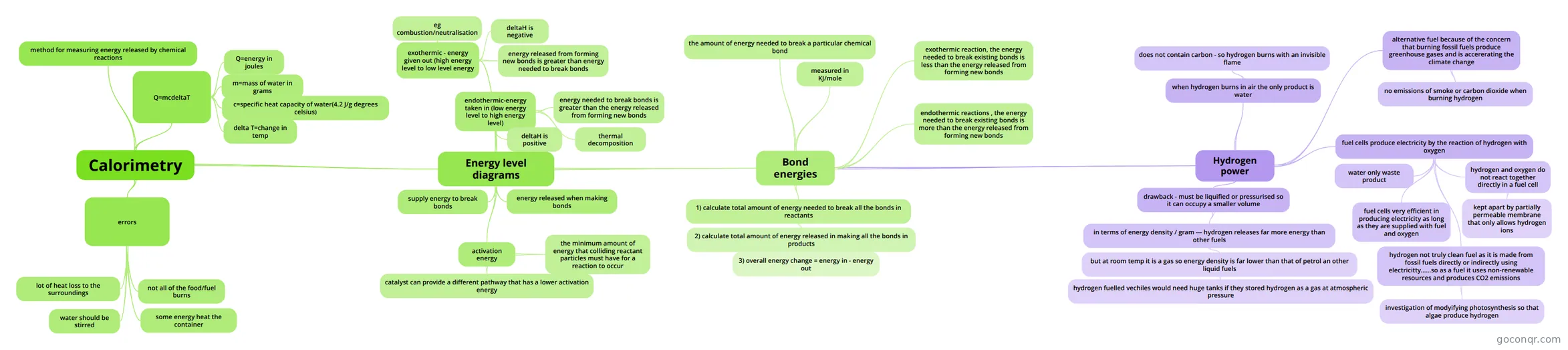
Mind map: calorimetry
Map content
Calorimetry
method for measuring energy released by chemical reactions
Q=mcdeltaT
- Q=energy in joules
- m=mass of water in grams
- c=specific heat capacity of water(4.2 J/g degrees celsius)
- delta T=change in temp
errors
- lot of heat loss to the surroundings
- not all of the food/fuel burns
- water should be stirred
- some energy heat the container
Energy level diagrams
- supply energy to break bonds
- energy released when making bonds
- exothermic - energy given out (high energy level to low level energy
- energy released from forming new bonds is greater than energy needed to break bonds
- eg combustion/neutralisation
- deltaH is negative
- activation energy
- catalyst can provide a different pathway that has a lower activation energy
- the minimum amount of energy that colliding reactant particles must have for a reaction to occur
- endothermic-energy taken in (low energy level to high energy level)
- energy needed to break bonds is greater than the energy released from forming new bonds
- deltaH is positive
- thermal decomposition
- Bond energies
- the amount of energy needed to break a particular chemical bond
- measured in KJ/mole
- 1) calculate total amount of energy needed to break all the bonds in reactants
- 2) calculate total amount of energy released in making all the bonds in products
- 3) overall energy change = energy in - energy out
- 2) calculate total amount of energy released in making all the bonds in products
- exothermic reaction, the energy needed to break existing bonds is less than the energy released from forming new bonds
- endothermic reactions , the energy needed to break existing bonds is more than the energy released from forming new bonds
- Hydrogen power
- when hydrogen burns in air the only product is water
- does not contain carbon - so hydrogen burns with an invisible flame
- alternative fuel because of the concern that burning fossil fuels produce greenhouse gases and is accererating the climate change
- no emissions of smoke or carbon dioxide when burning hydrogen
- drawback - must be liquified or pressurised so it can occupy a smaller volume
- in terms of energy density / gram --- hydrogen releases far more energy than other fuels
- but at room temp it is a gas so energy density is far lower than that of petrol an other liquid fuels
- hydrogen fuelled vechiles would need huge tanks if they stored hydrogen as a gas at atmospheric pressure
- but at room temp it is a gas so energy density is far lower than that of petrol an other liquid fuels
- in terms of energy density / gram --- hydrogen releases far more energy than other fuels
- fuel cells produce electricity by the reaction of hydrogen with oxygen
- water only waste product
- hydrogen and oxygen do not react together directly in a fuel cell
- kept apart by partially permeable membrane that only allows hydrogen ions
- fuel cells very efficient in producing electricity as long as they are supplied with fuel and oxygen
- hydrogen not truly clean fuel as it is made from fossil fuels directly or indirectly using electricitty......so as a fuel it uses non-renewable resources and produces CO2 emissions
- investigation of modyifying photosynthesis so that algae produce hydrogen
- when hydrogen burns in air the only product is water
Information
- Description
- A Levels Chemistry C3 Mind Map on Calorimetry, created by dpatel383 on 17/05/2013.
- Created by
- dpatel383
- Views
- 277
- Tags
- Rating