
Notes
THE CASES - GERMAN

Content of the notes (1)
Page 1
NOMINATIV
WHEN USED?
Used with SUBJECT of the sentence
Used with FORMS OF SIND e.g. BIN, BIST, IST, SIND, SEID, WAR, WARST, WART, WAREN
Used with FORMS OF WERDEN e.g. WERDE, WIRST, WIRD, WERDEN, WERDET, WURDE, WURDEN, WURDEST
ARTICLES IN THE NOMINATIVE CASE
DER, DIE, DAS, DIE
EIN, EINE, EIN, EINE
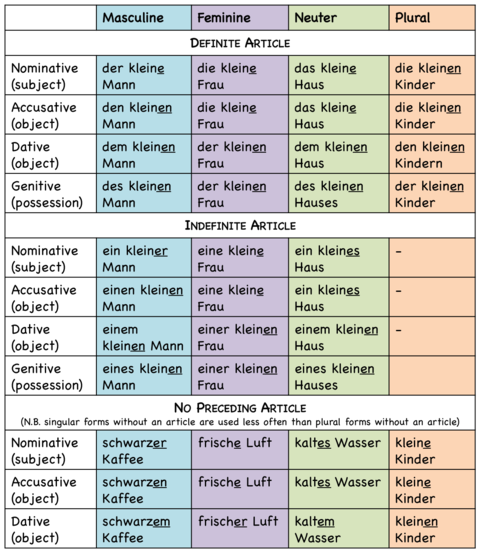
ADJECTIVAL ENDINGS IN THE NOMINATIVE CASE
DER -> +e DIE -> +e DAS -> +e DIE -> +en
EIN -> +er EINE -> +e EIN -> +es
NO ARTICLES
MASC. -> +er FEM. -> +e NEUT. -> +es PL. -> +e
http://www.youtube.com/watch?v=JXuHq1TcRYc (Embed)
AKKUSATIV
WHEN USED?
Used with DIRECT OBJECT (receiver of action)
Used when the nouns appears after the following PREPOSITIONS
DURCH - through, GEGEN - against, UM - around, BIS - until, FUER - for, OHNE - without, ENTLANG - along
Used with PREPOSITIONS IN MOVEMENT e.g.
IN - in, AN - on, onto, AUF - on, onto, UEBER - above, UNTER - under, NEBEN - next to, VOR - in front of, HINTER - behind, ZWISCHEN - between
Used with EXPRESSIONS OF TIME that have NO ARTICLE e.g.
Er kommt NAECHSTEN Sonntag, JEDEN Winter fahren wir Ski, DEN VIERTEN Juli
ARTICLES IN THE ACCUSATIVE CASE
The articles REMAIN THE SAME excluding the MASCULINE
DER -> DEN EIN -> EINEN
ADJECTIVAL ENDINGS IN THE ACCUSATIVE
DER -> +en EINEN -> +en NO ART. -> +en
http://www.youtube.com/watch?v=pYdalDbNLzI (Embed)
DATIV
WHEN USED?
Used as INDIRECT OBJECT of the sentence e.g. to whom or for whom
Used after certain PREPOSITIONS e.g.
AUS - out of, AUSSER - outside of, BEI - at, MIT- with, NACH - after, SEIT - since, VON - from, ZU - to, GEGENUEBER - across from, LAUT - according to
Used after STATIC PREPOSITIONS e.g.
IN - in, AN- on, at, AUF - on, UEBER - above, UNTER - under, HINTER - behind, VOR - in front of, ZWISCHEN - between, NEBEN - next to
ARTICLES IN THE DATIVE
DER -> DEM DIE -> DER DAS -> DEM DIE -> DEN
EIN -> EINEM EINE -> EINER EIN -> EINEM
ADJECTIVAL ENDINGS IN THE DATIVE
DER -> +en DIE -> +en DAS -> +en DIE -> +en
EIN -> +en EINE -> +en EIN -> +en
MASC. -> +em FEM. -> +er NEUT. -> +em PLU. -> +en
http://www.youtube.com/watch?v=b3OunCOWen4 (Embed)
GENITIVE
WHEN USED?
Used to show POSSESSION
Also used after the following PREPOSITIONS e.g.
AUSSERHALB - outside, INFOLGE - because of, (AN)STATT - instead of, TROTZ - in spite of, WAEHREND - during, WEGEN - because of
ARTICLES IN THE GENITIVE
DER -> DES DIE -> DER DAS -> DES DIE -> DER
EIN -> EINES EINE -> EINER EIN -> EINES
ADJECTIVAL ENDINGS IN THE GENITIVE
DER -> +en DIE -> +en DAS -> +en DIE -> +en
EIN -> +en EINE -> +en EIN -> +en
MASC. -> +en FEM. -> er NEUT. -> +en PLU. -> er
http://www.youtube.com/watch?v=XdkpJgtDq0o (Embed)
ARTICLES TABLES
ADJECTIVAL ENDINGS
NOMINATIV
AKKUSTIV
DATIV
GENITIVE
OTHER