
Notes
Radiation
Content of the notes (8)
Page 1
Radioactive Decay
Radioactive decay: The spontaneous decay of an unstable nucleus with the emission of one or more types of radiation.
There are different types of radioactive decay:
Alpha particles
Beta particles
Gamma rays
Electron capture
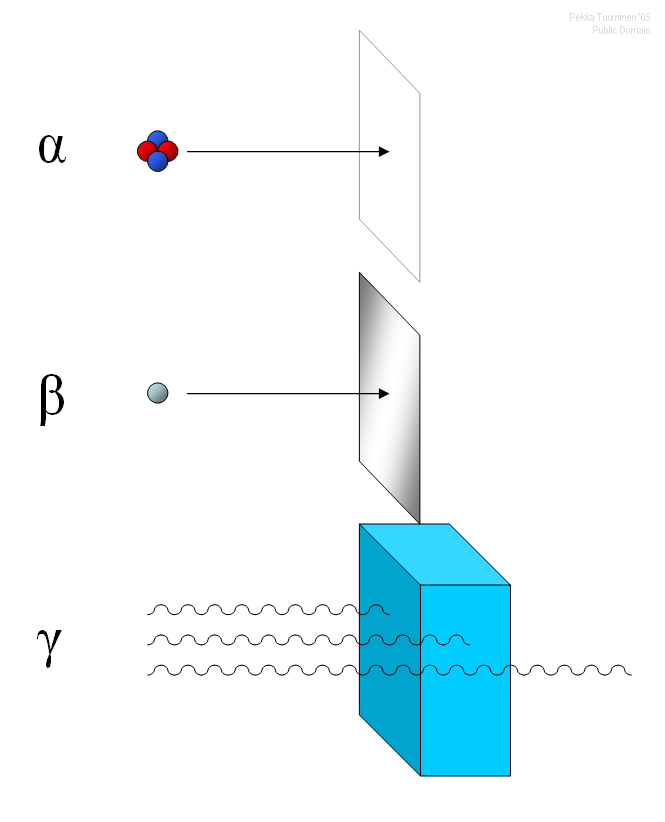
In general, for radioactive particles, the better they are at ionising particles around them, the easier they are to stop. This is because they lose energy as they ionise other particles, causing them to slow down.
In terms of ionising ability, Alpha particles > Beta particles > Gamma rays
In terms of penetrability, Gamma rays > Beta particles > Alpha particles
Page 2
Alpha Decay
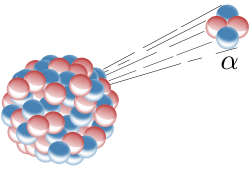
Alpha particles consists of two protons and two neutrons, the same as the nucleus of a helium atom.
Alpha particles have a charge of 2+ and therefore are deflected in electric and magnetic fields.
They can be written as \(\alpha \) or \(^4_2He\).
The release of an alpha particle reduced the atomic number of an atom by 2 and the mass number by 4. This means that the atom is a different element before and after the decay!
Alpha decay is written as follows:
\[^A_Z X \rightarrow ^{A-4}_{Z-2}Y + ^4_2 \alpha\]
For example, this equation describes the alpha decay of Thorium-90.
\[^{232}_{90} Th \rightarrow ^{228}_{88} Ra + ^4_2 \alpha\]
Because of their high speeds and high relative mass, alpha particles are good at ionising particles around them. They can be stopped by a sheet of paper or a few centimetres of air.
Page 3
Beta Decay
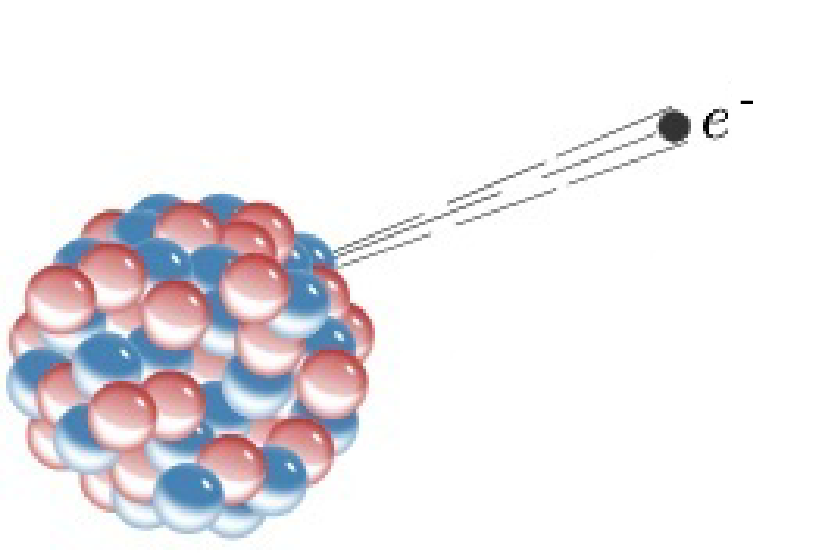
Beta particles consist of high speed, high energy electrons, released when a neutron decays into a proton and an electron.
When an electron is released, an anti-neutrino will also be released. An anti-neutrino can be represented as \( ^0_0 \bar \nu\) .
They can be written as \( \beta ^- \) or \( ^0_{-1}e \).
After beta decay, the atomic number of the atom will increase by one and the mass number will not change. Beta decay can be expressed as an equation as follows:
\[^A_Z X \rightarrow ^{A}_{Z+1}Y + ^0_{-1}e + ^0_0 \bar \nu\]
For example, this equation shows the beta decay of carbon 14:
\[^{14}_7 C \rightarrow ^{14}_{7}N + ^0_{-1}e + ^0_0 \bar \nu \]
Beta particles are less ionising than alpha particles. They will travel a few metres in air and can be stopped by a 3mm sheet of aluminium.
Because beta particles have mass and charge, they will be deflected in both electric and magnetic fields.
Page 4
Positron Decay
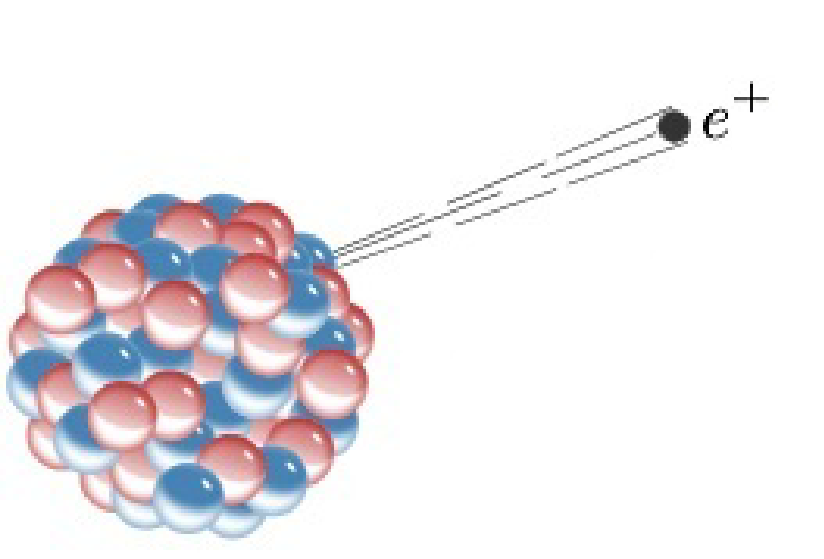
Positron decay involves the release of high speed, high energy positrons, released when a proton decays into a positron and a proton.
A positron has the same mass and as an electron, but has a charge of 1+ instead of 1-.
When a positron is released, a neutrino will also be released. A neutrino is represented as \(^0_0\nu\).
They can be written as \( \beta ^+\) or as \(^0_{+1}e\)
Positron decay can be written as follows:
\[^A_Z X \rightarrow ^{A}_{Z-11}Y + ^0_{+1}e + ^0_0 \nu\]
For example, this equation shows the beta decay of magnesium:
\[^{23}_{12} Mg \rightarrow ^{23}_{11}Na + ^0_{-1}e + ^0_0 \nu \]
Page 5
Gamma Rays
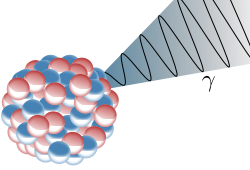
Gamma rays consists of high frequency electromagnetic waves.
They are not deflected in electric or magnetic fields.
Gamma rays are the least ionising type of radiation, making them the most penetrative.
They will travel a few kilometres in air – a thick sheet of lead or several metres of concrete is needed to stop them.
Gamma rays travel at the speed of light.
The release of gamma rays does not cause any change in the mass or atomic numbers of an element.
Page 6
Electron Capture
Electron capture is different to the other types or radiation – something enters the nucleus rather than being released from it.
An electron from the energy level closest to the nucleus falls into the nucleus, causing a proton to turn into a neutron, and a neutrino to be released.
This causes a cascade of falling electrons as electrons seek to fill empty lower energy levels.
One electron, moving in free space falls into the highest energy level.
This means that overall, the mass number does not change but the atomic number will decrease by one.
Page 7
Radiation in our lives
Risks associated with expose to radiation:
Alpha particles outside the body can be stopped by cloths / skin and are relatively harmless.
Alpha particles inside the body are very harmful as they are the most ionising.
Outside the body, beta particles and gamma rays are more harmful than alpha particles as the can penetrate into the body.
Everyday uses of radiation:
Beta particles, such as those from cobalt-60 are used in medicine to treat cancer.
Alpha particles, such as those from americium-241 are used in smoke detectors.
Industrial radiography cameras use gamma rays to examine places that are hard to reach or see. This can be used to examine welds for defects or irregularities.
Gamma rays are also used to sterilise medical equipment.
Page 8
Half-life
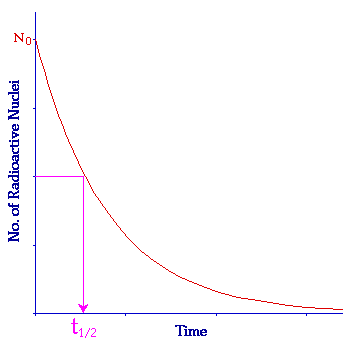
The half-life of a substance is the amount of time it takes for the amount of atoms in a sample of that substance to decay by half.
The more unstable a nucleus is, the shorter its half-life is.
Radioactive substances decay exponentially. This means that the rate of decay (The number of nuclei breaking down per unit time) is very high at first, and slows down as the amount of remaining nuclei decreases.
Information
- Description
- User has deleted their subject information Note on Radiation, created by Deleted user on 14/08/2017.
- Created by
- Deleted user
- Views
- 21
- History
-
- Created by Niamh Ryan · Aug 9, 2017
- Copied by Niamh Ryan · Aug 14, 2017
- Rating