
Notes
Soils Lecture
Content of the notes (12)
Page 1
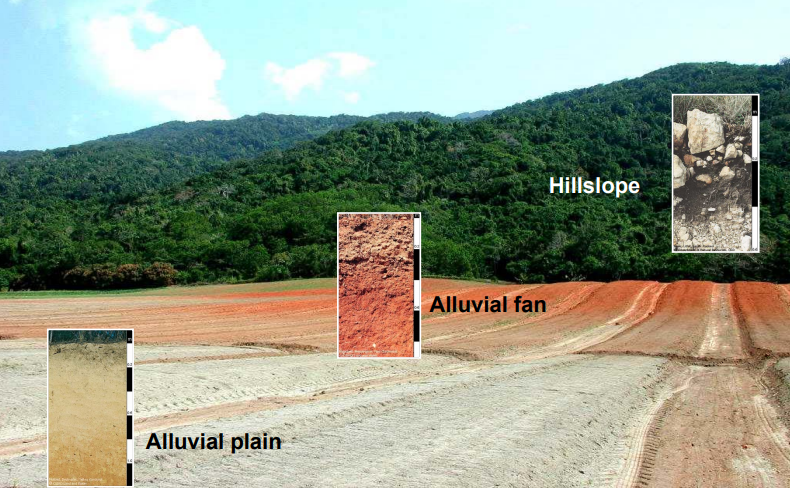
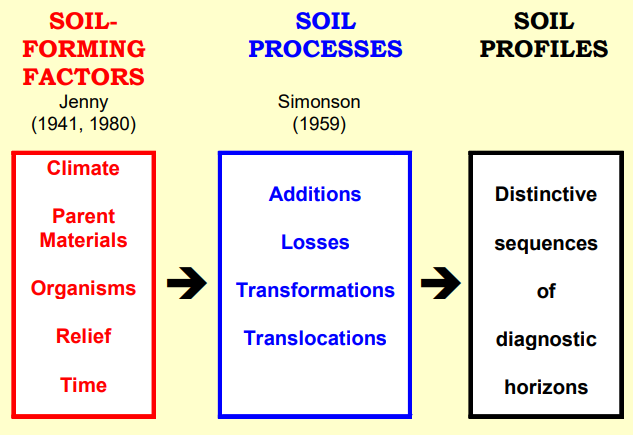
The properties of soils vary as a result of different combinations of five soil forming factors (climate, parent material, organisms, relief, time) occurring across the landscape
Page 2
Soil Processes
ADDITIONS:
Water as precipitation and runoff
Organic matter
Deposited sediments
N₂ from legumes
O₂ and CO₂ from the atmosphere
Salts in groundwater
LOSSES:
Soil by erosion
Water, nutrients, and elements by leaching
Water by transpiration
N₂ by denitrification
Carbon from organic matter
TRANSLOCATIONS:
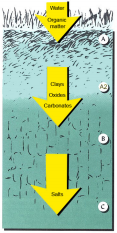
Clay, organic matter, carbonates, and oxides in leachates
Nutrients circulated by plants
Soluble salts in water
Soil moved by animals
TRANSFORMATIONS:
Mineral decomposition
Reduced particle size by physical weathering
Structure development
Clay and organic matter changes
Humus from organic matter
Page 3
Main Soil-Forming Processes:
water infiltration: rain or irrigation waters,
the addition of organic matter at the soil surface,
weathering and transformations of rockforming minerals in the soil parent material,
movement of clays, oxides, and carbonates and their accumulation lower in the soil profile,
leaching and loss of soluble salts from the soil profile.
Inert geological materials are turned into soil profiles by:
weathering: transformations and translocations of mineral matter,
accumulation of organic matter: plant and animal materials in the soil,
live organisms: in the soil converting biotic residues into plant nutrients.
Page 4
Soil horizons:
Layers approximately parallel with the earth’s surface.
Interrelated by processes of formation and degradation.
Soil profiles:
Complete vertical succession of soil horizons.
Continue down to: parent material, other consolidated substrate material, a selected depth (~2 m) in unconsolidated materials.
Page 5
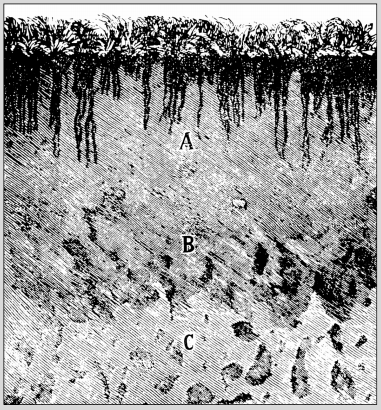
Soil Horizons:
Topsoil: (A horizon (A1, A2, A3 horizons))
zone of maximum biological activity.
the organically enriched surface horizon(s),
contain the bulk of the plant roots,
is the major entry point into the soil of air and water,
provides the chief nutrient reservoir in the soil.
Subsoil: (B horizon (B1, B2, B21, B22, …, B3, BC horizons))
zone of accumulation of clay, iron, etc.
the horizons in the soil profile below the topsoil, and above the soil parent material (i.e. above rock or deposited sediments).
Deep subsoil: (C horizon)
the weathered soil parent material.
Page 6
Properties of good soils:
Topsoil depth: 100 – 200 + mm
Soil profile depth: 1 - 2 m
Plant nutrient supply: organic and mineral
Beneficial (non-toxic) soil chemical properties
Good surface soil structure
Large pores: water entry, transmission, and drainage
Fine pores: water retention and storage for plant use
Approximately equal amounts of sand, silt, and clay: loam texture
Little gravel: few particles larger than 2 mm
Page 7
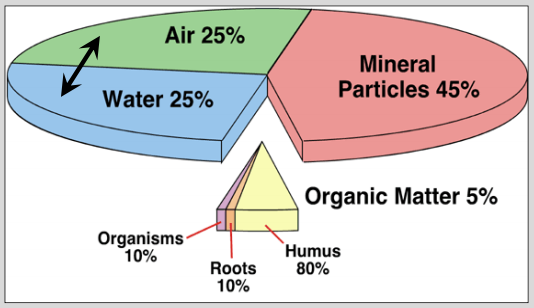
Soil Components:
equal parts of solid matter and holes.
Nearly equal proportions of air and water are best for plant growth.
Fluctuations in water and air contents occur as the soil dries or moistens.
Organic matter provides most of the naturally-occurring plant nutrients: living tissues and dead remains, Living soil microbes, Organic substances, such as “humus”
Soil organic carbon (SOC) x 1.72 = soil organic matter (SOM)
Page 8
Soil colours indicate:
soil moisture status: dark soil indicates soil is wet, OR, has a high soil organic matter content
organic matter content (i.e. soil fertility),
oxidation state of iron (i.e. profile drainage),
seasonal waterlogging
Red soils: contain hematite [Fe₂O₃], an oxidised iron oxide – good drainage and aeration,
Yellow soils: contain goethite [FeO(OH)], a hydrated iron oxyhydroxide – generally poorly drained,
Grey soils: iron leached out of the soil matrix, may be deposited as ironstone gravel in the soil – very poor drainage and/or seasonal waterlogging,
Mottles: strong iron redistribution – prolonged waterlogging,
Bleached A2 horizons: impeded drainage in subsoil.
Page 9
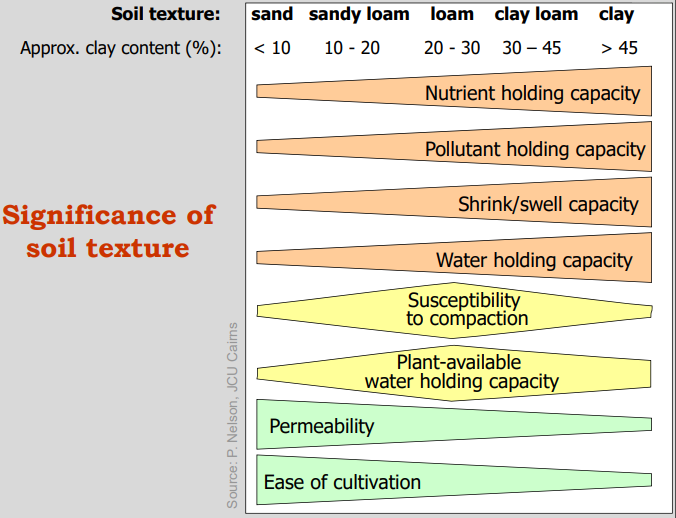
Soil Textures:
The sandy (light), weakly cohesive feel, and very short ribbon of a sandy soil.
Smooth, coherent feel, and slightly longer ribbon of a loamy soil.
Smooth, shiny, plastic, and long, flexible, self-supporting ribbon of a clayey soil (heavy).

Page 10
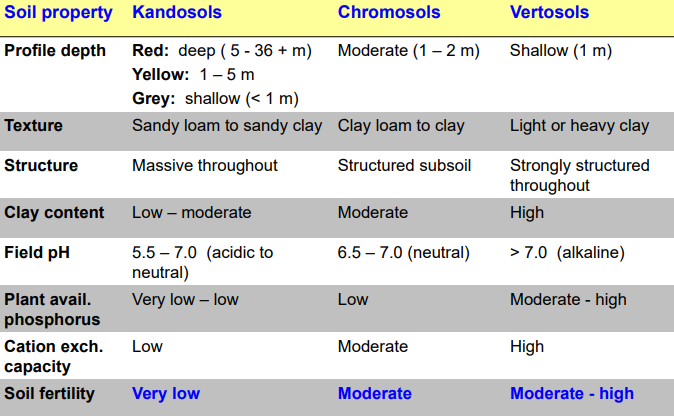
Characteristics of the Red, Yellow, and Grey Kandosols
sandstone and sandy sedimentary parent material;
non-calcareous profiles (i.e. well leached soils);
weakly differentiated soil horizons;
usually gradational texture changes down soil profiles; stable, massive structure and earthy fabric;
acid - neutral pH,
low cation exchange capacity,
low natural fertility.
Vertesols form cracks when dry and top soil falls through, gets mixed when wet (self turning soil)
Best fertility
Page 11
17 Elements essential for plant growth:
Macronutrients needed in large amounts:
H, C, O, N, P, K, Ca, Mg, S
Micronutrients (trace elements) needed in minor amounts:
Cl, Fe, B, Mn, Zn, Cu, Ni, Mo
Important to some plants:
Beneficial: Na, Co, Si
Undesirable: Al, Heavy metals (Cd, Pb, Hg, As, Cr, …)
Page 12
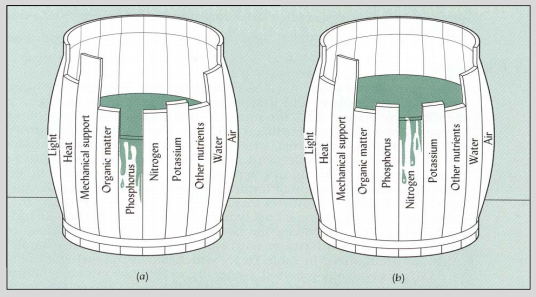
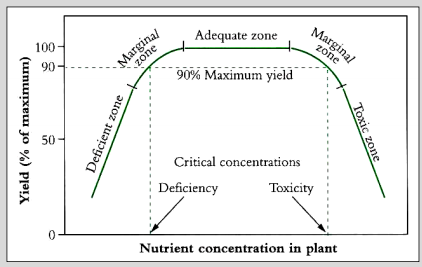
Yield-Law of minimum
Information
- Description
- TV1002 Note on Soils Lecture, created by Erika Cobb on 31/07/2019.
- Created by
- Erika Cobb
- Views
- 1
- Rating