
Soils
145 resources created by 123 users
This Soils page on GoConqr gathers community-made mind maps, flashcards, quizzes, notes and slide sets, from weathering and the rock cycle to soil orders, horizons and Irish brown earth soils. It's built for school students revising a topic, university students and professional candidates filling gaps, and teachers after ready-made material. There are over 140 resources here, including more than 10 quizzes and over 80 mind maps, pitched at secondary and university level. Pick a mind map, try a quiz to find your gaps, then build your own.
Top Soils resources
-
Mind map Chapter 2- Weathering and Soil
-
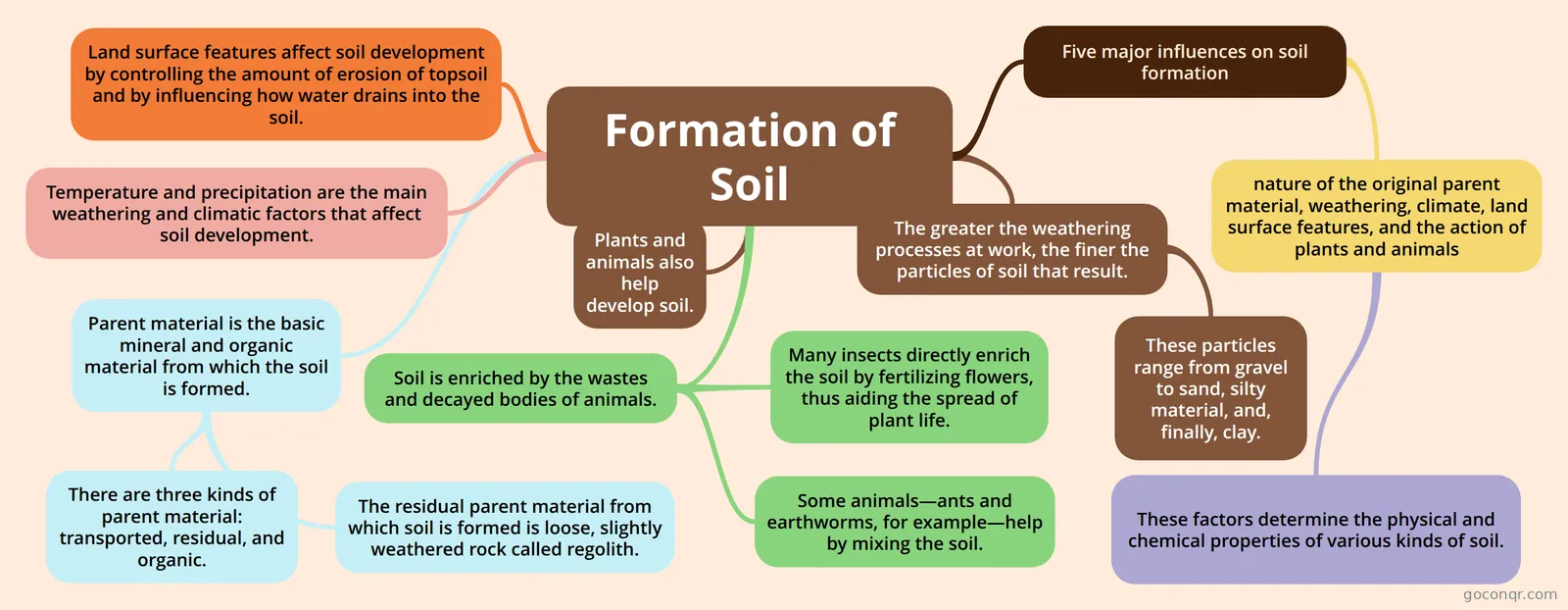 Mind map Formation of Soil this will take you through the whole process of formation of soil
-
104 questions1_EVSC 421
-
54 cardsSoils What are soils made up of?
-
60 questionsENVE 432 What are the major land uses:
-
34 questionsRen R 441 Midterm 1
-
93 questionsSoil Science Quiz Units 1-8 What is the driving force of an ecosystem?
-
124 cardsESS 230 exam 1 Part of rock cycle we are studying
Quizzes
See all 20 quizzes-
104 questions1_EVSC 421
-
60 questionsENVE 432 What are the major land uses:
-
34 questionsRen R 441 Midterm 1
-
93 questionsSoil Science Quiz Units 1-8 What is the driving force of an ecosystem?
-
46 questionsText#2 SCSC301
-
18 questionsRen R 441 - Post MDII Soils
-
23 questionsExam 1 Study Guide
-
15 questionsGeological Engineering What does an increase in void ratio do?
Mind maps
See all 84 mind mapsFlashcards
See all 31 flashcards-
54 cardsSoils What are soils made up of?
-
124 cardsESS 230 exam 1 Part of rock cycle we are studying
-
133 cardsSOSC WHAT IS PEDOLOGY
-
82 cardsExam #3 Flashcards section of the soil extending vertically through all its horizons and into the parent material
-
40 cardsSoil Science Final - Flashcards Microbial symbiont with grasses
-
22 cardssoil classifications 4 ways of soil formation - Transformatin
-
22 cardsSoil Science Chapter 3 What is a soil pedon?
-
30 cardsOther need to know
Flowcharts
Notes
-
Soils Lecture The properties of soils vary as a result of different combinations of five soil forming factors (climate, parent material, organisms, relief, time) occurring across the landscape Soil Processes ADDITIONS: Water ...
-
Soils - created from Mind Map Soil components Physical properties of soil Soild phase
-
Soil - created from Mind Map Define Properties soil Profile
-
soil soil definiton found on the surface of earth provide dynamic substrate for pant growth onsist of minerals organic matter organisms and water and air imprtance filter and reserve water media for macr...
-
Soils Soil=mixture of minerals and living thingsCommon soil type in Ireland=brown earth soilsSoil is a natural resource5 Ingredients=mineral matter,humus,organisms,water,airLeaching=When the ground becomes waterlogged and t...
Slides
Topics in Soils
More Geology and earth sciences topics
About Soils
GoConqr OriginalWhat the Soils resources cover
Most of this page is mind maps, and they follow the way soil is usually taught. The map on weathering and soil starts with minerals, rocks and the rock cycle, then moves on to weathering and erosion. Others look at the Formation of Soil, which lists five major influences: parent material, weathering, climate, land surface features, and the action of plants and animals.
Where to start
- Begin with Formation of Soil to see the five influences in one view.
- Read Soil Characteristics, which covers texture, water retention, drainage and leaching.
- Move to SOIL DESCRIPTION for pedogenic processes, soil profiles and the definition of soil.
- Finish with the Soil Orders slide set, which describes groups such as Alfisols, and the Gelisols mind map.
Using quizzes, maps and flashcards together
Read a map first, then test yourself. Flashcard decks such as Weathering and Soil Orders drill the key terms, including mechanical and chemical weathering, humus and topography. Quizzes then show what has not stuck. The page also lists a quiz on Chernozem and Solonetz colours and a quiz on soil orders, which suit later revision.
Some resources are local in focus. The Irish Soils and Brown Earth Soils mind maps may suit school students who need a regional example. Others read more like university lecture notes, such as the lecture on evaluation of land.
Where Soils sits
Soils belongs to the Surface Processes and Landscapes strand of Geology and earth sciences. It links weathering, rock types and climate to the ground we see. Work through the resources in order, or jump to the gap you know you have.
Choose one mind map today, then try a quiz and see which ideas you can already explain.
Frequently asked questions
Which resource should I open first?
Start with the Formation of Soil mind map. It sets out the five main influences on soil formation: parent material, weathering, climate, land surface features, and plants and animals. Once that is clear, the Soil Characteristics map and the Soil Orders slide set are natural next steps.
What do the mind maps cover?
There are over 80 mind maps. They cover minerals and rocks, the rock cycle, weathering and erosion, soil formation, texture, horizons, soil orders such as Gelisols, salinization, and Irish brown earth soils. Some are short overviews, while others follow lecture content more closely.
Are the resources free to use?
Yes. Every resource listed here is free to open, study and take, with no account needed. A free account also saves your quiz scores and lets you make your own quizzes, mind maps, flashcards and notes. All the resources were made by GoConqr users, not by GoConqr.
Who are these resources for?
They suit school students revising a topic, university students and professional candidates filling gaps, and teachers looking for ready-made material. The mix is mostly secondary and university level, so you may find both simple overviews and more detailed lecture-style content.
Is there anything for Irish soils?
Yes. The page lists an Irish Soils mind map and several on Brown Earth Soils. They are useful if you want a local example alongside the general material on soil formation, characteristics and classification.
What if I cannot find the topic I need?
Try nearby terms such as weathering, soil orders, soil horizons or soil characteristics, since many resources overlap. If a gap remains, you can make your own mind map, flashcards or quiz and keep it for revision.