
Notes
Topic 4d: Sound
Content of the notes (7)
Page 1
Sound: a vibration moving in space, AKA a wave.
All waves have: frequency, wavelength, period, and amplitude.
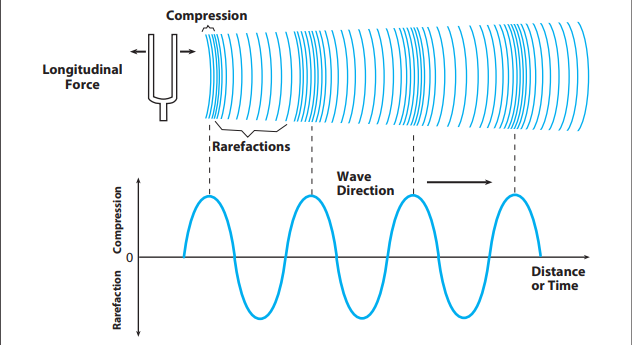
Sound is an example of longitudinal waves.
Longitudinal waves: waves generated by a disturbance that moves parallel to the direction of motion of the wave.
Sound waves are generated by the motion of molecules or particles of a medium vibrating back and forth in a direction parallel to the direction of wave motion.
The molecules alternate between compression and rare faction (being separated at distances greater than normal spacing).
The movement of sound requires molecules in a medium.
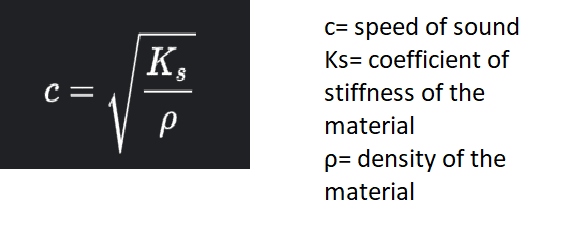
The speed of sound waves is directly correlated to the space between the molecules in the medium; The further apart the molecules, the slower the speed of sound through the medium.
Thus, the speed of sound is greatest through solids and slowest through gases.
speed of sound is calculated -->
Page 2
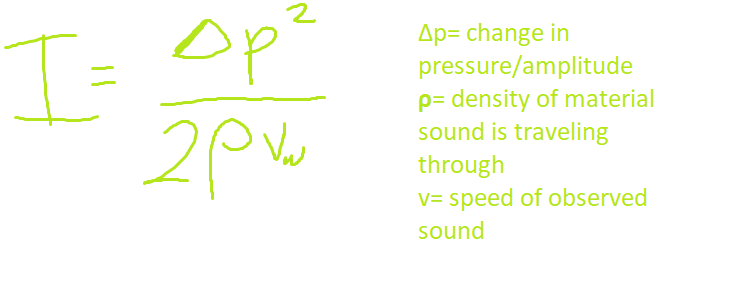
Sound intensity (I): the rate of energy transported by a sound wave per unit area perpendicular to its direction of motion-->
sound intensity depends on frequency, amplitude, density of the medium, and wave velocity. Frequency is a constant determined by the wave source. Amplitude and wave velocity are directly proportional to the intensity.
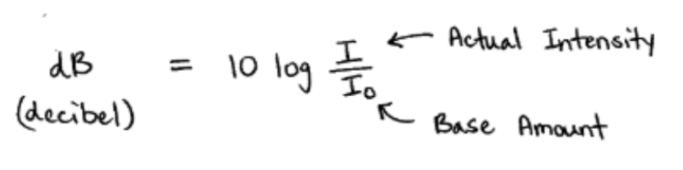
sound intensity in terms of decibels -->
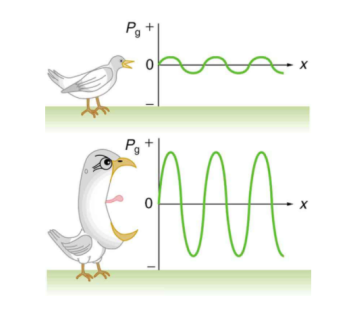
The larger the sound wave oscillation, the more intense the sound
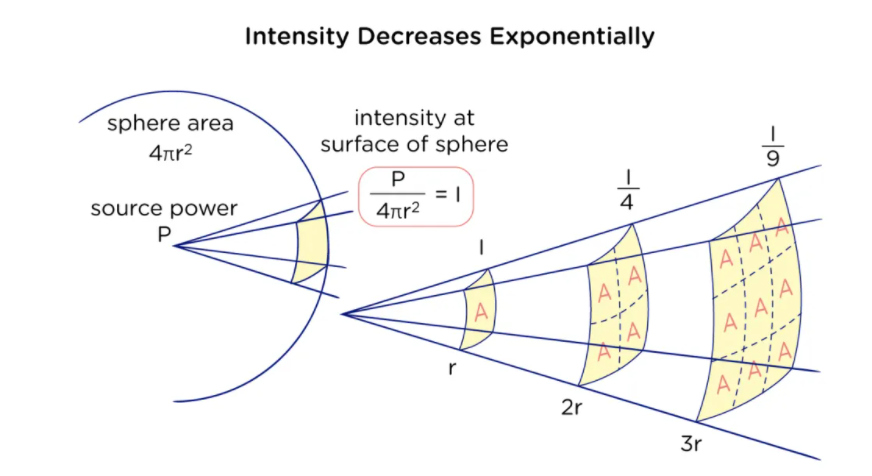
Sound intensity decreases with increasing area; intensity is inversely proportional to area-->
Beats: produced during interference by sound waves at slightly different frequencies.
The beat frequency is equal to the difference in the frequencies of the individual sound waves --> fbeat = f1 − f2
Page 3
Resonance: energy is absorbed by an object when the amplitude of an object’s motion increases as a result of a periodic, external force striking the object with a frequency equal to the natural frequency of the object.
The mechanical structure will experience maximum vibration and maximum displacement amplitudes when an outside driving force is applied at the resonant frequency.
In a non-ideal situation, energy is lost to damping at the resonant frequency and must be replaced by some outside driving force at the same frequency.
A small amplitude driving force can produce large amplitude motion.
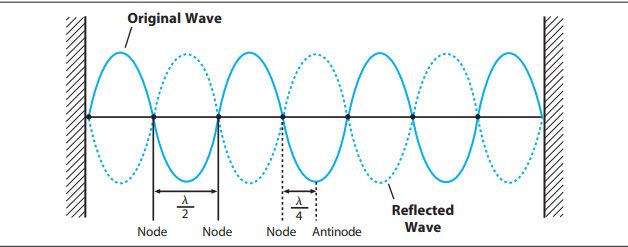
A string resonates (vibrates) at its natural/resonant frequency due to standing waves.
The relationship between wavelength, frequency, and wave velocity can be used to find the resonant frequency for any given wavelength that creates a standing wave.
Natural/Resonant frequency: the specific frequency at which an object vibrates
Applications of resonance: Analysis of structure failure in response to natural disasters; MRI technology, lithotripsy of kidney stones; the tonal qualities of certain string and brass instruments.
Standing wave: generated on a stretched string that has at least one end connected to a rigid surface or a pipe with at least 1 open end. The string vibrates as a result of the wave reflecting, inverting, and continuing back and forth across the string while it propagates towards the fixed end
strings generate transverse waves while pipes generate longitudinal waves
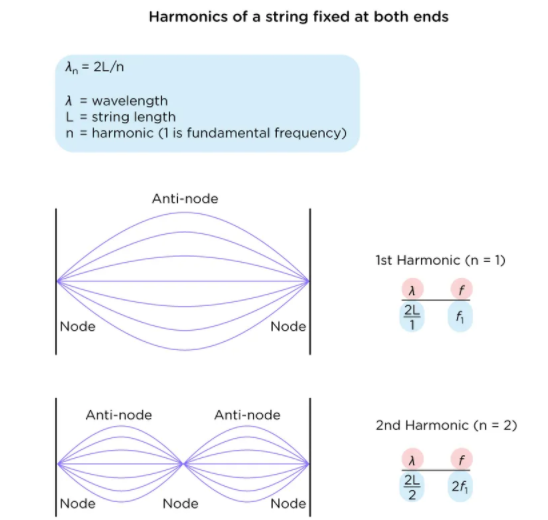
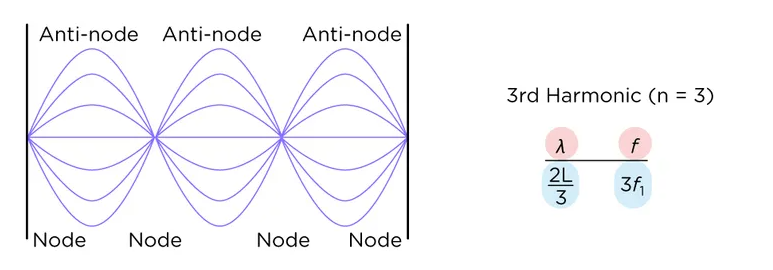
string with both ends attached:
each of the ends is a node: the points with no displacement from the horizontal axis; they do not vibrate
string with only 1 end attached:
the end that is not attached is the antinode: the points maximally displaced from the horizontal axis; The peaks and valleys of each wave. This end is able to vibrate, unlike a node, because it is unattached.
its displacement is equal to the amplitude of the wave
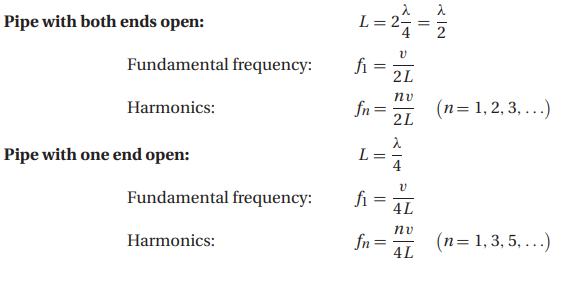
Closed air tubes: tubes closed at one end and open at the other
the molecules near to the closed end cannot oscillate, so the closed end is the node for particle displacement.
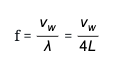
The frequency of a wave in a closed air tube is equal to the speed of sound in air divided by the wavelength -->
wavelength for closed tubes is --> λ=4L
L is the length of the tube/string
the distance from the node to the antinode is 1/4 of the wavelength -->λ/4
Page 4
Pitch: what we hear is actually the frequency (number of waves/unit time) of a sound wave. It is also used to describe how the frequency of the sound wave is perceived by an observer.
High pitch: high frequency, short wavelength
low pitch: low frequency, long wavelengths
Frequency is measured in units of cycles per second; For sound waves the most common unit is Hertz. Humans can perceive sounds with frequencies between 30 and 20,000 Hertz.
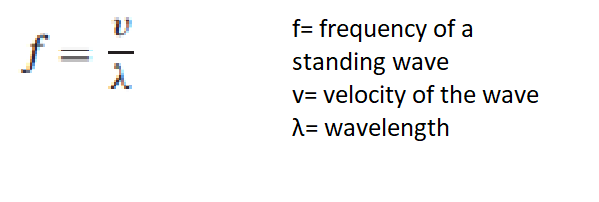
Frequency is dependent on wavelength and the speed of sound; It is calculated -->
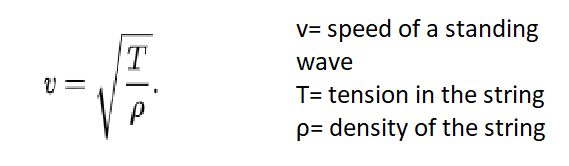
Speed of a standing wave is proportional to the total root of the string tension divided by string density -->
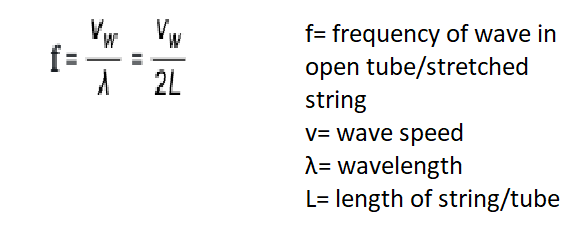
Open air tubes: tubes open at both ends; these end up having an anti node at both end since both ends are open. Equivalent to a stretched string with both ends secured to a rigid surface
the distance from the node to the antinode is 1/2 of the wavelength -->λ/2
wavelength for open tubes is --> λ=2L
L is the length of the tube/string
The frequency of a wave in an open air tube is equal to the speed of sound in air divided by the wavelength -->
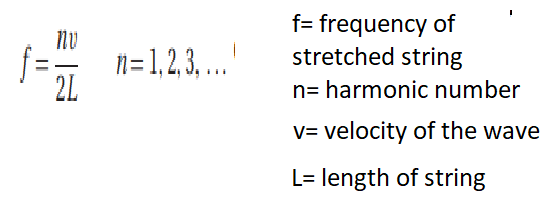
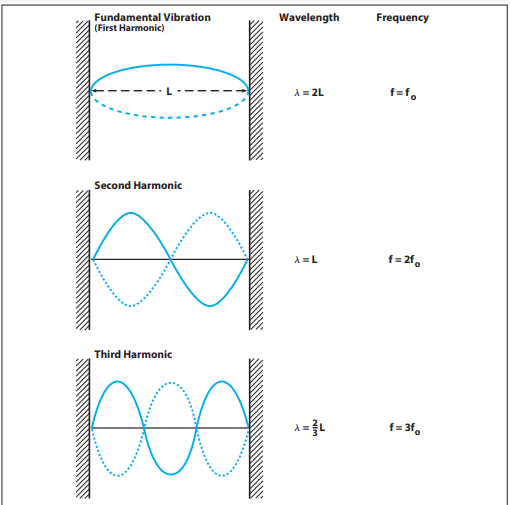
this is also known as the fundamental frequency: AKA the first harmonic; This is the lowest frequency that the string can accommodate.
The second harmonic frequency and harmonic frequencies onward can be determined from the following relation-->
Page 5
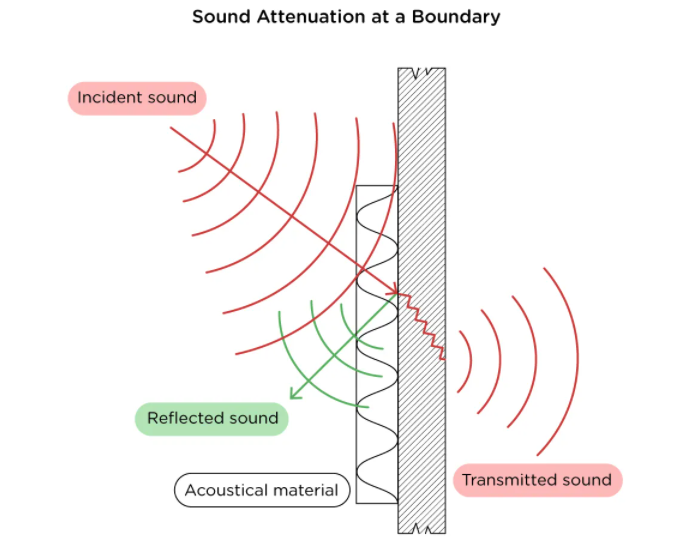
attenuation: also known as damping, this is a gradual reduction in the intensity of a sound wave, and a subsequent loss of sound energy as a result of -->
scattering: As the sound wave propagates from its source, it undergoes diffraction as it spreads across a wider and wider area, thereby losing its intensity.
absorption: Sound waves transfer portion of their energy, because sound is a form of energy, as they collide with surrounding molecules in their path; This includes air molecules.
reflection: sound wave bounces back off an obstacle while propagating
loss of wave energy is most evident in reduced amplitude.
Page 6
Doppler effect: a shift in the frequency of the transmitted sound caused by a change in the distance between the source of the sound and the observer.
If the source is moving towards the observer, the observer perceives an increase in the sound frequency.
If the source is moving away from the observer, the observer perceives a decrease in frequency.
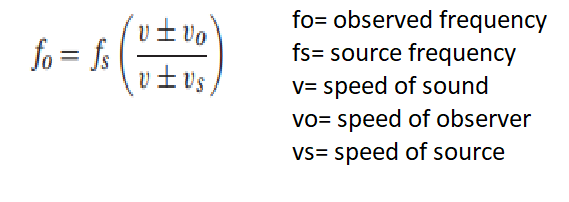
the plus minus signs in the below equation will be determined by the above 2 rules (i.e. if the source is moving towards a fixed observer, there should be a minus sign in the denominator, because we want the numerator to be greater for the frequency to be larger).
In general, movement of the source and observer towards each other will result in greater perceived frequency, while movement away from each other will result in decreased perceived frequency.
Doppler shifted frequency: the altered frequency detected by the observer; applicable to light, sound, and water waves.
Page 7
Ultrasound: a region of sound frequencies above the range audible to the human ear.
The range audible to the human ear is 20 Hertz to 20 kilohertz.
Ultrasound frequencies range from 20 kilohertz to 20 megahertz.
Ultrasound has many applications in medicine --> echocardiograms, ultrasounds during pregnancy, characterizing tissue.
its detection abilities are limited by its wavelength; it cannot detect details that are significantly smaller than its wavelength.
ultrasound is used to create images using reflection and transmission techniques. When an US wave encounters a boundary (transition from fat to muscle or muscle to bone), part of the wave is transmitted and part of it is reflected. The reflected rays are detected and used to construct an image of the object.
Sonar (Sound navigation and ranging) is a technique that utilizes the reflecting properties of sound waves to determine the depth of the ocean.
This technique is used both by ships and by certain animals such as dolphins and bats for navigation.
In animals, ultrasound waves are sent out and then reflected off the objects around the animal; The animals then use the reflected sounds to form a picture of their surroundings (echolocation).
Ships use sound waves to navigate by transmitting sound waves and measuring the time between the transmission and receiving the reflection
Shockwaves: develop when the speed of an object is greater than the speed of sound as a result of constructive interference.
The sounds from an approaching source are mixed with those from the source receding, resulting in the creation of a shockwave.
The shockwave can also be created by the superposition of similar sound waves arriving simultaneously.
A shockwave occurs along the surface or edge of the cone, resulting in a large decrease in air pressure, and a large increase in sound wave amplitude.
Shock waves are visible because of the sudden decrease in air pressure causes water molecules in the air to condense.
Wavefronts generated by the object surpass the position of the source, resulting in a cone shaped formation of successive wavefronts known as a Mach zone.
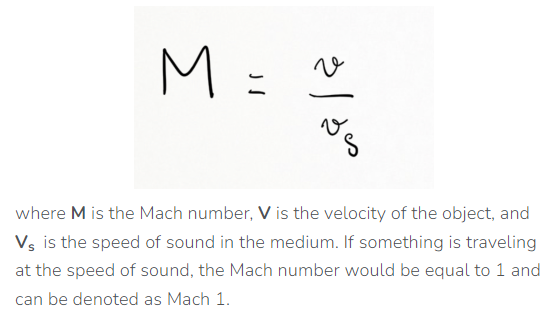
An object’s Mach number is the ratio of an object speed in relation to the speed of sound -->
Information
- Description
- Note on Topic 4d: Sound, created by 000 000 on 17/03/2022.
- Created by
- 000 000
- Views
- 1
- Rating