
Notes
Stationary Waves

Content of the notes (2)
Page 1
Progressive Waves Reflected at a Boundary Can Create a Stationary Wave
A stationary or standing wave is the superposition of two progressive waves
with the same frequency (wavelength) moving in opposite directions.
No energy is transmitted by
stationary wave
For most frequencies the
resultant pattern is difficult to detect. However, if the the oscillator
happens to produce an exact number of waves in the time it takes to get a
wave to the boundary and back to the starting point, the original and
reflected waves reinforce eachother
At these resonant
frequencies, a stationary wave occurs, where the pattern remains unmoved.
Stationary Waves in
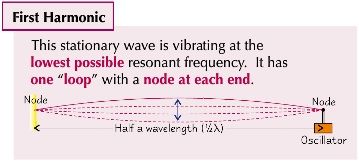
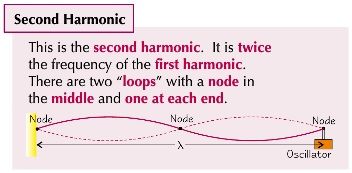
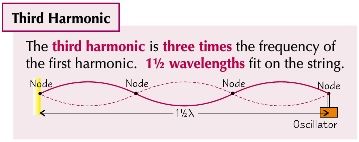
Strings Form Oscillating Loops Separated by Nodes
Each particle vibrates at right
angles to the string. Nodes are where the amplitude of the vibration is zero.
Anti nodes are points of maximum amplitude. At resonant frequencies, an exact
number of half wavelengths fits onto the string.
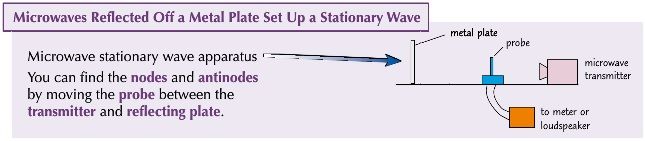
Stationary waves
can be demonstrated with microwaves and sounds

Page 2
Factors Affecting Resonant Frequencies of A
String Can Be Investigated
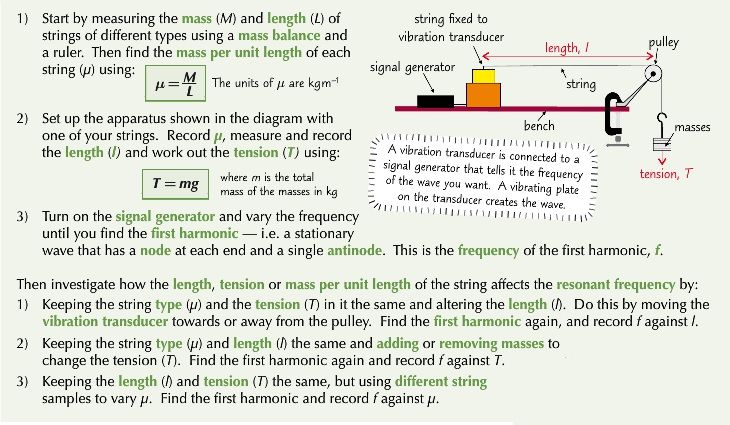
The following conclusions can be drawn from the experiment:
1. The longer the string, the lower the resonant frequency
2. The heavier the string (i.e. the more mass per unit length), the lower the resonant frequency. For a given length, a lower wave speed, c, makes a lower frequency, f.
3. The looser the string, the lower the resonant frequency

Information
- Description
- A2 Physics Note on Stationary Waves, created by Leonie Jenkins on 06/01/2017.
- Created by
- Leonie Jenkins
- Views
- 2
- Rating