
Notes
Birdsong Lecture 7
Content of the notes (3)
Page 1
Bird song
Aims
•Be able to describe the three
neuronal pathways involved in birdsong
•Be able to explain and evaluate how
the learning of birdsong is investigated
•Be able to explain the findings of
Thorpe’s early experiments
•Be able to explain the stages of
song development and appreciate how it differs
•Be able to explain Marler’s observation on how birds
crystallize their songs and link this to neuronal changes
•Be able to explain Konishi’s key experiments on auditory
feedback
•Explain and evaluate the idea of
templates, and the differences between them.
•Use examples of electophysiological experiments support as support for
templates
What is bird song
•Spontaneous whistles, chirps,
complex songs
•Communication – defending
territory, attracting a mate, finding conspecifics, identifying individuals and
their background.
•4000 of the 9000 species of birds
can sing. These are in the order Passeriformes (passerines) or perching birds.
•Song repertoires can range from 1
song (white-crowned sparrow) to several thousand (brown thrasher)
•Bird song is both species specific,
and modified to the individual (dialects).
•Mostly, only male birds sing.
Why is it important to understand how birds learn songs
There are similar parts of the brain used to learn language and birdsong. Both have a sensitive critical period where observed behaviour is learnt. There are similarities in stages of development and experience is vital for both. Auditory feedback is key for both whilst learning how to make sounds and they are reinforced by social interaction. On the other hand bird songs are not as complex as language
Birds are a good research model as they are accessible , easily reared amd songs can be recorded, manipulated and analysed.
•Be able to describe the three neuronal pathways involved in birdsong
1.Auditorypathwaytohearingbirdsong.
Auditorynoise
2.Anteriorforebraipathway Neurons within the Higher vocal center and send projections to DLM to LMAN , RA
3.Song motor/production pathway (posterior vocal pathway)
HVC-RA-respiratory control and nXIIts
Syrinx and sound production
Muscular tension modulates the vibrations and sound made.
1.Air comes from air sacs not lungs
2.Body wall muscle expels air from air sacs
3.Air movement causes tympaniform
membranes to vibrate creating sound waves
4.Internal and external syringeal
muscles alter tension of tympaniform membrane altering frequency of
vibrations
•Be able to explain and evaluate how the learning of birdsong is investigated
Originally people tried to write birdsongs as music
Thorpe developed the time frequency sound spectrogram also known sonogram.
The
terms ‘note’ and ‘element’ are interchangeable – and refer to the most basic
unit of the song – a continuous sound in the spectrogram that may contain many
frequencies. Notes are grouped into syllables, and these in turn are grouped
into phrases. Different sorts of phrases have descriptive names like ‘whistle’,
‘trill’ and ‘buzz’. A phrase can consist of just a single syllable or even a
single note.
Do birds learn from others
He reared chaffinch bird eggs in isolation in sound proof boxes so he could control the sounds. He would play a tune on a speaker called the teacher song.
1. He would play an adult birdson for the juvenile and see if the juvenile was able to play the song in the future. The experiment found that they had very similar sounding song practically identical.
2. When the chaffinch is kept in complete sound isolation it still sings a song but it is not similar to the original species song. When analysing the sonogram it has similar sounds but they are not completely identical. The song is not refined.
3. If the chaffinch is kept in isolation and is given a tree pipit bird species song , there are similarities between the chaffinch and tree pipit song which shows that it did have an effect on the song produced.
This research suggests birds have an innate template, young birds also have a preference for their own species. If a bird did not have a tutor during the critical period it is unable to reproduce the song.
•Be able to explain Marler’s observation on how birds
crystallize their songs and link this to neuronal changes
He used finches sparrows and caries. Young birds heartbeat increases.
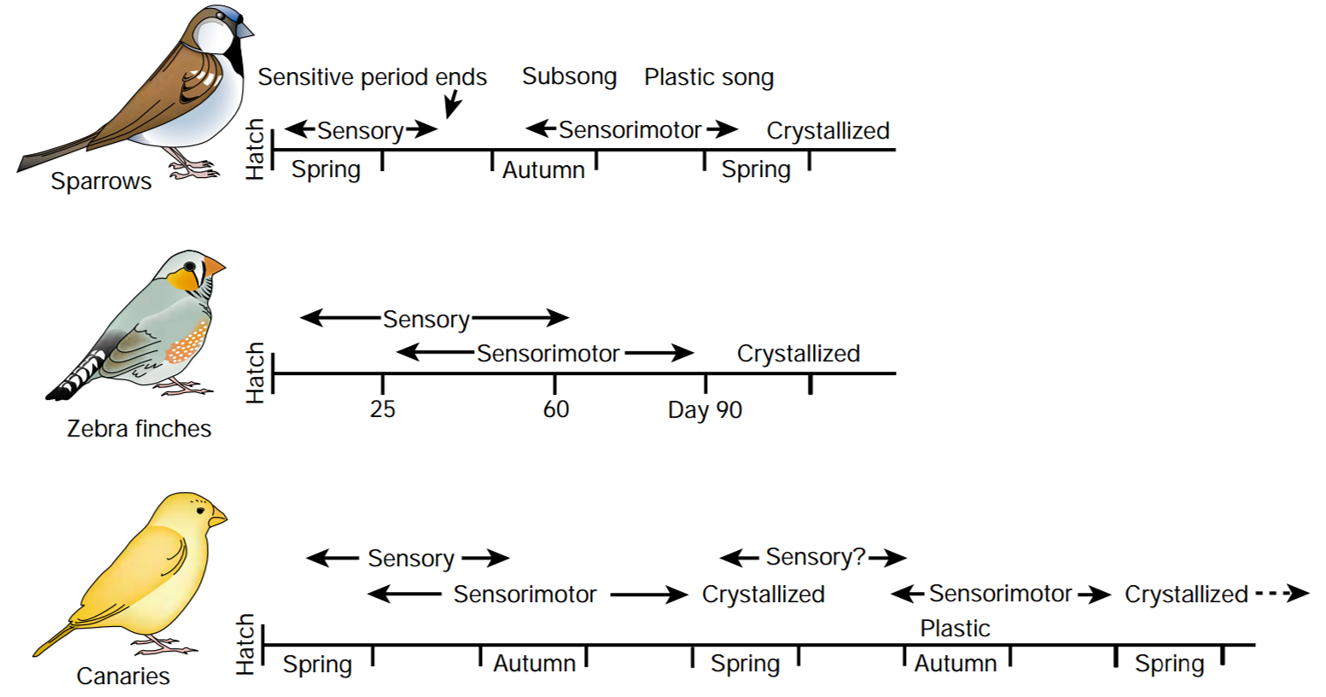
There are 3 stages of song development. If a bird hatches in spring it is in the sensory phase were it listens to tutor song. In the sensorimotor phase can be split into subsong which is a soft variable rambling syllables and plastic song which is rehearsaa;, syllables and phrases of tutor song start to become recognisable.
The last phase is the crystallized phase where the song has characteristic volume, duration, syllables and phrase order of species specific turor song. Song remains unchanged but there are species differences.
In zebra finches the sensory and sensorimotor phases overlap. Canaries seems to be able to learn new songs after another spring. There is question as to whether they are remembering old songs or learning new ones.
In theauditory and anterior pathway is active at hatching causing the sensory phase suggesting a combination of learning and hearing and the senorimotor pathway instgates the song motor production pathway when it actually begins to sing.
Stopped at 4-.21
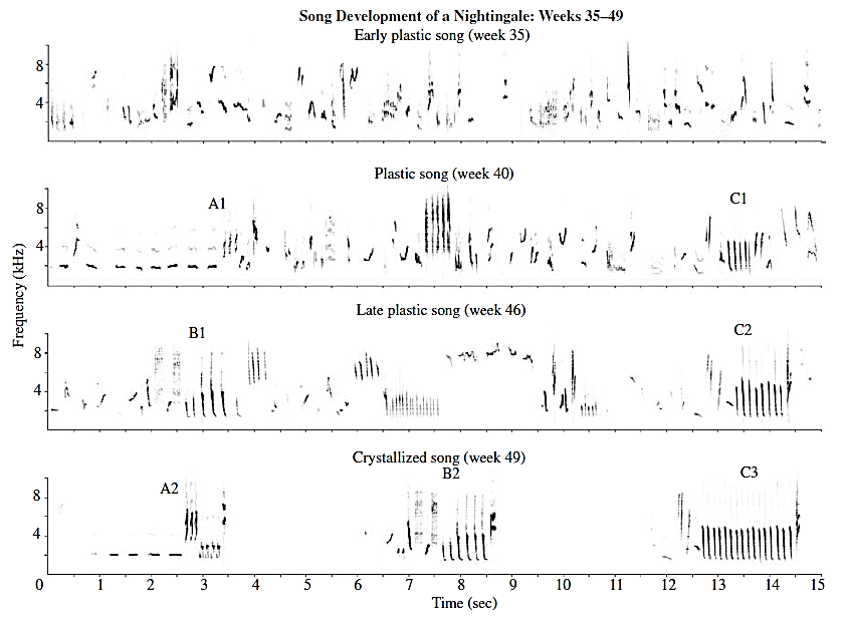
How do vocalisations change during bird song learning?
Page 2
How do vocalisations change during song bird learning
In a nightingale as time goes on towards crystalisation syllables and notes become more distinct and there are more repetitions. After crystalisation the song stays the same. Initially there is overproduction of synapse in the anterior vocal pathway. Baynard and Dupe to about synaptic pruning which reduces neuron connection. This maybe due to limited repetetition of the crystalised song.
Alan Murer and Carew 2002 found that in Swamp Sparrows given 2 different songs will combine them into a novel song
Murler took a song
Marler 1981 Took 16 birds in isolation, he modified a song and trained birds twice a day over 40 days. He recorded the songs and analysed it.
There were 200 syllables learnt in the plastic song phase. At lot of them had been lost in the crystalised phase. He found some innate and were improvised and others were immitations of the syllables taught.
•Marler
and Peters (1981) analysed 200 plastic phase syllables in swamp sparrows.
–33%
were copies (Imitations)
of original tutor song
–18%
were variations (Improvisations)
on tutor song
–50%
were inventions
(not based on tutor song)
Page 3
•Be able to explain Konishi’s key experiments on auditory feedback
Do birds need to be able to hear themselves sing?
Konishi originally looked at sparrows but has been tried with other species
They hear a song in the sensory period and then are surgically defeaned by having their cochlea removed before the sensorimotor phase. They would have formed memories of the song but cannot hear themselves singing it. They found that the song produced was even more disorientated than when birds were never given a tutor song suggesting auditory feedback to be essential for bird song learning.
•Konishi allowed juveniles to hear tutor song
during sensory period, and then deafened them before they could start singing
in sensorimotor period.
•Completely
disrupted song.
•Documented
in 5 species (Konishi, 1964-1965)
•Auditory feedback is essential for birds
to learn a song.
•Further experiments demonstrated that
deafening adult birds that could already sing, resulted in a deterioration of
their song.
•So, auditory feedback is required for
maintenance too
Models of Bird Songs.
This led to suggestions that there are templates of what a song is.
- There is a innate template
- There must be a template of tutor song in sensory period
- There must be a template of its own song as shown by konishi
One possible mechanism
There is an idea there is a crude template that gives a disposition to listen to other birdsongs. During listening to the tutor song allows it to refine the template. During sensorimotor it listens to its song and matches it until it has refined its template to its 'satisfaction'.
Information
- Description
- 2nd Yeat Behavioural Neurobiology (Birdsong) Note on Birdsong Lecture 7, created by Tino Mutasa on 03/04/2017.
- Created by
- Tino Mutasa · Apr 2017
- Updated
- May 5, 2017
- Views
- 59
- Rating