
Notes
KARST PROCESSES + LANDFORMS - created from Mind Map
Content of the notes (1)
Page 1
karstification process
essential independent variables that guide the development of the karst landscape = 'coordinate features'
Karst hydrologic cycle
CHEMICAL DRIVING FORCE
PHYSICAL DRIVING FORCE
HYDROGEOLOGIC SETTING
PRECIPITATION
chemical reactions drive towards equilibrium (saturation and cessation of dissolution)WITHOUT PRECIPITATION
PRECIPITATION
RELIEF
removes saturated solutions and replaces with fresh solutions
TECTONIC SETTING
THIICKNESS OF SOLUABLE ROCK
STRATIGRAPHIC AND LITHOLOGICAL SETTING
places limits on the extent of karst development
e.g. western Pennsylvania only 10-12m
E.G. Adriatic coast 9000m
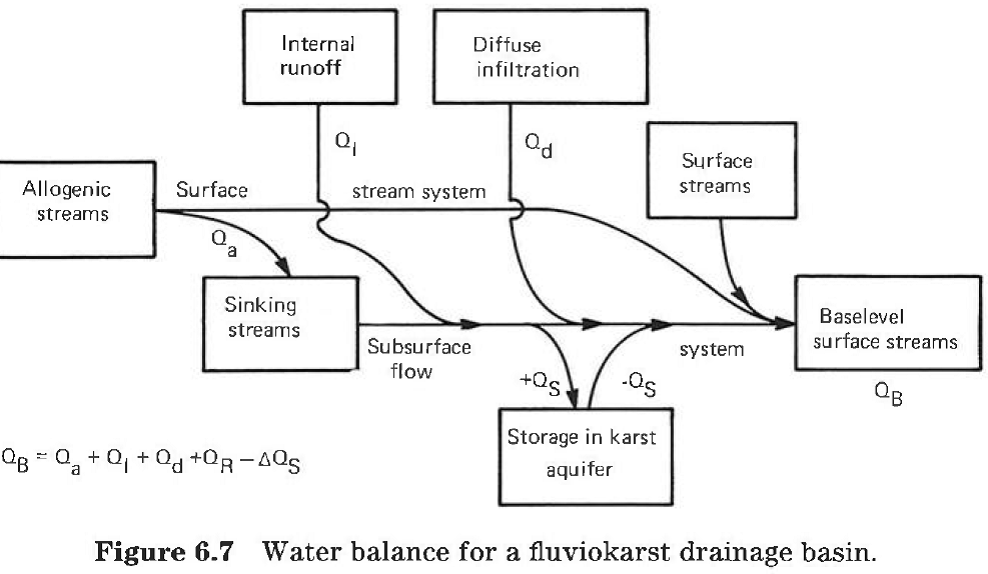
Karst aquifer and associated groundwater basins assumed to be embedded in larger basins containing non-karstic rocks (ALLOGENIC)
Runoff originates from allogenic streams together with internal runoff (Qi = IN DIAGRAM )
Overland flow disappears into sinkholes -> internal runoff (Qa )
Karst aquifer assumed to have a single output = base level stream with flow QB from springs
Porosity and permeability OF AQUIFERS - ranges
KARST RECHARGE
Primary porosity
fracture porosity
conduit porosity
INFLUENCE ON
Karstic aquifers contain integrated systems of pipe-like conduits that act as drains for the highly localised transport of watery
Properties of carbonate aquifers vary widely
Water infiltrating percolates downwards under gravity until it reaches level where all pores are water-filled.
Phreatic zone
Vadose zone
water-saturated zone below the water table
unsaturated zone above the water table
OCCURS IN = Catchments of mixed geology
solution attributable both:
Denudation varies as geochemical evolution of the water different
1) precipitation (autogenic recharge)
AND 2) water that flows on to the karst from elsewhere (allogenic recharge)
BECAUSE
1) soil and boil vary from point to point
recharge is organised differently
AUTOGENIC CASE = diffuse and relatively even
ALLOGENIC CASE = ocused + high volume + solution restricted to line of watercourse
Theoretical Cave Development Models in Carbonates
VADOSE THEORY
DEEP PHREATIC THEORY
Caves formed by action of underground streams flowing at or above the water table
solution takes place most actively at the top of the saturated zone BECAUSE aggressiveness is lost once water descends through sinkholes and enters the water table
origin = Davis's work on Peneplains
KARST = A distinctive topography in which the landscape is largely shaped by the dissolving action of water on carbonate bedrock
results in
IN = humid regions.
surface and subsurface features
Caocite Dissolution
changing water table levels
subsidence
Distinctive landforms
Saturated and undersaturated solutions
sinkholes
vertical shafts
disappearing streams
springs
underground drainage systems
caves
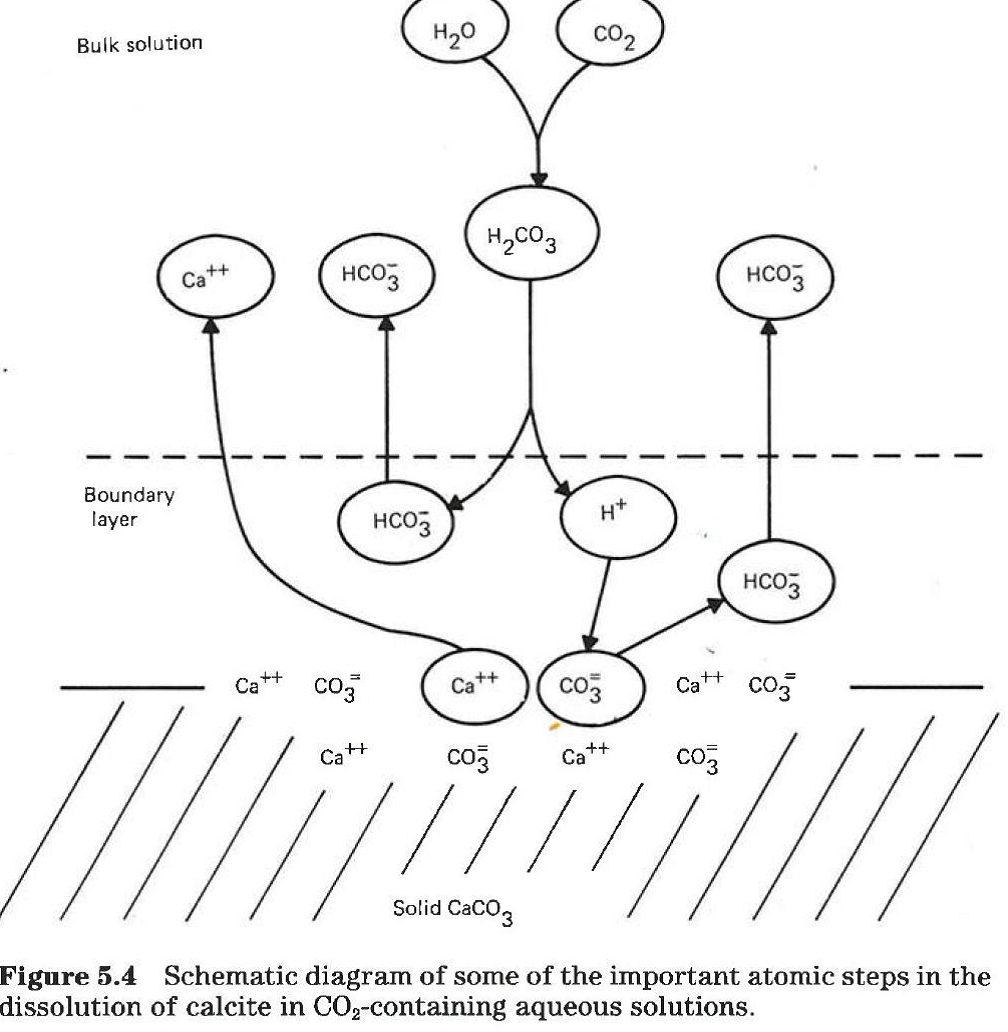
1) In the presence of water, calcite dissociates to yield a positively charged calcium cation and a negatively charged carbonate anion
2) Carbon dioxide gas dissolves in water to produce carbonic acid
3) The carbonic acid dissociates into a hydrogen cation (protom) and a bicarbonate ion.
4) Free protons H+ combine with carbonate anions HCO3 -
5) Continuing production of bicarbonate releases calcium ions Ca2+ into the boundary layer of the water
Both limestone and marble = composed of the mineral calcite= chemically is calcium carbonate: CaCO3
SUMMARY EQUATION = CaCO3 + H20 + CO2 ->
CaCO3 ->
Dissolution of the limestone or dolomite is most intensive where the water first contacts the rock surface
CO2 + H20 ->
Hydration of aqueous CO2 to form neutral carbonic acid
H2CO3 ->
Ionization of the carbonic acid to form a bicarbonate ion and a proton
HCO3 - = which are more soluble in water than carbonate
H+ + CO3 2- ->
Reaction of the proton with a carbonate ion on the crystal surface to form a second bicarbonate ion
Kinematics
The ions are carried away in solution
1. Desorption of the second bicarbonate ion and its diffusion across the boundary layer into the bulk solution
2. Release of the calcium ion from the crystal
3. Diffusion of the calcium ion across the boundary layer into the bulk solution
MARBLE = metamorphosed limestone
Dolomite is a double carbonate of calcium and magnesium: CaMg(CO3 )2 = less soluble than calcite = karst on dolomite = less well developed than on limestone or marble
Ca(HCO3 )2 = calcium bicarbonate
HOWEVER reactions are fully reversible = when precipitates are exposed to un-saturated ground water = re-dissolve
SATURATED = dynamic equilibrium with no more solution: the solution
UNSATURATED = there is net dissolution of the mineral
either
can lead to groundwater becomes SUPERSATURATED with dissolved minerals
supply of CO2 going into solution being exhausted
where it is balanced by outgassing of CO2
further dissolution = not possible, =carbonate salts of calcium and magnesium may precipitate from the water
features E.G. stalactites.
SOMETIMES refferred to as AGGRESSIVE
Aggressive dissolution = flow is focussed in pre-existing openings in the rock OR in the zone of water-table fluctuation where ground water is in contact with the atmosphere
wet regions have much higher denudations rates than drier regions
EXAMPLE FLORIDA
LANDFORM
Distinctive landforms due to high rock solubility, which causes secondary porosity and subsidence.
FORMATION
the carbon dioxide cascade
Environmental variables affecting karst formation
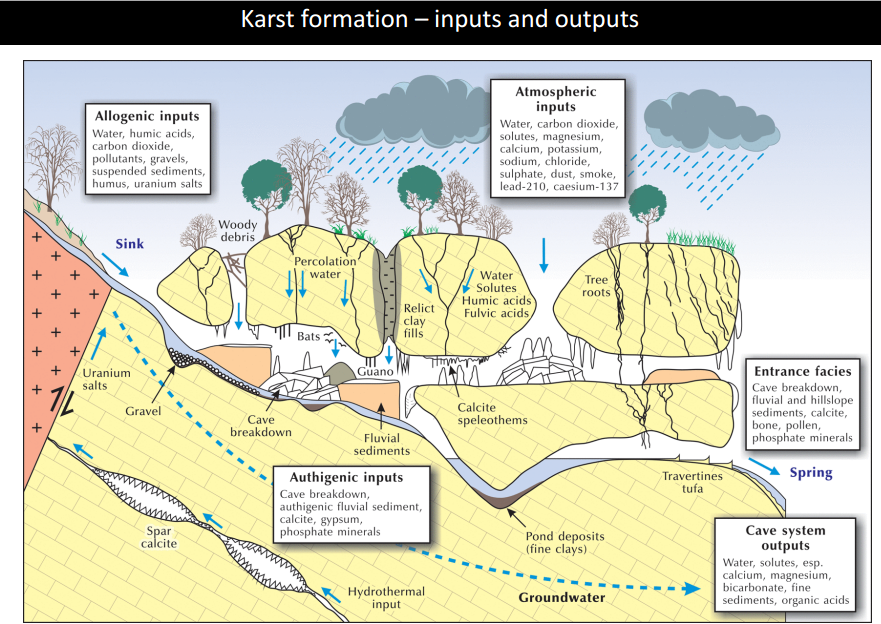
1. As rain falls through the atmosphere, it picks up CO2 which dissolves in the droplets
2. Once rain hits the ground, it percolates through the soil and picks up more CO2
3. a weak solution of carbonic acid is formed
4. infiltrating water naturally exploits any cracks or crevices in the rock.
5.. Over long periods, with a continuous supply of CO2 -enriched water, carbonate bedrock begins to dissolve.
6. Openings in the bedrock increase in size
7. underground drainage system begins to develop, = allows more water to pass = accelerating the formation of karst
8. leads to the development of subsurface caves
EQUATION = H2O + CO2 ->
Hydration
CHEMISTY = carbonic acid reacts readily with limestone CaCO3 and/or dolomite (CaMgCO3)2
CHEMISTRY = Cavities and voids develop a= limestone or dolomite dissolved into component ions of calcium (Ca++), magnesium (Mg++) and bicarbonate (HCO3 - ).
PRECIPITATION= DOMINANT
TEMPERATURE
ORGANIC MATTER
TURBULENCE
wet regions have much higher denudations rates than drier regions
CHEMISTRY
Salts
Ph
Soils
Temperature
Pressure
Mixing
Speed of flow
Solubility:
Calcite and dolomite are ionic salts. In pure water they dissociate into their constituent ions
1) CaCO3 ->
2) CaMg(CO3 )2 ->
Calcite: pH ~ 8.4 CO2 in air dissolved in cloud droplets Falls as lower pH precipitation with very slow dissolution
Water, and Humic Acid; pH ~ 4-7 Precipitation soaks though O and A horizons and adds plant acids
CaCO3 (s) + 2H+ (aq) ->
Cold water contains more CO2
CO2 + H2O ->
deeper H2O , more CO2 absorbed -> more ‘aggressive’ water
can result in undersaturated H2O
runoff can move a long distance in a few days
runoff = time taken for a solution to approach saturation)
calcite in pure water = very small (less than that of quartz)
Add CO2 to water = carbonic acid = calcite begins to dissolve.
Evolution
: Karst aquifers form by flowing water containing carbon dioxide (CO 2) which dissolves carbonate rocks.
KARST PROCESSES + LANDFORMS
Information
- Description
- Note on KARST PROCESSES + LANDFORMS - created from Mind Map, created by tiffragbourne on 28/05/2014.
- Created by
- tiffragbourne
- Views
- 55
- History
-
- Created by tiffragbourne · May 28, 2014
- Copied to Note by tiffragbourne · May 28, 2014
- Rating