
Landforms and Geomorphology
260 resources created by 234 users
This Landforms and Geomorphology page on GoConqr gathers community-made mind maps, quizzes, flashcards and notes on weathering, erosion, mass movement, karst, deserts and plate tectonics. It's built for school students revising a topic, university students and professional candidates filling gaps, and teachers after ready-made material. There are over 240 resources here, including more than 160 mind maps, more than 40 flashcard decks and over 10 quizzes, made by over 220 contributors. Pick a topic, try a quiz to find your gaps, then make your own set.
Top Landforms and Geomorphology resources
-
Mind map Weathering, Erosion, and Deposition -Elementary This mind map has a variety of activities to engage learners in a study of weathering, erosion, and deposit...
-
Mind map The Himalayas Description is about the Himalayas how the Himalaya was formed and what are the divisions of it I tried and...
-
Mind map Rocks, resources and scenery
-
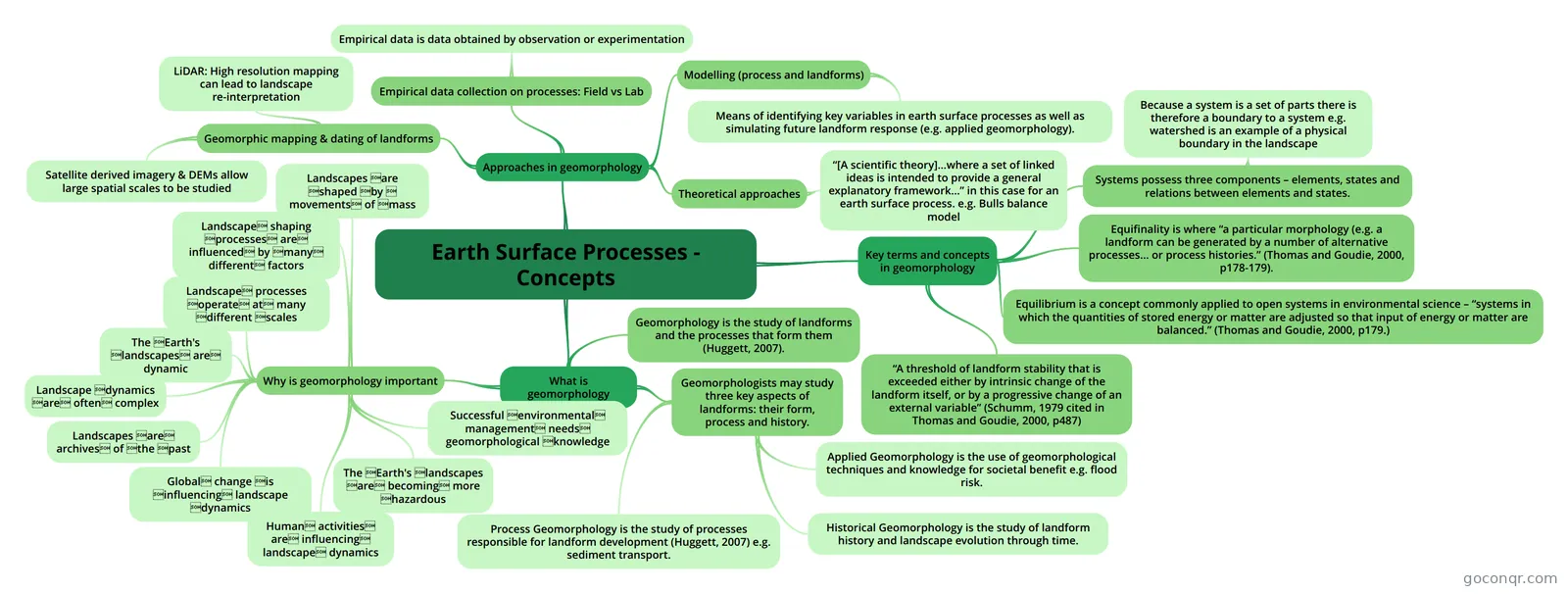 Mind map Earth Surface Processes - Concepts This is an introductory lecture to Earth Surface Processes and Hazards which will cover key definitions of ...
-
Mind map Geomorphology Introduction
-
29 cardsChapter 23 Vocabulary
-
5 questionschallenge of natural hazards - weather hazards - tropical storms where do tropical storms develop? (latitude)
-
 Mind map social Geography: Ch-2 Major Landforms for revision in this chapter
Quizzes
See all 21 quizzesMind maps
See all 171 mind maps-
Weathering, Erosion, and Deposition -Elementary This mind map has a variety of activities to engage learners in a study of weathering, erosion, and deposit...
-
The Himalayas Description is about the Himalayas how the Himalaya was formed and what are the divisions of it I tried and...
-
Rocks, resources and scenery
-
Earth Surface Processes - Concepts This is an introductory lecture to Earth Surface Processes and Hazards which will cover key definitions of ...
-
Geomorphology Introduction
-
social Geography: Ch-2 Major Landforms for revision in this chapter
-
How are landforms shaped?
-
Limestone Landscapes- Formation of Underground Features
Flashcards
See all 51 flashcardsNotes
See all 16 notes-
Shaping earths crust Denudation occurs by weathering and erosion weathering: is the breakdown and decay of rocks that are exposed to the weather 2 types:-mechanical+chemical weathering erosion: is the breakdown od rocks and the removal of...
-
Hot Desert Environments Processes and ProductsWadi conglomeratesDesert stream channels are known as wadis. Their source is usually high in mountains, so they have steep gradients. Together with the intensity of the rainfall, this gives the s...
-
"You Should Be Able To" (ECS) Explain mechanical weatheringGive at least 3 examples of mechanical weatheringExplain chemical weatheringGive at least 3 examples of chemical weatheringExplain the difference between mechanical and chemical weathering...
More Geology and earth sciences topics
About Landforms and Geomorphology
GoConqr OriginalWhat this unit covers
The unit is about how landscapes are shaped. Much of it starts with weathering, erosion and deposition. The notes titled Shaping earths crust explain that denudation happens through weathering and erosion, and split weathering into mechanical and chemical types. Several mind maps, including Weathering and Weathering!, go through physical weathering such as exfoliation, which happens when rock is repeatedly heated and cooled.
Landforms by environment
From there the page moves to particular settings. The notes on Hot Desert Environments describe wadis, the desert stream channels that start high in the mountains and have steep gradients. The Landform in Karst Region mind map covers limestone, cave pillars and dripstone features, and there is a matching set on karst processes and landforms. For cold environments, the notes on Frost heaving/hillslope processes cover bedrock heave, and there is a mind map on the Periglacial Environment. Mass Movement sorts slope processes into slow ones, such as soil creep, and fast ones, such as slides, falls and slumps.
Where to start
- Open the Weathering mind maps to get the basic vocabulary.
- Read Shaping earths crust to see how the ideas connect.
- Choose an environment: deserts, karst or periglacial.
- Look at Mass Movement and Slopes and Slope Stability.
- Finish with the Theme 1: Geomorphic Processes maps for a wider view.
Using quizzes and maps together
Read a map first, then take a quiz such as Weathering, erosion and deposition or Landforms Exit Quiz. Anything you get wrong tells you which map to reopen. Flashcard decks such as Formation of Tors and Glacial Geomorphology help with key terms. Some resources mention GCSE Geography, and most of the material suits secondary students, with a fifth aimed at university level.
Where it fits
This unit sits in the Surface Processes and Landscapes strand of Geology and earth sciences. Choose one topic today, try its quiz, and then build a map or deck of your own.
Frequently asked questions
Which resource should I open first?
Start with the Weathering mind maps, then read the notes called Shaping earths crust. They explain denudation, weathering and erosion in plain terms, and most later topics, such as karst, deserts and slopes, build on those ideas.
What do the mind maps cover?
They cover weathering types, mass movement, karst landforms, arid processes, periglacial environments, plate tectonics and the drainage basin. Some are short vocabulary maps, while others, such as Theme 1: Geomorphic Processes, go through processes in more detail.
Are the resources free to use?
Yes. Every resource on this page is free to open, study and take, with no account needed. A free account also saves your quiz scores and lets you make your own quizzes, mind maps, flashcards and notes.
Which levels and exams do they suit?
Most resources are for secondary school students, and about a fifth are at university level. Some mention GCSE Geography. Teachers can use the maps, notes and quizzes as ready-made material for lessons or revision.
Who made these resources?
They were made by GoConqr users, not by GoConqr itself. Over 220 contributors have added maps, decks, quizzes and notes, so styles and depth vary. Browse a few on the same topic and choose the one that suits you.
What if my topic is missing?
Try nearby titles first. Glacial, coastal and slope topics may appear under names like Glacial Geomorphology or Slopes and Slope Stability. If you still can't find it, make your own mind map or flashcards for it.