
Quiz
Actinopterygii
This quiz has question types that open in the usual player.
Questions in this quiz (29)
1Actinopterygii are the...
- Aray-finned fishes
- Blobe-finned fishes
2Actinopterygii are the most diverse group of all aquatic vertebrates
- ATrue
- BFalse
370% of extant ray-finned fishes are teleosts.
- ATrue
- BFalse
4Check all characters of teleosts
- Ajaw mobility
- Bhomocercal tails
- Clunate tails
- Dfused jaws
5Check the non-teleost ray-finned fishes
- APolypteriformes
- BLepisosteiformes
- CAmiformes
- DOsteoglossomorpha
6Osteoglossomorpha are the most primitive teleosts.
- ATrue
- BFalse
7Osteoglossomorpha means...
- A"bony tongues"
- B"primitive fish"
- C"big mouth"
- D"slippery fish"
8Chack characters of Clade Elopomorpha
- AMost eel-like
- BSpecialized leptocephalus larva
- Cmost compressiform
- Dspawn in same region of atlantic
9Clade Otocephala is separated into two groups:
[blank_start]Clupeomorpha[blank_end] (herrings, shad, sardines, anchovies)
[blank_start]Ostariophysi[blank_end] (catfishes, milkfish, carps, suckers...)- AClupeomorpha
- BPerciformes
- COstariophysi
- DEuteleostei
10Check characters of Clupeomorpha
- Asilver
- Bmostly marine
- Cspringtime migrations greatly reduced now
- Dalarm pheromone synapomorphy
- Epredominant in freshwater
11Check characters of Ostariophysi
- AAlarm pheromone synamorphy
- BPredominant in freshwater
- CWeberian apparatus
- Dgreatly enhanced hearing sensitivity due to gas bladder used as amplifier
- Emostly marine
12What is the Weberian apparatus in Ostariopysi?
- Asmall bones that connect gas bladder with inner ear
- Ban organ that releases a chemical signal into the water when wounded
- Cvestigial organ related to lung
13Which group of Clade Otocephala releases a chemical signal into the water upon being wounded?
- AClupeopmorpha
- BOstariophysi
14Check characters of Clade Euteleostei
- AVast majority of extant teleosts
- BEsocidae and Salmonidae
- Cwide diversity of body forms related to habitat and habits
- D"true teleosts"
- Esmallest clade of teleost
15In most ray-finned fish, swimming (propulsion) is mostly is done with the...
- Amuscles of posterior region of trunk and caudal peduncle
- Bpaired fins
- Clateral line
- Ddorsal fin
16In most ray-finned fish, steering is mainly done with the...
- Apaired fins
- Bposterior region of the trunk and caudal peduncle
- Clateral line
- Ddorsal fin
17This term refers to fish whose swimming style involves bending in more than half a sinusodial wavelenghth.
- AAnguilliform
- BCarangiform
- CLabriform
- DRajiform
18This term refers to fish whose swimming method involves undulations mostly limited to the caudal region:
- ACarangiform
- BAnguilliform
- COstraciiform
- DAmiiform
19This term refers to fish whose swimming method involves undulation limited to caudal fin due to an inflexible body.
- AOstraciiform
- BLabriform
- CCarangiform
- DBalistiform
20This term refers to fish whose swimming method uses the pectoral fins for most of the force of locomotion, and very little use of the caudal fin.
- ALabriform
- BGymnotiform
- COstraciiform
- DRajiform
21[blank_start]Rajiform[blank_end]: sine waves passed along elongated pectoral fins
[blank_start]Amiiform[blank_end]: sine waves passed along elongated dorsal fin
[blank_start]Gymnotiform[blank_end]: sine waves passed along elongated anal fin
[blank_start]Balistiform[blank_end]: sine waves passed along elongated dorsal and anal fins- ARajiform
- BAmiiform
- CGymnotiform
- DBalistiform
22Label the forms of locomotion
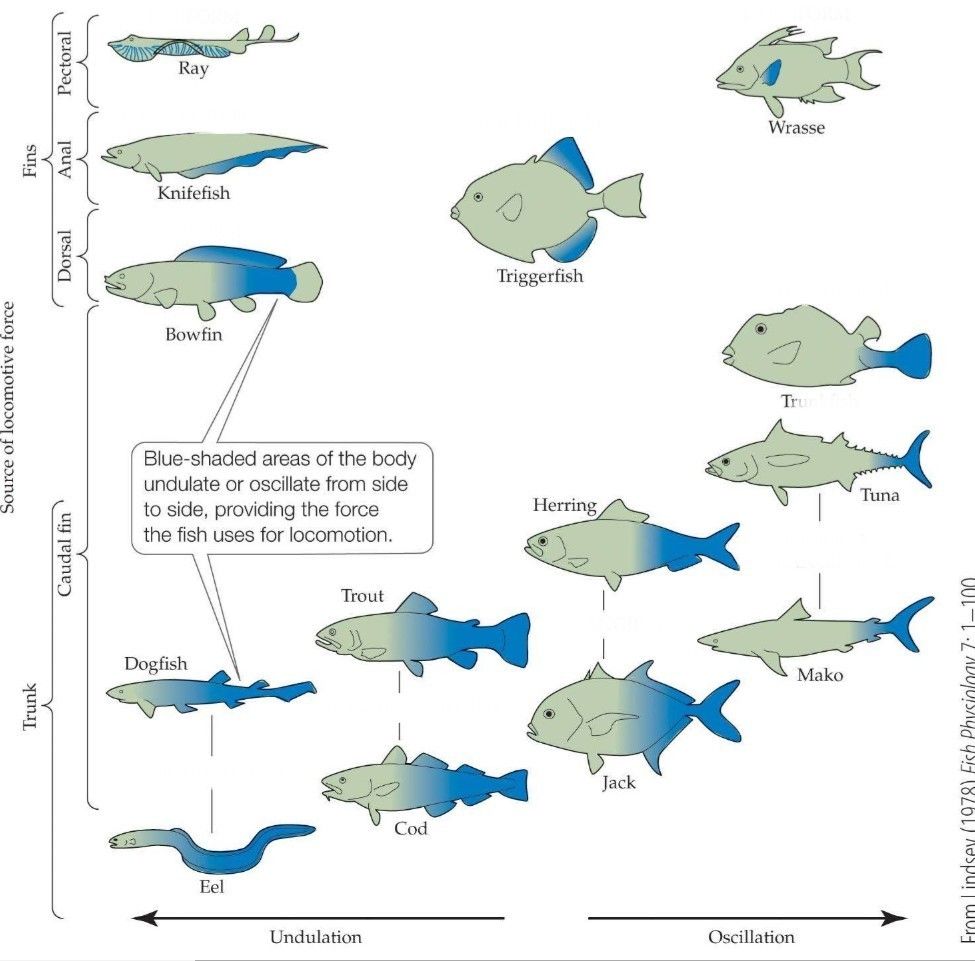
- ARajiform
- BGymnotiform
- CAmiiform
- DAnguilliform
- EBalistiform
- FCarangiform
- GOstraciform
- HLabriform
- ISubcarangiform
- JModified Carangiform
23[blank_start]Viscous[blank_end] drag (frictional) [blank_start]is relatively constant[blank_end] over range of speed and is sensitive to [blank_start]surface area[blank_end].
[blank_start]Inertial[blank_end] drag (pressure differences as result of water displacement) [blank_start]increases[blank_end] as speed increases and is sensitive to [blank_start]body shape[blank_end].- AViscous
- BInertial
- CInertial
- DViscous
- Eis relatively constant
- Fincreases
- Gincreases
- His relatively constant
- Isurface area
- Jbody shape
- Kbody shape
- Lsurface area
24Thin bodies induce [blank_start]viscous[blank_end] drag because of the [blank_start]large[blank_end] surface area relative to muscle mass, but thick bodies induce [blank_start]inertial[blank_end] drag due to the [blank_start]large[blank_end] cross-sectional area of the body.
Scaleless skin has [blank_start]low[blank_end] viscous drag. Streamlined shapes produces [blank_start]minimal[blank_end] inertial drag.- Aviscous
- Binertial
- Clarge
- Dsmall
- Einertial
- Fviscous
- Glarge
- Hsmall
- Ilow
- Jhigh
- Kminimal
- Lmaximal
25Which form of locomotion typically produces the fastest swimmers?
- AModified Carangiform
- BRajiform
- CAngilliform
- DSubcarangiform
26[blank_start]Mesopelagic[blank_end] fishes: vertical nocturnal migrations to forage closer to surface with light availability
[blank_start]Bethypelagic[blank_end] fishes: photphores, naked retinas, large mouths and stomachs- AMesopelagic
- BBethypelagic
27Check all that apply to Deapsea habitat/fishes
- Ano light
- Blow food availability
- Csmaller fishes
- Dsparse populations
- Ehigh food availability
- Fdense populations
- Glarger fishes
28Assemblages of vertebrates on coral reefs have low diversity.
- ATrue
- BFalse
29Why are many fish who live beneath the euphotic zone bright red?
- AThe bright color warns predators that they are toxic.
- BThe brighter the color, the more likely they are to achieve a mate.
- CBecause red light does not extend past the euphotic zone, so the fish can blend in with their surroundings.
- DBecause they're drama queens.
Information
- Description
- User has deleted their subject information Quiz on Actinopterygii, created by Deleted user on 13/10/2018.
- Author
- Deleted user
- Language
- English
- Views
- 24
- History
- Created on 13 Oct 2018 · updated on 13 Oct 2018
- Tags