
Kinetic molecular theory of gases KMT
Slides in this set (6)
-
- The Kinetic Molecular Theory (Animation) (Embed)
- Caption: The Kinetic Molecular Theory Animation 1:30
- All matter is made up of atoms and molecules ( particles ) that are always moving.
- These particles hold kinetic energy ( energy of motion )
- Direct relationship between temperature T° and this energy.
- As a consequence of the above, there is also a direct relation between temperature and the particles motion.
-
All matter is composed of particles
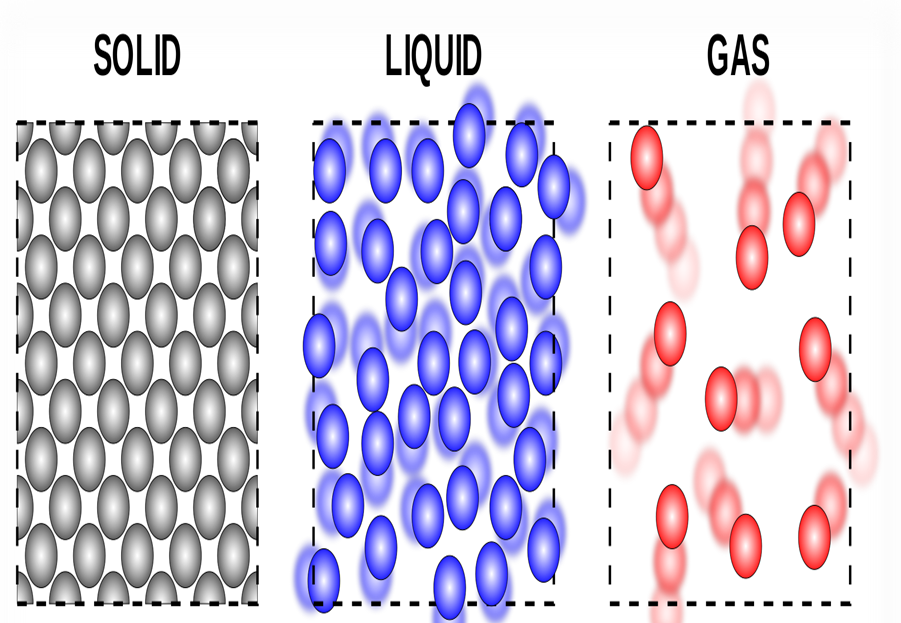
- Caption: " It is the balance between these forces of attraction and their kinetic energy what determines the physical stale of a substance "
-
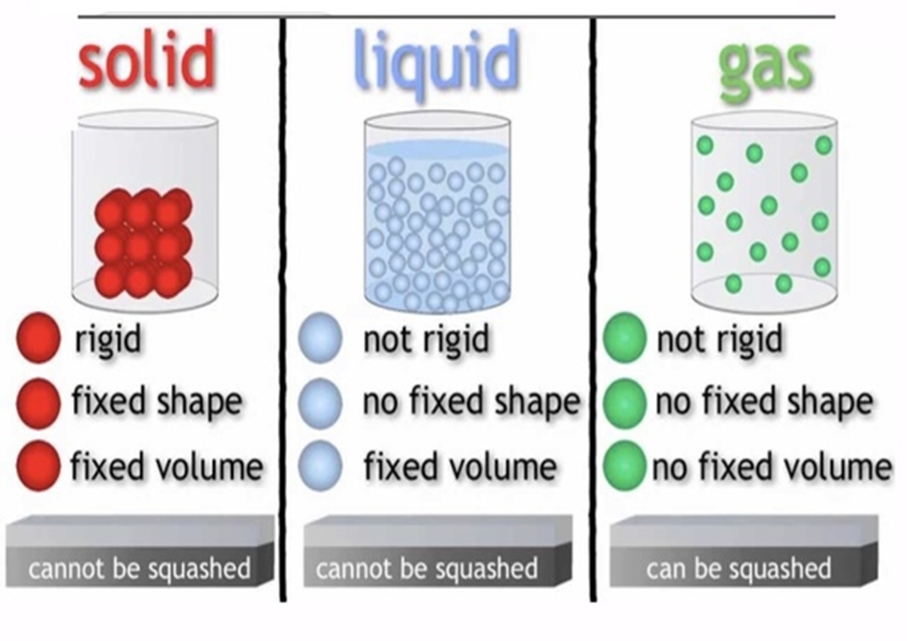
- Caption: Depending on how closely packed or how far appart ( IMF- Kinetic energy ) a substance particles are, will determine not only its state but also its characteristics in terms of volume, shape, ability to flow ( fluids ) among others.
-
- Simulación de los estados de la materia (Sólido, Líquido y Gaseoso)❄️☃️??? - La Leyenda en Ciencias (Embed)
- Caption: Simulación de los estados de la materia (Sólido, Líquido y Gaseoso) 4:54
- The arrangement of particles in solids, liquids and gases - Edukite Learning (Embed)
- Caption: The arrangement of particles in solids, liquids and gases. Edukite learning 2:27min
-
- 1. Gases are composed of tiny particles (atoms or molecules) Gases are relatively small with relatively low atomic and molecular weights.
- 2. The gas particles are so small when compared to the distances between them, that their volume is negligible (assumed to be zero). There is a lot of space between the gas particles which explains gases compressibility (ability to be squeezed together)
- 3.The gas particles are in constant random motion, moving in straight lines and colliding with the inside walls of the container.
- Gas particles move in straight lines and in all directions uniformly until they collide with something: another particle or the wall of the container they are in. This is why gases exert pressure on the walls of the container they are held in.
- 4. Gas particles are assumed to have negligible attractive or repulsive forces between each other. Their attraction and repulsion forces can be ignored (very little or weak – if any – IMF)
- 5. Gas particles may collide with each other in an elastic way, causing the total kinetic energy of the colliding particles not to change (Remain the same). Gas particles collide elastically thus the kinetic energy is not lost, but it may be transferred from one particle to the other.
- 6. The temperature (K°) is directly proportional to the average kinetic energy of the gas particles.
- If a gas is heated so that the temperature increases, the average kinetic energy of the gas also increases, in other words the energy of motion of the gas particles increases proportionally.
-
- Source+Kinetic+Molecular+Theory+Of+Gases+Kmt (application/pdf)
- Caption: SOURCE Kinetic molecular theory of gases PDF
Information
- Description
- Chemistry 10th Slide Set on Kinetic molecular theory of gases KMT, created by Alejandra Gomez on 15/04/2020.
- Created by
- Alejandra Gomez · Apr 2020
- Updated
- Apr 3, 2021
- Views
- 349
- Tags
- Rating