
Inorganic chemistry
Slides in this set (20)
-
Bonding in Transition Metal complex
- Introduction
- Crystal field theory
- MO Theory
-
- Six topics with the average lecture time indicated in brackets.
- Wave Mechanics and Spectroscopy(12) - Bourne
- Inorganic bonding(10) -Egan
- Introduction to liquids(10)-Venter
- Crystal structure analysis(9)-Oliver
- Inorganic Reaction Mechanism(8)-Jackson
- Inorganic complex equilibra (8)-Jackson
-
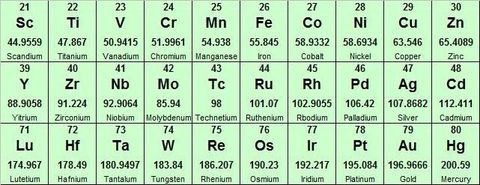
- D electrons : 3d^x-z ,x= group number z= charge
- Trends
- Ionization energy-increases from left to right , the changes are small due atomic size decrease from left to right.=D oribtals are furtheraway from the nuclues,(less effective nuclear pull) and thus are more effectively shielded than s and p oribtals.
- Ionic radii
- Innic size depends on charge of ion and magnetic propertise.
- M(2+) is >>M(3+)
-
- Lewis theory
- Ligand-Base-A pair of electron donor
- Metal-Acid-A pair f elctron acceptor
- Lewis bases-Bronsted-Lowery bases
- Not all lewis bases are sig. Bronsted-Lowery
- Exception;CO,CN even though they are organic moclues which have relatively high pka they form coordinative complexes
- Metal-ligand=Lewis Acid-Lewis base
- Bronsted-Lowery theory
- Ligand-A proton acceptor
- Metal-A proton donor
- Exceptions Cl,Br,I and CO not sig.bronsted lowey bases but for complexes.
- Metal-ligand=Lewis Acid-Lewis base
-
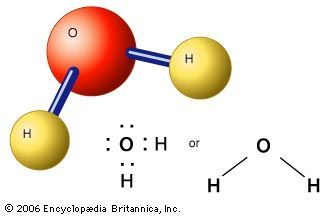
- Caption: Mono(1 donor atom)dentate
- O,N,S and Halides
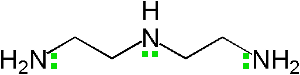
- Bidentate,tridentate and polydentate
- Open chain bidentate and mulitdentate=Chelate=rings=Jackson
-
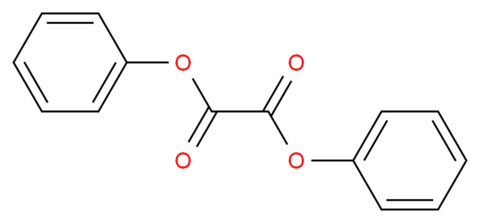
- Caption: Bidentate
- Caption: Tridentate
-
- Octaheral
- square planar
- tetrahderal
- Linear
-
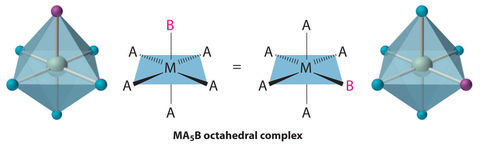
- The metal centre want a maxium charge around it .
- The d block has a number of 6 ligands9max) due to steric factors .
- Has a centre of inversion
- Can have a pesudoctahedral form.
- Caption: Octahedral complex
-
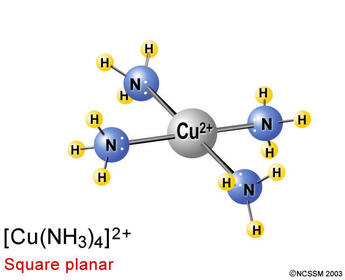
- Large ligands e.g halides and small metals e.g Ni(11) and Zn(11).
- Tetragonal and square planar =e;ectronic reasons
- Tetragonal = d4 (HS) and d7(LS) ,d9(both)
- Square planar=d8
- Caption: Square planar complex
-
- A Electrostatic model
- uses ligands to create a electric field around the metal centre
- Ligands are treated as negative point charges which are attracted to postive charged metal.
- The ligand electrons and metal electrons repel one another.
- There is no metal-ligand covalent interaction
- What do we use this theory for?
- Colour-which is due the presence of d--d transtions in electronic spectra of complexes.
- Magnetic propertise of complexes
- High spin/Low spin---Metals with the same d count can give complexes with different number of unpaireed electrons.
- since CFT-ignores covalent interaction,one must take into account in advanced ligand filed theory (Jackson)
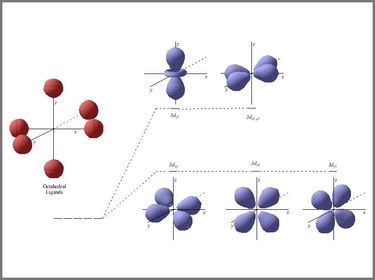
- Caption: 5 avaliable oribtals in d metals
-
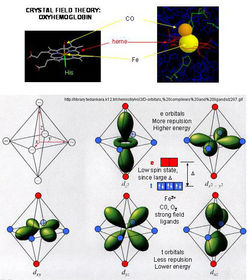
- Caption: The 5 types of oribtals you can get
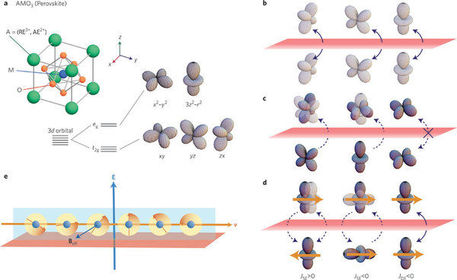
- Since the distribution of ligands around the metal is not spherically symmetrical ,there are electrons which are more stable than others.
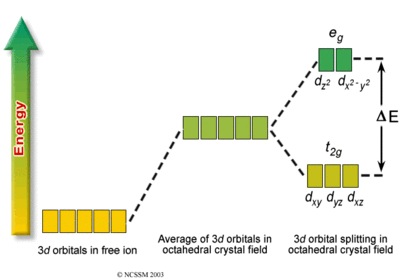
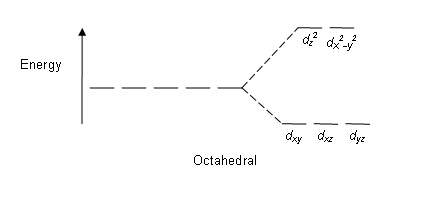
- Those which point along the dx2y2 and dz2 are less stable than those in the dxy,dxz,dyz.
- Thus if it were spherical the energies of 5 oribtals would be risen (destablized by the same amount) however this is not the case.
-
-
-
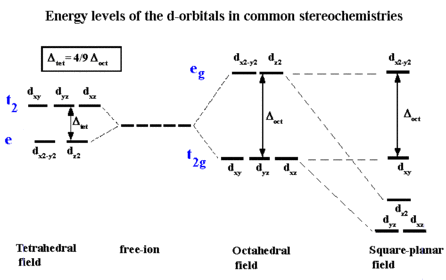
- Replusion of electrons from 6 ligands spilt the d complex into:
- 1.doubly degenerate (eg)
- 2.Triple degenerate (t2g)
- Octahedreal and square planar complexes are centrosymmetric while tetragonal and teterahedral are not.
- NB!!!!
- 1.-dz2 and dx2-dy2 have subscript g =gerade=even
- if they have n centre of iversion=ungendree=uneven
- The energy seperation between the energy levels is delta oct
- An electron in one of this oribtals is stablized by 2/5 delta oct called ligand field stabalization energy(LFSE)
- CFSE- a measure of the net energy of occupation of the d oribtals realitive to the mean energy
- Formula: CFSE=-(0.4X+0.6Y)delta oct
- The reason we see colour is because of the delat oct value which carries the right energy to oxlate electrons from t2g-eg levels .
- The E of the visible peak max corresponds to delta oct.
-
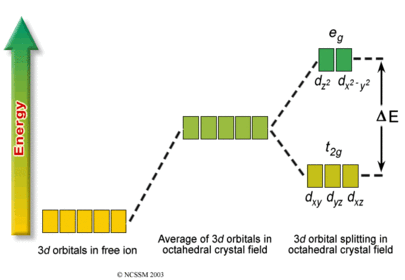
- If the lower t2g levels are filled and the upper eg levels are vacant or partially vacant .
- you have a energy jump from the lower level to the higher level =d-d transitions.
- colour dependency is on the the change of energy-change of wavelength.
- 1.REQUIREMENT
- must have a spin state change from (+0.5-0.5)
- Caption: see worked example
-
- Answer
- if wavelength=493nm the v=1/493=20283.97cm^-1
- then
- hv=delta oct
- =20284cm^-1 convert to kj.mol^-1
- =243.4kj.mol^-1
-
Variations in the Crystal splitting Field
- Nature of the ligand
- Small degree of splitting- small delta value-weak ligand.
- Large degree of splitting-large delta value-strong ligand .
- SPECTROCHEMICAL SERIES
- I
- Weak ligands-LHS and vice versa
- For a ligand colour depends on the oxidation state of metal.
- For a given metal colour depends on the ligand
- Weaker field-smaller delta-longer wavelength and vice versa
- Oxidation state of metal
- Delta values increase with oxidation state of the metal ion for a given metal and given ligand.
- For a given metal and given ligand delta oct increases down the group .
- Remember high oxidation state-Smaller ion , Shorter M-L bond.
- Mn(2)
- NB Delta Oct /tet=determined by strength of crystal field.
- THE AMOUNT OF CRYSTAL SPILITING IS DETERMINED BY STRENGTH OF THE LIGAND
-
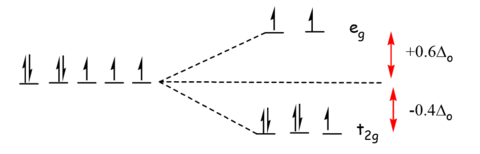
- Caption: The energy of the electron is >> than the splitting of the energy levels.I.e it is easier to promote electrons to upper eg levels than it is to pair them in t2g level.
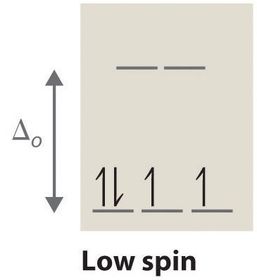
- Caption: VICE VERSA
-
This means Hs/Ls is determine by CFS
- if delta oct(spilting of d oribtals)
- General rules:
- Forumla for HS: CFSE=nt2g*-0.4delta oct +(ng*0.6)deltaoct
- LS:CFSE:nt2g*-.04delta oct +neg*0.6delta oct
- LS-STRONG FIELD LIGAND ,HS-weak field ligand(Given metal,Given ligand) and it is metal dependant
-
- vIa magnetic measurements using magnetic susceotibility .
- Achieved through spin-only magnetic moment
- fancy u=(n(n+2))^1/2 fancy ub
Information
- Description
- notes summarizing the propertise of d metals and why we study them.
- Created by
- Shoneeze Simone Renga · Nov 2015
- Updated
- Jan 18, 2017
- Views
- 234
- Tags
- Rating