
Mass Spectrometry and how it works
Slides in this set (10)
-
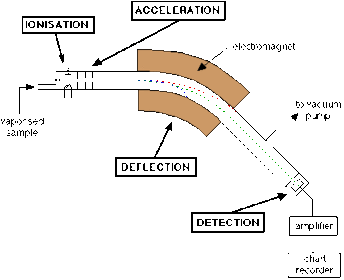
What a mass spectrometer looks like:
-
- The atom or molecule is ionised by knocking one or more electrons off to give a positive ion. This is true even for things which you would normally expect to form negative ions (chlorine, for example) or never form ions at all (argon, for example). Most mass spectrometers work with positive ions.
-
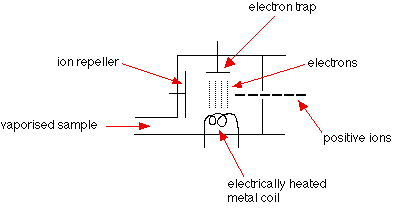
- The vaporised sample passes into the ionisation chamber. The electrically heated metal coil gives off electrons which are attracted to the electron trap which is a positively charged plate.
- The particles in the sample (atoms or molecules) are therefore bombarded with a stream of electrons, and some of the collisions are energetic enough to knock one or more electrons out of the sample particles to make positive ions.
- Most of the positive ions formed will carry a charge of +1 because it is much more difficult to remove further electrons from an already positive ion.
- These positive ions are persuaded out into the rest of the machine by the ion repeller which is another metal plate carrying a slight positive charge.
-
- The ions are accelerated so that they all have the same kinetic energy.
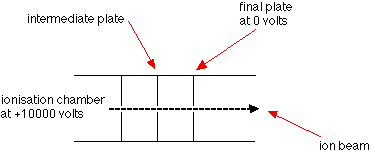
- Caption: The positive ions are repelled away from the very positive ionisation chamber and pass through three slits, the final one of which is at 0 volts. The middle slit carries some intermediate voltage. All the ions are accelerated into a finely focused beam.
-
- The ions are then deflected by a magnetic field according to their masses. The lighter they are, the more they are deflected.
- The amount of deflection also depends on the number of positive charges on the ion - in other words, on how many electrons were knocked off in the first stage. The more the ion is charged, the more it gets deflected.
-
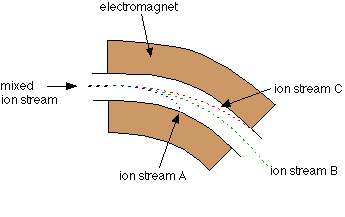
- Different ions are deflected by the magnetic field by different amounts. The amount of deflection depends on:
- the mass of the ion. Lighter ions are deflected more than heavier ones.
- the charge on the ion. Ions with 2 (or more) positive charges are deflected more than ones with only 1 positive charge.
- These two factors are combined into the mass/charge ratio. Mass/charge ratio is given the symbol m/z (or sometimes m/e).
- In the last diagram, ion stream A is most deflected - it will contain ions with the smallest mass/charge ratio. Ion stream C is the least deflected - it contains ions with the greatest mass/charge ratio.
-
- The beam of ions passing through the machine is detected electrically.
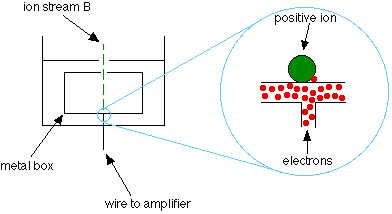
- Caption: When an ion hits the metal box, its charge is neutralised by an electron jumping from the metal on to the ion (right hand diagram). That leaves a space amongst the electrons in the metal, and the electrons in the wire shuffle along to fill it. A flow of electrons in the wire is detected as an electric current which can be amplified and recorded. The more ions arriving, the greater the current.
-
- It's important that the ions produced in the ionisation chamber have a free run through the machine without hitting air molecules.
-
- The output from the chart recorder is usually simplified into a "stick diagram". This shows the relative current produced by ions of varying mass/charge ratio.
- You may find diagrams in which the vertical axis is labelled as either "relative abundance" or "relative intensity". Whichever is used, it means the same thing. The vertical scale is related to the current received by the chart recorder - and so to the number of ions arriving at the detector: the greater the current, the more abundant the ion.
- As you will see from the diagram, the commonest ion has a mass/charge ratio of 98. Other ions have mass/charge ratios of 92, 94, 95, 96, 97 and 100.
- That means that molybdenum consists of 7 different isotopes. Assuming that the ions all have a charge of 1+, that means that the masses of the 7 isotopes on the carbon-12 scale are 92, 94, 95, 96, 97, 98 and 100.
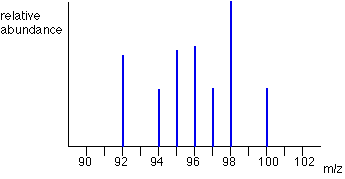
- Caption: The stick diagram for molybdenum looks like this:
Information
- Description
- AS - Level Chemistry (Mrs Gaskell) Slide Set on Mass Spectrometry and how it works, created by Iqra Rashid on 30/12/2015.
- Created by
- Iqra Rashid · Dec 2015
- Updated
- Feb 25, 2016
- Views
- 85
- Rating