
Notes
Linear Motion: Basic Vector Operations
Content of the notes (1)
Page 1
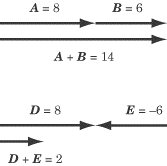
Adding Co-linear Vectors
AKA finding a resultant
Vectors are co-linear when their directions are parallel
Adding vectors that act in the same direction --> add magnitudes, use same direction
Adding vectors that act in opposite directions --> subtract magnitudes, use direction of larger vector
Adding Perpendicular Vectors
Use Basic Trigonometry:
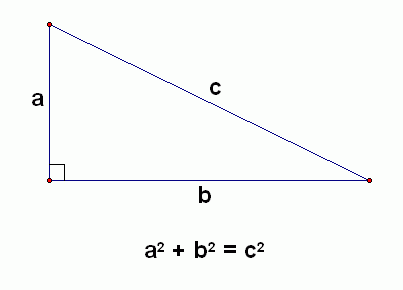
Pythagoras' Theorem
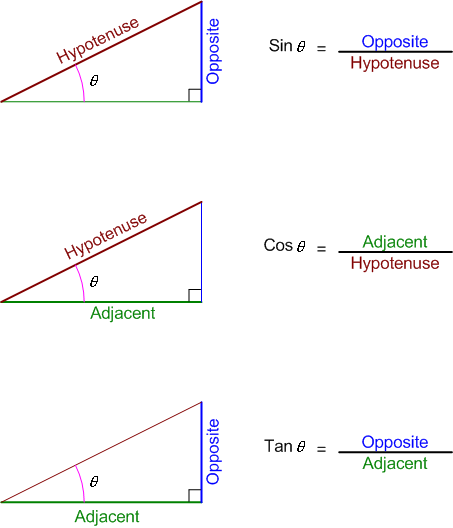
Trigonometric functions: sine, cosine, tangent
Pythagoras' Theorem
The square of the hypotenuse is equal to the sum of the squares of the other two sides
Trigonometric Functions
Sine
Cosine
Tangent
Useful mnemonic: Silly Old Harry Caught A Herring Trawling Off America
Triangle Law for Perpendicular Vectors:
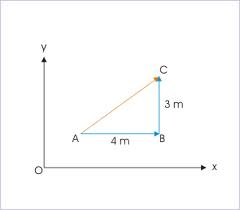
The resultant of any two perpendicular vectors is equal to the hypotenuse of the right-angled triangle formed by the two vectors placed "tip to tail"
The second vector starts at the end of the first vector
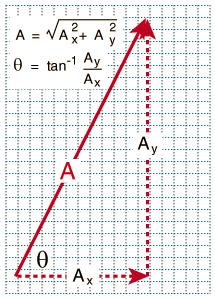
Use Pythagoras' Theorem to get the magnitude of the resultant vector
Use trigonometric functions to get the direction of the resultant vector
The diagram shows the addition of vectors AB and BC. The resultant vector is AC
Resolving Vectors
This is the opposite of finding the resultant
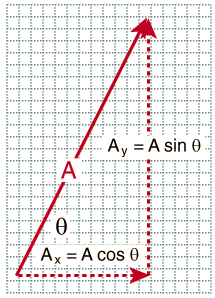
A vector is resolved into two component perpendicular vectors
The component vectors are equal to the magnitude of the original vector multiplied by sin θ and cos θ
New Page
Information
- Description
- This note provides an introduction to calculations involving vectors. It covers adding and resolving vectors, both co-linear and perpendicular. This is ideal preparation for calculations that will be encountered in the Leaving Certificate examination.
- Created by
- alex.examtime9373 · Dec 2013
- Updated
- Sep 16, 2017
- Views
- 1,354
- Tags
- Rating