
Flashcards
BISC 100-Lecture 22: Meiosis
Cards in this deck (13)
- 1SEXUAL REPRODUCTION • Three major eventsMeiosis
Formation of gametes
Fertilization - 2Sexual reproduction is performed by1. Organisms that have 2 (usually) or
more sets of chromosomes
2. Through meiosis they produce gametes that
harbor just one set of these chromosomes.
For example in humans we find:
46 (2n) chromosomes.
i.e. 23 (1n) paternal and 23 (1n) maternal
i.e. 23 pairs of chromosomes - 3Homologous ChromosomesThey both
* look alike
* same length,
* same centromere position
* same banding pattern
Each pair harbors the same set of
software (GENES).
Each gene that is found in one
chromosome is found on the other
at the same position or Locus (loci)
We call these forms,
different Alleles of the same gene
ex. Human Height (Trait)
tall vs short (Alleles or forms) - 4THE PROBLEM SEXUALLY REPRODUCING ORGANISMS HAVE ADDRESSEDIF no mechanism to HALVE the number of
chromosomes (i.e. 2n n) THEN the
number of chromosomes would DOUBLE
at each generation
46 Chromosomes 47,104
(HUMAN) Chromosomes
THE PROBLEM SEXUALLY REPRODUCING
ORGANISMS HAVE ADDRESSED
10 GENERATIONS
LETHAL - 5Meiosis involves two successive divisionsPhase one: Reduction division (Halving)
Prophase 1
Metaphase 1
Anaphase 1
Telophase 1 and cytokinesis I
Phase two: Similar to mitosis
Prophase II
Metaphase II
Anaphase II
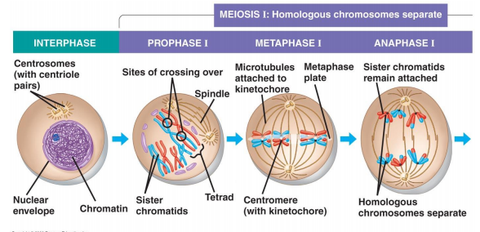
Telophase 1I and Cytokinesis - 6Prophase 1Chromosomes are much more thread like than in
Mitosis.
Why would that be?
Chromosomes that are more stretched out are
more accessible.
Why accessibility important?
During this phase homologous chromosomes
pair up into a structure called tetrad and cross over
one another and shuffles the chromosome parts
(recombinations)
Crossing over can happen several times
along the length of the chromosomes
• Why allow breaking and shuffling?
This is an exceptionally good way of
creating new combinations of alleles
• After crossing over chromosomes start
to condense.
• Why would that be?
Now transport is more important than
accessibility
– Genetic recombination is the production of new
combinations of genes due to crossing over
– Crossing over involves exchange of genetic
material between homologous chromosomes
– Nonsister chromatids join at a chiasma
(plural, chiasmata), the site of attachment
and crossing over
– Corresponding amounts of genetic material are
exchanged between maternal and paternal
(nonsister) chromatids - 7MEIOSIS I
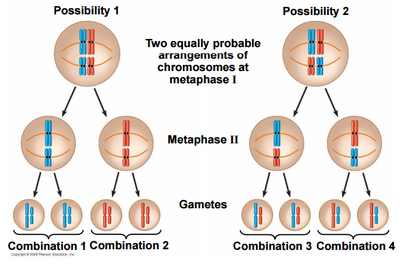
- 8Random fertilization
- 9MEIOSIS II
- 10Meiosis reduces the chromosome number fromdiploid to haploid
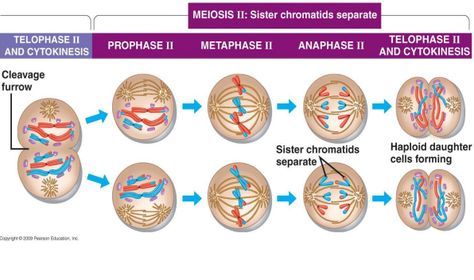
- 11Events in the nucleus during meiosis IIProphase II
– Chromosomes coil and become compact
Meiosis reduces the chromosome number
from diploid to haploid
– Events in the nucleus during meiosis II
– Metaphase II
– Duplicated chromosomes align at the cell equator
– Anaphase II
– Sister chromatids separate and chromosomes move
toward opposite poles
– Events in the nucleus during meiosis II
– Telophase II
– Chromosomes have reached the poles of the cell
– A nuclear envelope forms around each set of
chromosomes
– With cytokinesis, four haploid cells are produced - 12Mitosis and meiosis have important similarities and differencesWhich characteristics are similar for mitosis and
meiosis?
– One duplication of chromosomes
– Which characteristics are unique to meiosis?
– Two divisions of chromosomes
– Pairing of homologous chromosomes
– Exchange of genetic material by crossing over
Mitosis and meiosis have important
similarities and differences
– What is the outcome of each process?
– Mitosis: two genetically identical cells, with the
same chromosome number as the original cell
– Meiosis: four genetically different cells, with half
the chromosome number of the original cell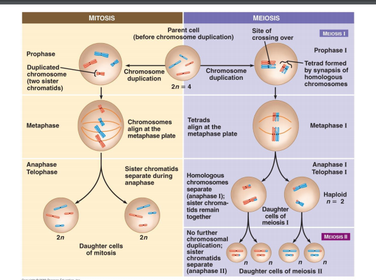
- 13—
Information
- Description
- User has deleted their subject information Flashcards on BISC 100-Lecture 22: Meiosis, created by Deleted user on 10/08/2016.
- Created by
- Deleted user · Aug 2016
- Updated
- Dec 2, 2016
- Views
- 32
- Tags
- History
-
- Created by Chelsi Souch · Aug 10, 2016
- Copied by Chelsi Souch · Aug 10, 2016
- Rating