
Mind map
Interactive Multimodal Learning Environments
Map content
Interactive Multimodal Learning Environments
by Roxana Moreno & Richard Mayer
published in 2007 in Educational Psychology Review
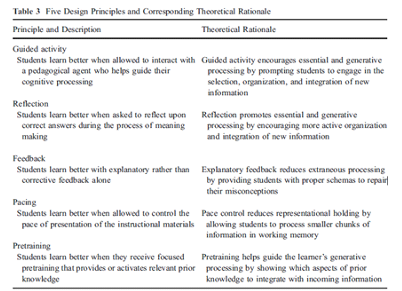
five design principles
- guided activity
- -similar to the guided discovery principle in multimedia learning (de Jong, 2005) -structure and guidance, rather than open-ended exploration, is key in order to prevent extraneous processing
- reflection
- priming students to reflect is an example of dialoguing interactively
- feedback
- another example of dialoguing interactively
- feedback principle
- novice students learn better with explanatory rather than corrective feedback alone
- pacing
- -example of controlling type of interativity -benefits of pacing may reside on cognitive load reduction
- pretraining
- form of dialoguing interactively
- pretraining principle
- students learn better when receiving pretraining that activates or provides relevant prior knowledge
- guided activity
directions for future IT research
- games and simulations
- Which features of games and simulations improve learning of which kinds of knowledge for which kinds of learners?
- pedagogical agents
- research is needed that pinpoints the features of agents that hurt learning and those that improve learning
- internal vs. external properties
- -internal: methods used during instruction -external: voice/image charateristics
- digital libraries
- the examination of interactivity methods that are germane to any engine or hypermedia program, such as searching and navigating
- case-based learning
- investigating the conditions for designing effective learning from interactive multimodal environments that include cases in video and other formats
- embedded authentic assessment
- -learners take part in a simulation of an authentic task -research is needed to determine whether this type of interactive learning environment can serve as a venue for valid, reliable, and efficient assessment of student knowledge
- games and simulations
two views of learning
- information acquisition
- -Behaviorist -knowledge flows from the instructor to the student -environments tend to be non-interactive
- knowledge construction
- -Constructivist -learner is a "sense-maker" who incorporates new knowledge with existing knowledge; goal of instruction is to guide the learner through the process of making sense of the instructional materials
- interactive multimodal learning environments
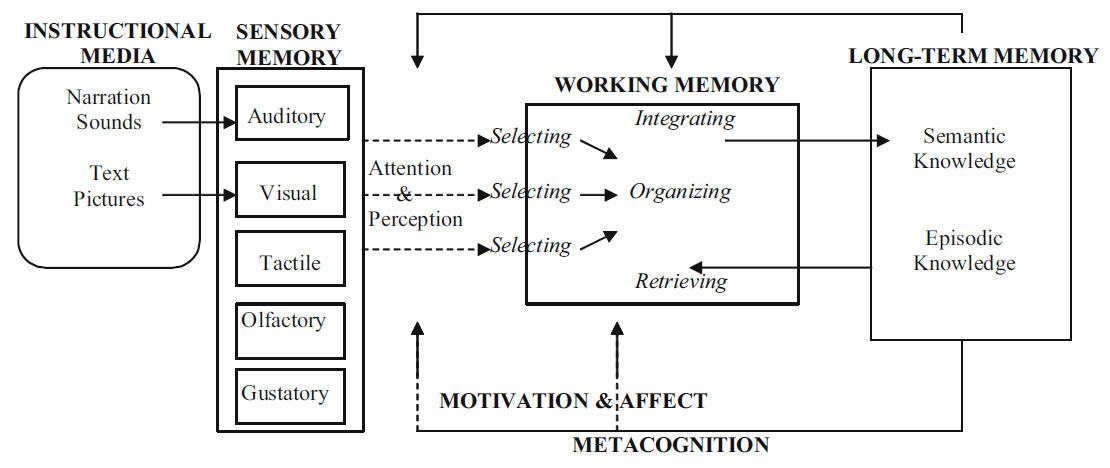
- cognitive-affective theory of learning with media (CATLM)
- Moreno (2005a) (a) humans process different information modalities differently (b) within each channel, only a few pieces of information can be processed at any one time (c) meaningful learner occurs through selecting, organizing, and integrating new information with existing knowledge (d) long-term memory = dynamic & evolving; holds memory for past experiences and memory for general knowledge (e) motivational factors increase/decrease cognitive engagement (f) learning is mediated by metacognitive processes (g) how much a student learns with specific media may be determined by their past knowledge/abilities
- processing
- extraneous processing
- originates from a poorly designed learning task
- representational holding
- the holding of a mental representation in working memory during meaning-making process
- essential processing
- required to mentally select new information presented in working memory
- generative processing
- making sense of new information
- extraneous processing
- present content knowledge verbally and non-verbally
- Paivio (1986)
- multimedia principle
- student understanding is improved by adding a non-verbal representation of knowledge to complement the verbal representation; the "tell me AND show me" idea
- modality principle of instructional design
- the most effective learning environments are those that combine verbal and non-verbal representations of the knowledge using mixed-modality presentations
- what happens depends on the actions of the learner
- interactivity
- between student and instructor, student and other students, etc.; as opposed to a one-way interaction between insructor and learner
- the goal of interaction = to foster learning
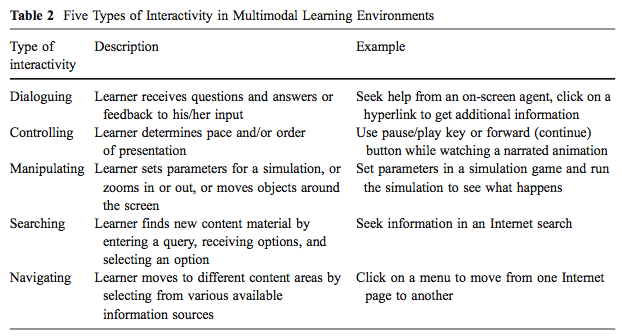
- five types
- dialoguing
- learner can ask/answer questions and receive feedback
- controlling
- learner determines pace and/or order of learning episode
- manipulating
- learner can control aspects of presentation
- searching
- learner can engage in information seeking
- navigating
- learner can determine content of a learning episode by selecting from various available sources (e.g. a menu)
- dialoguing
- interactivity
- cognitive-affective theory of learning with media (CATLM)
- information acquisition
Images and files in the map
Information
- Description
- A concept map of an article on interactive multimodal learning environments.
- Created by
- Deleted user · Mar 2017
- Updated
- Mar 1, 2017
- Views
- 14
- Tags
- History
-
- Created by kaylamclaughlin8 · Oct 9, 2015
- Copied by Ali Hyder Hulio · Mar 1, 2017
- Rating