
States of Matter
Slides in this set (4)
-
- The three states of matter are solid, liquid and gas.
- Melting and freezing take place at the melting point
- Boiling and condensing take place at the boiling point.
- Sublimation is when a solid turns straight into a gas
- In chemical equations, solid substances will be followed by (s), substances in the gas form will be followed by (g), substances in the liquid form will be followed by (l) and substances that are dissolved in an aqueous solution will be followed by (aq)
-
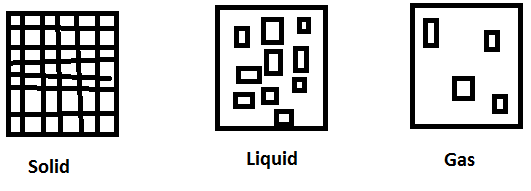
- In the solid state, particles can vibrate, but not move around. A solid has a definite shape.
- In the liquid state, particles are free to roll and slide over each other. A liquid will flow while a solid will not. Liquids get their shape from the container in which they are placed.
- In the gas state, particles are free to move in any direction. A gas will diffuse into all the space available to it. Therefore, gases can be compressed while liquids and solids cannot.
-
- The amount of energy needed to change the state of a substance therefore depends on the amount of energy needed to separate the particles.
- This, in turn, depends on the type of particle and the nature of the bonding between them.
- Substances which have strong intermolecular forces will require more energy to move from solid to liquid to gas. This means they will have higher boiling points.
- Ionic compounds experience stronger intermolecular forces than covalent compounds.
- Bigger molecules experience stronger intermolecular forces than small ones
-
Limitations of the Particle Model
- Limitations of the particle model in relation to changes of state when particles are represented by inelastic spheres:
- Does not take into account electric fields of particles
- Particles are always in motion, they only stop moving at -273°C
- Particles are not hard spheres
Information
- Description
- User has deleted their subject information Slide Set on States of Matter, created by Deleted user on 06/07/2017.
- Created by
- Deleted user · Jul 2017
- Updated
- Jul 6, 2017
- Views
- 12
- History
-
- Created by Niamh Ryan · Jul 5, 2017
- Copied by Niamh Ryan · Jul 6, 2017
- Rating