
Quiz
Chapter 8
This quiz has question types that open in the usual player.
Questions in this quiz (176)
1label the bacteriophage lambda
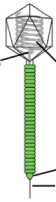
- Aportal vertex
- BDNA (ds and linear)
- Ctail cone
- Dhelical tail
- Ehead (T=7)
- FJ protein
2One of the [blank_start]vertices[blank_end] of the [blank_start]5[blank_end] fold of the head is attached to the helical portion
- A5
- Bvertices
3 • The [blank_start]portal vertex[blank_end] is where the DNA gets ejected out of the head and it is also the same location where the DNA gets loaded into during packaging
- Aportal vertex
4When the DNA is inside the bacteriophage lambda virus itself, it is going to be in a [blank_start]linear[blank_end] form. After infection of the cell, the DNA [blank_start]ligates[blank_end] and becomes [blank_start]circular[blank_end]
- Alinear
- Bcircular
- Cligates
5Lambda attaches to cells via the [blank_start]J protein[blank_end] which binds to cell membrane protein [blank_start]LamB[blank_end]
- AJ protein
- BLamB
6LamB found in E.coli [blank_start]outer[blank_end] membrane
- Aouter
7bacteriophage DNA is:
- Alinear
- Bcircular
- Css
- Ddd
- E40-60 kb
- F60-80 kb
- G80-100 kb
8Bacteriophage lambda have complementary [blank_start]ss[blank_end]DNA ends composed of [blank_start]12[blank_end] nucleotides at the [blank_start]5'[blank_end] end which are coshensive and base pair with each other
- Ass
- B12
- C5'
9What distinguishes bacteriophage lambda virus from MS2 and qbeta viruses is that gene regulation for lambda occurs at the transcriptional level.
- ATrue
- BFalse
10Transcriptional regulation of gene expression in bacteriophage lambda occurs as:
- AImmediate Early
- BEarly
- CMiddle
- DLate
11Bacteriophage lambda carry their own polymerases
- ATrue
- BFalse
12Bacteriophage lambda use cellular polymerases.
- ATrue
- BFalse
13The cellular polymerases bacteriophage lambda use are:
- AcDdRp
- BcRdRp
- CcDdDp
- DcRdDp
14Lyosgentic growth is also referred to as active growth
- ATrue
- BFalse
15Lytic growth is also referred to as active replication
- ATrue
- BFalse
16Lytic growth is [blank_start]independent[blank_end] of the cellular genome.
- Aindependent
17When a bacterium has a phage genome integrated in it, it is referred to as a [blank_start]lysogen[blank_end] and the phage inserted into the genome is referred to as the [blank_start]prophage[blank_end].
- Alysogen
- Bprophage
18Lysogentic growth is also referred to as [blank_start]passive[blank_end] replication
- Apassive
19UV light induces the integrated viral genome in the bacteria to exit and enter lytic growth
- ATrue
- BFalse
20The bacteriophage virus is likely to take on the lytic pathway if it senses that the cell it is infecting is [blank_start]metabolically active[blank_end]
- Ametabolically active
21The bacteriophage virus is likely to take on the lysogentic pathway if it senses that the cell it is infecting is [blank_start]metabolically inactive[blank_end]
- Ametabolically inactive
22Promotor left encodes protein Cro
- ATrue
- BFalse
23Promotor Left encodes protein N
- ATrue
- BFalse
24N, cro, cl and cll are all regulatory proteins
- ATrue
- BFalse
25N protein is an [blank_start]anti-terminator[blank_end] of both promotor left and right
- Aanti-terminator
26The left or right N utilization signal is bound by the N protein in its DNA version
- ATrue
- BFalse
27The left or right N utilization signal is bound by the N protein in its RNA version
- ATrue
- BFalse
28When N protein is not present, very small and very little transcripts are made, vs. when N is actually present
- ATrue
- BFalse
29Transcription from promotor left is going to allow [blank_start]recombination[blank_end] proteins to be expressed, whereas transcription from promotor right is going to allow [blank_start]replication[blank_end] proteins to be expressed
- Arecombination
- Breplication
30Regulatory proteins produce immediate early proteins
- ATrue
- BFalse
31Immediate early proteins produce regulatory proteins
- ATrue
- BFalse
32Regulatory proteins, produced by immediate early proteins, are going to turn on early genes, which turn on replication
- ATrue
- BFalse
33O and P proteins bind to the [blank_start]ori[blank_end] site on the circular, viral DNA which in turns, helps to recruit [blank_start]cDdDp[blank_end] to help start the replication process
- Aori
- BcDdDp
34O and P proteins are considered replication proteins , whereas cro, N, cI and cII are considered regulatory proteins.
- ATrue
- BFalse
35O and P proteins are transcribed by promotor left
- ATrue
- BFalse
36Protein Q is an anti-terminator for [blank_start]PR'[blank_end]
- APR'
37When Q protein is not present, polymerase will transcribe a little message that encodes for a tiny protein
- ATrue
- BFalse
38When Q is present, it will transcribe a little message which does not encode for anything but when Q is present it is going to anti terminate PR'
- ATrue
- BFalse
39Select the proteins made during immediate early gene expression:
- AReplication proteins
- BStructural proteins
- CN protein
- DLysis proteins
- EQ Proteins
- FCro proteins
40Select the proteins made during early gene replication?
- AN protein
- BStructural Protein
- CReplication Protein
- DQ Protein
- ECro Protein
- FLysis Protein
41Select the proteins made during late gene expression?
- ACro Protein
- BStructural Protein
- CLysis Protein
- DQ Protein
- EN Protein
- FReplication Protein
42Expression of early gene expression is going to help make more genome (Rep proteins)
- ATrue
- BFalse
43[blank_start]Q protein[blank_end] is going to anti-terminate PR' to help make structural proteins
- AQ protein
44When the head and tail portion are made, they are created together
- ATrue
- BFalse
45When PL and PR are both active, we are going to get [blank_start]lytic[blank_end] growth.
- Alytic
46In order to get [blank_start]lysogentic[blank_end] growth, we must turn off PL and PR
- Alysogentic
47What controls PL and PR?
- AProtein N
- BProtein cll
- Cprotein cl
- DProtein Q
- ELysis Proteins
48The [blank_start]Cl[blank_end] repressor blocks the lytic program.
- ACl
49The Cl protein contains a [blank_start]PRM[blank_end] promotor
- APRM
50Cl protein is made by only 1 promotor
- ATrue
- BFalse
51the RM in PRM for making Cl stands for [blank_start]repressor maintenance[blank_end]
- Arepressor maintenance
52The location of Cl is right in between [blank_start]PL[blank_end] and [blank_start]PR[blank_end]
- APR
- BPL
53Cl can do both inhibit and activate gene expression
- ATrue
- BFalse
54Cl protein binds at the [blank_start]initiation start[blank_end] site
- Ainitiation start
55[blank_start]-35[blank_end] and [blank_start]-10[blank_end] are specific regions on the DNA that the polymerase will bind to
- A-35
- B-10
56in addition to polymerase binding sequences there are also regulatory sequences such as the operator
- ATrue
- BFalse
57If the operator overlaps with a promotor region, [blank_start]competitive[blank_end] binding is going to occur
- Acompetitive
58operator [blank_start]A[blank_end] does not overlap with the polymerase binding region, whereas operator [blank_start]B[blank_end] does
- AA
- BB
59when a protein binds to operator [blank_start]b[blank_end] it is going to inhibit transcription.
when a protein binds to operator [blank_start]a[blank_end] it is going to enhance transcription.
[blank_start]cl[blank_end] can bind to either operator.- Ab
- Ba
- Ccl
60PRM and PR are made in opposite directions
- ATrue
- BFalse
61Cl is able to bind to all 3 operators: OR1, OR2 and OR3
- ATrue
- BFalse
62Cl prefers to bind to [blank_start]OR1[blank_end].
- AOR1
63C1 binds to OR1 as a single protein.
- ATrue
- BFalse
64There is a high level of [blank_start]cooperativity[blank_end] between operator 1 and operator 2.
- Acooperativity
65Once Cl dimer binds to OR1, another dimer binds to OR2
- ATrue
- BFalse
66The dimer bound to OR2 also interacts with the dimer bound on OR1
- ATrue
- BFalse
67When the cl dimers bind to OR1 and OR2, they block [blank_start]-10[blank_end] and [blank_start]-35[blank_end] regions
- A-10
- B-35
68RNA polymerase found at the PRM site can also interact with the cl dimer found on OR2.
- ATrue
- BFalse
69The dimer in OR1 is helping the RNA polymerase to bind to its promotor
- ATrue
- BFalse
70When OR1 and OR2 are filled in, PR is turned on
- ATrue
- BFalse
71When OR1 and OR2 are filled in, the PRM gets turned on
- ATrue
- BFalse
72PRM can be activated regardless if cl is around
- ATrue
- BFalse
73PL does not contain operators of its own.
- ATrue
- BFalse
74When Cl binds to OL1 and OL2, it turns on PL.
- ATrue
- BFalse
75When the level of cl gets very very high, eventually also [blank_start]OR3[blank_end] also gets filled in
- AOR3
76When OR3 gets filled, it activates PRM.
- ATrue
- BFalse
77It is only until the dimers on OL1, 2 and OR1 and 2 interact, that OR3 and L can be filled with cl protein and cooperatively bind dimers between them
- ATrue
- BFalse
78When cl levels are really high, it is going to turn cl transcription [blank_start]off[blank_end]
- Aoff
79Repression maintenance involves the regulation of [blank_start]cl[blank_end] levels all the time
- Acl
80When cl levels are high, OR3 site gets filled, turning transcription [blank_start]off[blank_end]
- Aoff
81[blank_start]Cl[blank_end] shuts off lytic program by repressing PL and PR
- ACl
82[blank_start]CII[blank_end] controls the level of CI in an infected cell
- ACII
83CII does not get expressed unless PR gets anti-terminated.
- ATrue
- BFalse
84When PR is not anti-terminated, only protein [blank_start]cro[blank_end] gets made.
- Acro
85CII gets expressed in [blank_start]early[blank_end] gene expression
- Aearly
86Promotor [blank_start]repressor establishment[blank_end] establishes CI regulation
- Arepressor establishment
87CI activates PRE.
- ATrue
- BFalse
88CII activates PRE.
- ATrue
- BFalse
89CLL activates promotors:
1.) [blank_start]Int[blank_end]
2.) [blank_start]PRE[blank_end]
3.) [blank_start]Paq[blank_end]- APaq
- BPRE
- CInt
90Once CII activates PRE, this will be the source of our CI, activating PRM because PRM depends on CI to make its own transcripts
- ATrue
- BFalse
91CII activates the promotor for Int, in which the protein is responsible for inserting the prophage DNA into the bacteria genome.
- ATrue
- BFalse
92Paq is an antisense message to [blank_start]mRNA-Q[blank_end]
- AmRNA-Q
93Paq makes an antisense mRNA q which has the [blank_start]opposite[blank_end] orientation and is [blank_start]complementary[blank_end] to the Q message, thus base pairing with it, blocking ribosomes from coming on. Q is responsible for turning on late messages
- Aopposite
- Bcomplementary
94When CII is low, we end up getting [blank_start]lytic[blank_end] growth.
- Alytic
95CII is going to be less stable in metabolically active cells because of active [blank_start]protease[blank_end] enzymes
- Aprotease
96When PL and PR are activated, we get immediate early expression of [blank_start]N[blank_end] and [blank_start]Cro[blank_end] protein, in which both will [blank_start]anti-terminate[blank_end] PL or PR.
PL and PR go on to synthesize [blank_start]Rec[blank_end], [blank_start]Repl[blank_end], [blank_start]Q[blank_end] and [blank_start]CII[blank_end] protein, in which CII gets degraded by proteases in metabolically active cells. The degradation of CII causes [blank_start]PRM[blank_end] and [blank_start]PRE[blank_end] not to be activated, and [blank_start]CI[blank_end] does not get produced. As a result, PL and PR are not repressed, and the lytic cycle program stays on.- AN
- BCro
- Canti-terminate
- DQ
- ECII
- FRec
- GRepl
- HPRM
- IPRE
- JCI
97In metabolically active cells, high levels of cll activates [blank_start]PRE[blank_end], [blank_start]Pint[blank_end], [blank_start]Paq[blank_end].
When [blank_start]PRE[blank_end] is activated, it will make cl.
When [blank_start]Pint[blank_end] is activated, the phage integrates.
When [blank_start]Paq[blank_end] is activated, an RNA is made that inhibits [blank_start]Q[blank_end] translation, decreasing the production of late genes.- APRE
- BPint
- CPaq
- DPRE
- EPint
- FPaq
- GQ
98When UV light hits a bacterium with a viral genome integrated in it, UV is going to damage the bacterial DNA and induce [blank_start]repair mechanisms[blank_end].
The virus thinks the cell is being damaged and might die. Virus thus has to excise. The protein [blank_start]Xis[blank_end] is required in addition to [blank_start]Int[blank_end] for excision.- Arepair mechanisms
- BXis
- CInt
99The LexA protein is a viral repressor protein
- ATrue
- BFalse
100The bacterial LexA repressor protein binds an operator which overlaps -10 and -35 regions on the bacterial, not the viral, genome.
- ATrue
- BFalse
101The binding of LexA to an operator sequence on the bacterial genome causes the repression of [blank_start]SOS[blank_end] repair mechanism expression.
- ASOS
102UV light introduces [blank_start]thymine[blank_end] dimers into DNA.
- Athymine
103The damage induced by UV is bound by protein [blank_start]RecA[blank_end].
- ARecA
104When RecA protein binds to damaged DNA, there is a conformational change that occurs in RecA, enabling it to bind to LexA
- ATrue
- BFalse
105Damaged bacterial DNA is recognized by LexA
- ATrue
- BFalse
106When RecA, in association with the damaged DNA, binds to LexA repressor, it induces a conformational change in LexA that causes its [blank_start]autoproteolytic[blank_end] activity to become active.
- Aautoproteolytic
107RecA is an autoprotease.
- ATrue
- BFalse
108Once LexA's autoproteoyltic activity is activated, it can no longer bind to the promotor turning on the SOS pathway
- ATrue
- BFalse
109CI binds to RecA because it contains a similar structure to [blank_start]LexA[blank_end]
- ALexA
110CI does not contain proteolytic activity
- ATrue
- BFalse
111When CI binds to RecA (along with damaged DNA), CI will become an [blank_start]autoprotease[blank_end]
- Aautoprotease
112CI concentration goes down once it binds with RecA/damaged DNA.
- ATrue
- BFalse
113Xis and Int get expressed by promotor [blank_start]left[blank_end]
- Aleft
114Xis and Int are expressed from early mRNA.
- ATrue
- BFalse
115The cos sites are the integration sites
- ATrue
- BFalse
116the circular genome integrates at attP (attachment prophase)
- ATrue
- BFalse
117The attP sequence found on the viral genome attacks another sequence on the bacterial genome for integration, called [blank_start]attB[blank_end]
- AattB
118When the circular genome integrates, it does so at the attP sequence site.
- ATrue
- BFalse
119The cos site is located 180 directly above the attP site when the genome is circularized.
- ATrue
- BFalse
120attP's only binds to attB.
- ATrue
- BFalse
121Pint promotor is bound by CI to turn it on.
- ATrue
- BFalse
122Pint promotor, because of its location, only makes Int
- ATrue
- BFalse
123During viral genome integration, [blank_start]Int[blank_end] protein is what we need from the virus, and [blank_start]IHF[blank_end] protein from the bacteria
- AInt
- BIHF
124IHF's job is to help w/ [blank_start]bending[blank_end] of the DNA genome
- Abending
125When CII levels are high, no Xis gets made
- ATrue
- BFalse
126UV shines on integrated prophage with the bacteria, CI levels decrease due to it's [blank_start]autoprotase[blank_end] activity
- Aautoprotase
127When PL becomes activated, Int and Xist are going to be made.
- ATrue
- BFalse
128Int and Xis are required for the excision step, but not IHF.
- ATrue
- BFalse
129IHF is required in both integration and excision pathways for the bacteriophage.
- ATrue
- BFalse
130[blank_start]O[blank_end] and [blank_start]P[blank_end] proteins are responsible for the replication of the dsDNA genome of lambda, in which these proteins are going to bind to ori.
- AP
- BO
131O and P proteins are viral polymerases.
- ATrue
- BFalse
132O and P proteins bind to ori to help guide proteins and other factors to the ori
- ATrue
- BFalse
133O and P proteins get transcribed by the activation of PL.
- ATrue
- BFalse
134O and P proteins are produced during EARLY gene replication
- ATrue
- BFalse
135O and P proteins are early gene proteins
- ATrue
- BFalse
136O and P proteins are both early genes expressed from anti-terminator of the [blank_start]PR[blank_end] by [blank_start]N[blank_end] protein.
- AN
- BPR
137O protein recruits a bacterial helicase called DnaB to ori.
- ATrue
- BFalse
138O protein binds ori and melts adjacent [blank_start]AT[blank_end]-rich regions
- AAT
139P protein recruits [blank_start]bacterial[blank_end] helicase called [blank_start]DnaB[blank_end] to [blank_start]ori[blank_end].
- ADnaB
- Bori
- Cbacterial
140O protein alone, is sufficent enough to melt ori
- ATrue
- BFalse
141cDdDp have de novo initiation (they can start w/o a primer)
- ATrue
- BFalse
142cDdDp is primer dependent.
- ATrue
- BFalse
143cDdDp depends on cDdRp.
- ATrue
- BFalse
144In the bacteria, its cDdRp is also considered a [blank_start]primase[blank_end]
- Aprimase
145When the linear genome gets inside a bacterium and it circularizes, there is a [blank_start]small[blank_end] amount of replication that occurs before the incision is made
- Asmall
146Early replication (small viral replication) occurs before lytic/lysogenic decision
- ATrue
- BFalse
147Early replication of the virus when injected into the bacterium is uni-directional
- ATrue
- BFalse
148Early replication of the viral genome occurs and replicates only 1 circular genome
- ATrue
- BFalse
149Early replication of the viral genome occurs and replicates few linear genomes
- ATrue
- BFalse
150In the lytic mode, many [blank_start]linear[blank_end] copies of the genome are made by the [blank_start]rolling circle[blank_end] mechanism
- Alinear
- Brolling circle
151An example of a virus that replicates its genome via rolling circle mechanism is [blank_start]HSV[blank_end]
- AHSV
152A [blank_start]concatemer[blank_end] is connected copies of the same thing
- Aconcatemer
153When the virus would want to replicate A LOT of genomes, it uses a rolling circle mechanism
- ATrue
- BFalse
154late genes expressed from anti-terminated [blank_start]PR'[blank_end] (by Q)
- APR'
155Many late structural proteins involved in assembly:
1.) some of them are [blank_start]cleaved[blank_end] during incorporation. The protein gets modified after it becomes incorporated.
2.) Some are incorporated [blank_start]intact[blank_end].
3.) Some proteins are [blank_start]scaffolding[blank_end] therefore, not incorporated.- Aintact
- Bcleaved
- Cscaffolding
156The gp in gpNu1 and gpA refers to [blank_start]glycoprotein[blank_end]
- Aglycoprotein
157The proteins [blank_start]Nu1[blank_end] and [blank_start]A[blank_end] are responsible for filling the icosahedral head in lambda, with DNA.
- ANu1
- BA
158The Nu1 and A protein complex together is referred to as the [blank_start]terminase[blank_end].
- Aterminase
159Terminase acts as a restriction enzyme, binding to the cos site and nicks the opposite strand 12 bp apart, leaving a 5' overhang
- ATrue
- BFalse
160Terminase acts as a restriction enzyme, binding to the cos site and nicks the opposite strand [blank_start]12[blank_end] bp apart, leaving a [blank_start]5'[blank_end] overhang
- A12
- B5'
161Once terminase binds to the DNA at the cos site and cuts it, it immediately dissociates from the DNA.
- ATrue
- BFalse
162Unlike MS2, in which the capsid is built around the genome, bacteriophage capsids are built empty.
- ATrue
- BFalse
163A capsid built empty is referred to as a [blank_start]prohead[blank_end].
- Aprohead
164The terminase associated with the DNA binds to the [blank_start]portal[blank_end] of the prohead.
- Aportal
165the portal of the prohead is [blank_start]helical[blank_end]
- Ahelical
166The terminase [blank_start]translocates[blank_end] the genome, up to the next cos site into the prohead.
- Atranslocates
167One terminase can only feed into one prohead.
- ATrue
- BFalse
168There is a conformational change that occurs when the genome gets filled into the prohead, leading to [blank_start]maturation[blank_end].
- Amaturation
169A pre-assembled tail section binds to the prohead.
- ATrue
- BFalse
170The terminase plays a dual role where it does both: chopping of the DNA as well as filling it into the prohead.
- ATrue
- BFalse
171[blank_start]S[blank_end] protein forms a [blank_start]pore[blank_end] in the cell membrane so that proteins [blank_start]R[blank_end] and [blank_start]Rz[blank_end] can get to peptidoglycan of the cell wall.
- AS
- BR
- CRz
- Dpore
172Proteins [blank_start]R[blank_end] and [blank_start]Rz[blank_end] digest bacterial cell walls.
- AR
- BRz
173R protein is also referred to as trans[blank_start]glycosidase[blank_end].
- Aglycosidase
174Rz protein is also referred to as endo[blank_start]peptidase[blank_end].
- Apeptidase
175Which viral protein is involved in digesting the sugars in the bacterial cell wall?
- AR
- BRz
176Which viral protein is involved in digesting the peptides in the bacterial cell wall?
- AR
- BRz
Information
- Description
- Quiz on Chapter 8 , created by Nina Butris on 25/02/2019.
- Author
- Nina Butris
- Language
- English
- Views
- 2
- Rating
- No ratings yet Rate this quiz