
Quiz
Protein Structure Pt. 1
Create a free account to finish this quiz
Save your progress and see your final score.
Already have an account? Sign in
Questions in this quiz (39)
1Which type of protein is conjugated?
- AOne that contains only amino acid residues
- BOne that contains prosthetic groups
- COne that is bound to a membrane
2Which of the following means a protein with two identical subunits?
- AHeteromultimer
- BHomomonomer
- CHomomultimer
3Which of the following proteins types tend to have various roles, as opposed to a single, defined one?
- AFibrous
- BGlobular
- CMembrane
4Which of the following tend not to be water soluble?
- AFibrous
- BGlobular
- CMembrane spanning
5What secondary structures tend to make up fibrous proteins?
- ALong strands
- BLong sheets
- CShort strands
6What is specific about the membrane spanning part of membrane proteins?
- AThey are hydrophobic
- BThey are hydrophillic
7Define 'Domain' in reference to protein structure
- AIndependent folding units of the tertiary structure that have independent functions
- BIndependent folding units of tertiary structure that have related functions
- CDependent folding units of secondary structure that have relation functions
- DDependent folding units of tertiary structure that have related functions
8Define subunit
- AIndependent structures in a quaternary structure
- BIndependent structures in a tertiary structure
- CDependent subunits in a quaternary structure
9What can be the result of a single amino acid mutation in collagen?
- AOsteoarthritis
- BOsteogenesis imperfecta
- COsteocalcification
10What is Resonance (as pertaining to protein structure)?
- AWhere bond pairs cannot be described as a single Lewis Diagram
- BWhere two atoms in separate molecules cause each other to vibrate
- CWhere two atoms in separate molecules are more likely to bond to each other than to another atom
11Which is the psi bond?
- ABetween the carbonyl carbon and the alpha carbon
- BBetween the alpha carbon and the amide group
- CBetween the alpha carbon and the R group
12Which is the phi bond?
- ABetween the alpha carbon and the amide group
- BBetween the alpha carbon and the carbonyl carbon
- CBetween the alpha carbon and the R group
13What is Steric clashing?
- AWhere the charge of an atom prevents it from being close to another
- BWhere the electron arrangement of an atom prevents it from being close to another
- CWhere the size of an atom prevents it from being close to another
14Why is a peptide bond planar?
- AIt has a double bond like structure
- BIt's electrons clash with that of the psi bond
- CIt's electrons clash with the phi bond
15How many residues per turn in an alpha helix?
- A3.4
- B3.5
- C3.6
16How much does an alpha helix rise per aa?
- A1.5 angstroms
- B1.6 angstroms
- C1.7 angstroms
17Alpha helices are stabilised by hydrogen bonding with what groups?
- ACarbonyl oxygen 4 amino acids away
- BCarbonyl oxygen 6 amino acids away
- CCarbonyl oxygen 8 amino acids away
18The stabilising effect of the hydrogen bonds makes a loop of how many atoms?
- A12
- B13
- C14
19Which of the following destabilize an alpha helix?
- AGlycine
- BProline
- CLeucine
- DGlutamic acid
20Beta sheets rise by 3.47A per residue in anti-parallel sheets
- ATrue
- BFalse
21In parallel sheets, there is a rise of .... per residue
- A3.25A
- B4.25A
- C2.25A
223 residues per turn of the strand are pictured as a helix
- ATrue
- BFalse
23Anti-parallel strands are _ stable than parallel ones
- AMore
- BLess
24Side chains all point the same way (in the plane of the sheet)
- ATrue
- BFalse
25What is the role of loops?
- AConnecting alpha and beta sheets
- BConnecting alpha helices and alpha helices
- CConnecting beta sheets and beta sheets
26Loops contain mostly hydrophillic residues & are found on the protein surface
- ATrue
- BFalse
27What is the role of beta turns?
- ATo allow beta sheets to reverse direction
- BTo connect beta sheets together
- CTo link protein subunits together
28What two amino acids cannot be contained within a beta sheet?
- AProline
- BArgenine
- CGlycine
- DValine
29Beta turns link the oxygen of the carbonyl group and the hydrogen of the nitrile group 4 residues away
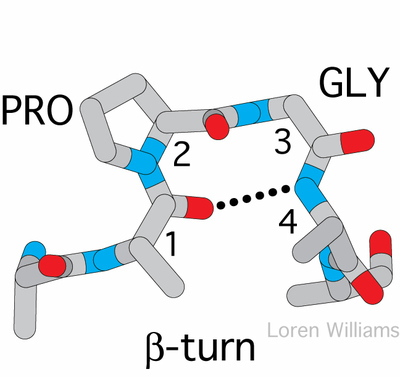
- ATrue
- BFalse
30Levinthals Paradox- if a protein folded by trying each fold in a sequence, it would take an impossibly long time to fold correctly. Therefore, protein folding cannot be random or sequential
- ATrue
- BFalse
31What is this?
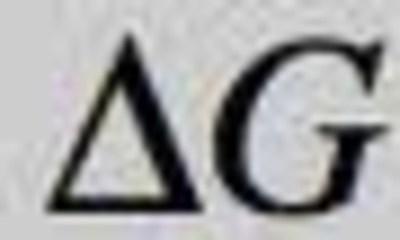
- AThe energy change as proteins fold
- BGibbs free energy
- CEntropy change
32Why are the internal interactions of protein folding unfavorable?
- AIt decreases entropy
- BThey're hydrophobic in a hydrophillic environment
- CThey prevent the protein from folding correctly
33Non-covalent and hydrophobic effects (which effects free water) decrease enthalpy
- ATrue
- BFalse
34Change in energy during folding = Internal interactions - (Hydrophobic effect + conformational entropy)
- ATrue
- BFalse
35Proteins fold towards configurations with the...
- Alowest energy
- BHighest energy
- CEasiest energy to reach (energy closest to that of unfolded protein)
36What can slow the progress of protein folding?
- AA local low energy minimum
- BA local high energy minimum
37What is nucleation?
- AReversible secondary structure formation
- BReversible tertiary structure formation
- CReversible quaternary structure formation
38Which of the following happens after nucleation?
- AThe secondary structure aggregation forms a molten globular intermediate
- BDomains adjust to the lowest energy form
39The protein is capable of conformational change after forming
- ATrue
- BFalse
Information
- Description
- Structural Basis for Biological Function (Basics) Quiz on Protein Structure Pt. 1, created by gina_evans0312 on 21/09/2013.
- Author
- gina_evans0312
- Language
- English
- Views
- 1,022
- Tags
- Rating
- No ratings yet Rate this quiz