
Quiz
9.1 Quiz
This quiz has question types that open in the usual player.
Questions in this quiz (18)
1Label the following image.
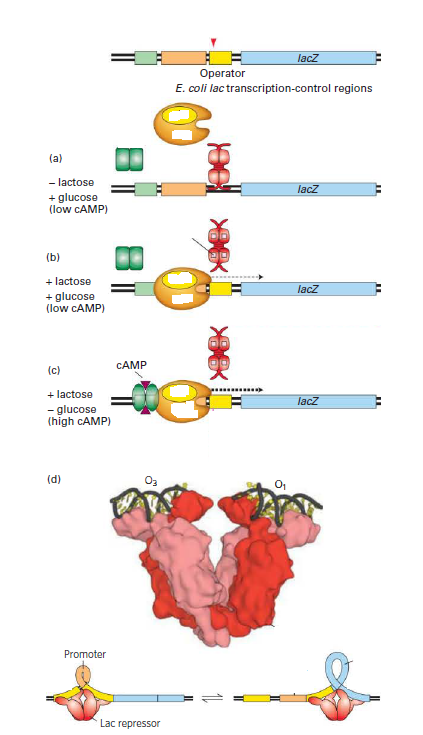
- APromoter
- BCAP site
- Ctranscription start site
- Dsigma^70
- ECAP
- Flac repressor
- Glactose
- HcAMP
- Ihigh transcription
- Jlow transcription
- Kno transcription
- LO3
- MO1
- NlacZ
- OO2
- PO3 (right picture)
- Qpromoter
- RO1 (right picture)
- SlacZ (right picture)
- TO2 (right picture)
2Most E. coli promoters interact with _____ polymerase,
the major initiating form of the bacterial enzyme.- Asigma^90-RNA
- Balpha^70-RNA
- Csigma^70-RNA
- Dbeta^80-RNA
3In E. coli, there are [blank_start]6[blank_end] alternative σ-factors in addition to the major “housekeeping”
σ-factor, σ70.- A6
4One class, represented in E. coli by ___, is unrelated to σ70 and functions differently
- Aσ67
- Bσ54
- Cσ11
- Dσ70
5Transcription of genes by RNA polymerases
containing σ54 is regulated solely by activators whose
binding sites in DNA, referred to as [blank_start]enhancers[blank_end], are generally
located 80–160 bp [blank_start]upstream[blank_end] from the transcription start site.- Aenhancers
- Bupstream
6Transcription by σ54-RNA Polymerase Is
Controlled by Activators That Bind close to the
Promoter- ATrue
- BFalse
7Even when enhancers are moved more than a kilobase away
from a start site, σ54-activators can activate transcription- ATrue
- BFalse
8Electron microscopy studies have shown that phosphorylated
NtrC bound at enhancers and σ54-polymerase bound
at the promoter interact directly, forming a [blank_start]loop[blank_end] in the
DNA between the binding sites (Figure 9-5). As discussed
later in this chapter, this activation mechanism resembles
the predominant mechanism of transcriptional activation
in [blank_start]eukaryotes[blank_end].- Aloop
- Beukaryotes
9The best-characterized σ54-activator—the [blank_start]NtrC[blank_end] protein
- ANtrC
10The operator is where the [blank_start]repressor[blank_end] binds.
- Arepressor
11The [blank_start]promoter[blank_end] is where RNA-Polymerase binds.
- Apromoter
12Gene expression in both prokaryotes and eukaryotes is regulated
primarily by mechanisms that control gene [blank_start]transcription[blank_end].- Atranscription
13The first step in the initiation of transcription in E. coli
is the binding of a [blank_start]sigma[blank_end]-factor complexed with an [blank_start]RNA polymerase[blank_end]
to a [blank_start]promoter[blank_end].- Asigma
- BRNA polymerase
- Cpromoter
14The ___________ of a promoter determines its
strength, that is, how frequently different RNA polymerase
molecules can bind and initiate transcription per minute.- AGC content
- Bnucleotide sequence
- CAT content
- DThere is no correlation between the promoter and its strength.
15[blank_start]Repressors[blank_end] are proteins that bind to [blank_start]operator[blank_end] sequences that
overlap or lie adjacent to promoters. Binding of a [blank_start]repressor[blank_end] to
an operator inhibits transcription initiation or elongation.- ARepressors
- Boperator
- Crepressor
16Genes transcribed by σ54-RNA polymerase are regulated
by activators that bind to enhancers located about 100
base pairs [blank_start]upstream[blank_end] from the start site. When the activator
and σ54-RNA polymerase interact, the DNA between their
binding sites forms a [blank_start]loop[blank_end]- Aloop
- Bupstream
17In [blank_start]two-component regulatory systems[blank_end], one protein acts as
a sensor, monitoring the level of nutrients or other components
in the environment. Under appropriate conditions, the γ-phosphate of an ATP is transferred first to a [blank_start]histidine[blank_end] in the sensor protein and then to an [blank_start]aspartic acid[blank_end] in a second protein,
the response regulator. The phosphorylated response regulator
then performs a specific function in response to the stimulus,
such as binding to DNA regulatory sequences, thereby stimulating
or repressing transcription of specific genes- Atwo-component regulatory systems
- Bhistidine
- Caspartic acid
18Transcription in bacteria can also be regulated by control
of [blank_start]transcriptional elongation[blank_end] in the [blank_start]promoter-proximal[blank_end] region.
This control can be exerted by ribosome binding to the
nascent mRNA, as in the case of the E. coli trp operon (see
Figure 9-7), or by riboswitches, RNA sequences that bind
small molecules, as for the B. subtilis xpt-pbuX operon (see
Figure 9-8), to determine whether a stem-loop followed by
a string of uracils forms, causing the bacterial RNA polymerase
to pause and terminate transcription.- Atranscriptional elongation
- Bpromoter-proximal
Information
- Description
- Advanced Cell Biology I (Unit 1) Quiz on 9.1 Quiz, created by Brooks Johnson on 31/05/2020.
- Author
- Brooks Johnson
- Language
- English
- Views
- 23
- History
- Created on 31 May 2020 · updated on 31 May 2020
- Tags
- Rating
- No ratings yet Rate this quiz