
Quiz
B3 Quiz
This quiz has question types that open in the usual player.
Questions in this quiz (11)
1What is a species?
- AA group of organisms that can breed together to produce fertile offspring.
- BA group of similar organisms.
- CThe environment in which an organism lives.
2It is not just the environment that affects the chances of a [blank_start]organism[blank_end] surviving. Organisms are also dependant on other [blank_start]species[blank_end] for their survival. They may depend on other species for food or for their habitat. Many species of insect, for example, have habitats within or on particular [blank_start]plants[blank_end].
In a particular habitat there will be competition between species for resources. [blank_start]Animals[blank_end] may compete for breeding sites or territories, food, mates or living space. Plants may compete for space, [blank_start]light[blank_end], nutrients and water.
A food web shows the feeding [blank_start]interactions[blank_end] of some of the species within a habitat. Because species depend on each other in many ways, any impact on one species within a food web will have a [blank_start]knock-on effect[blank_end] on many of the other species that are part of the same food web. Food webs are extremely useful because they give us a visual representation of [blank_start]interdependence[blank_end].- Aorganism
- Bspecies
- Cplants
- DAnimals
- Elight
- Finteractions
- Ginterdependence
- Hknock-on effect
3Using the diagram, choose the correct equation for photosynthesis.
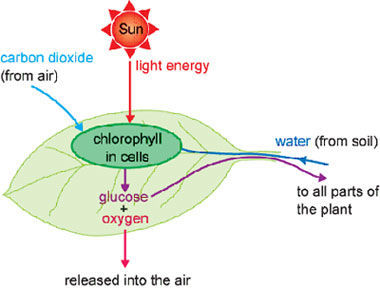
- Acarbon dioxide + water (+sunlight) -> glucose + oxygen
- Boxygen + water (+sunlight) -> glucose + carbon dioxide
- Cglucose + oxygen -> carbon dioxide + water (+sunlight)
4The efficiency of transfer of energy at each level of a food chain is the ratio of the energy available in the organism's tissues to the total amount of energy the organism has ingested.
percentage efficiency = (energy in tissues/energy in food eaten) x 100- ATrue
- BFalse
5Complete the diagram of the carbon cycle.
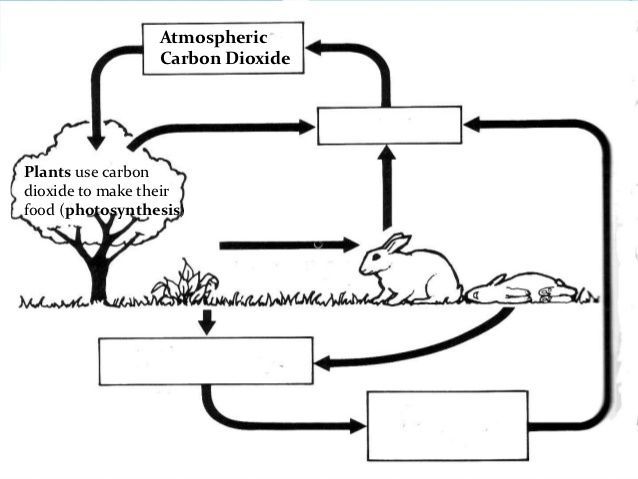
- Adecay by fungi and bacteria
- Brespiration
- Cdead remains of plants and animals
- Dgreen plants are eaten by animals
- ECO2 added through combustion
6Complete the diagram of the nitrogen cycle.
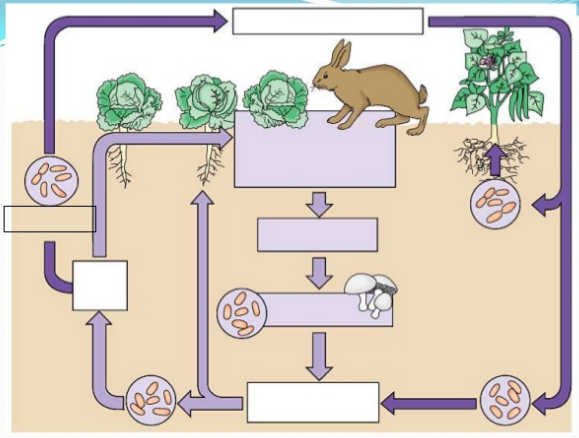
- ANitrogen gas in the atmoshpere
- BNitrogen-fixing bacteria in plant roots
- CNitrogen-fixing bacteria in soil
- DAmmonium
- ENitrates
- FDenitrifying bacteria
- GDetrivores
- HDecomposition
- IAmino acids/proteins in plants & animals
7What are examples of non-living indicators?
- Amayflies
- Bcarbon doixide levels
- Ctemperature
- Dphytoplankton
8Organisms can be [blank_start]classified[blank_end] in many different ways. In the past, organisms were classified mainly by their [blank_start]appearance[blank_end]. Today, we have a much more [blank_start]accurate[blank_end] way of classifying organisms, based on their DNA [blank_start]sequences[blank_end]. Organisms with more similar DNA are likely to be more [blank_start]similar[blank_end] species. Classifying organisms in this way helps us to see how they [blank_start]evolved[blank_end]. A [blank_start]common[blank_end] ancestor is the most recent individual from which all organisms in a group are descended. Organisms with the most similar DNA have more [blank_start]recent[blank_end] common ancestors than those with [blank_start]less[blank_end] similar DNA.
- Aclassified
- Bappearance
- Caccurate
- Dsequences
- Esimilar
- Fevolved
- Gcommon
- Hrecent
- Iless
9Biodiversity is the word used to describe the variety of living things in a habitat.
- ATrue
- BFalse
10Define 'Sustainability'.
- AFinding a way to meet our needs now without stopping future generations from meeting their needs.
- BUsing renewable resources.
11How can we improve sustainability?
- Arecycle more
- Buse products that need little energy to be produced
- Cuse bio-degradable products
- Dconserve our finite resources
- Euse more electricity
- Fincrease packaging
Information
- Description
- GCSE Biology (B3 - Life on Earth) Quiz on B3 Quiz, created by Leah Firmstone on 31/10/2015.
- Author
- Leah Firmstone
- Language
- English
- Views
- 63
- Tags
- Rating
- No ratings yet Rate this quiz