
Quiz
SD329 Block 2
This quiz has question types that open in the usual player.
Questions in this quiz (36)
1Label the lobes of the brain
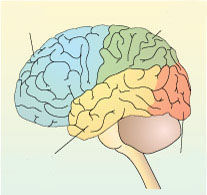
- Afrontal lobe
- Btemporal lobe
- Coccipital lobe
- Dparietal lobe
2Label the brain
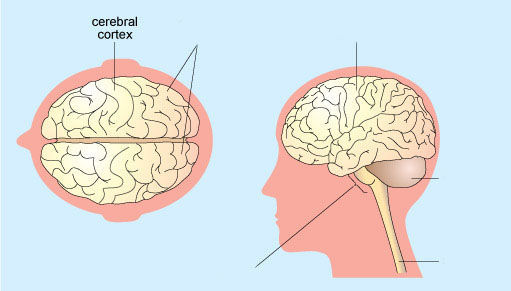
- Acerebral cortex
- Bcerebral hemispheres
- Cbrainstem
- Dcerebellum
- Espinal cord
3Label the directions
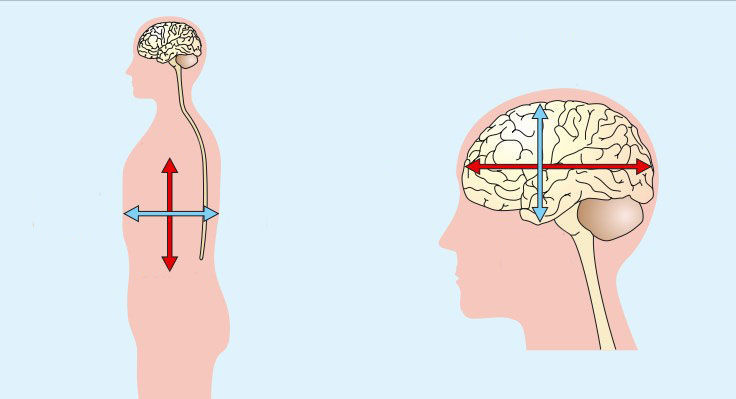
- Arostral
- Bcaudal
- Cventral
- Ddorsal
- Erostral
- Fcaudral
- Gdorsal
- Hventral
- Irostral
- Jcaudral
- Kdorsal
- Lventral
- Mrostral
- Ncaudral
- Odorsal
- Pventral
- Qrostral
- Rcaudral
- Sdorsal (posterior)
- Tventral (anterior)
- Urostral
- Vcaudal
- Wdorsal (posterior)
- Xventral (anterior)
- Yrostral
- Zcaudal
- AAdorsal (superior)
- ABventral (inferior)
- ACrostral
- ADcaudal
- AEdorsal (superior)
- AFventral (inferior)
4Label the directions
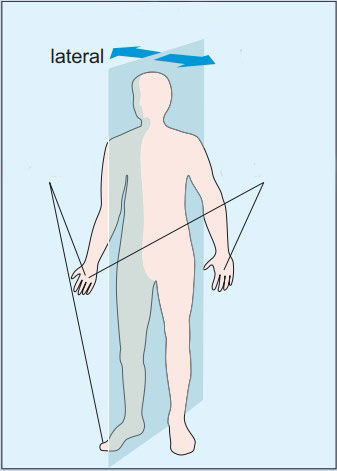
- Amedial plane
- Blateral
- Cipsilateral
- Dcontralateral
5Label the planes!
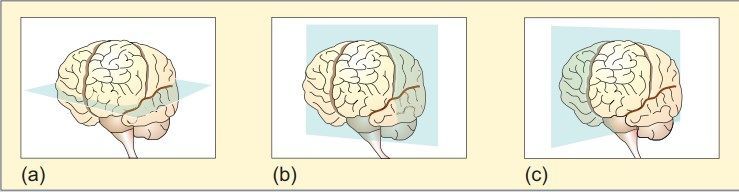
- Ahorizontal (or axial/transverse)
- Bcoronal
- Csagittal
6The nervous system can be divided into the [blank_start]central[blank_end] and peripheral nervous systems (CNS and PNS, respectively). The CNS consists of the [blank_start]brain and the spinal cord[blank_end] while the PNS comprises all the [blank_start]peripheral nerves[blank_end].
The brain is housed within the [blank_start]skull[blank_end] and protected by the [blank_start]meninges[blank_end] and bone. It is divided into two [blank_start]hemispheres[blank_end] and its outer structure is dominated by the [blank_start]cerebral cortices[blank_end], which can be divided into a number of [blank_start]functionally distinct[blank_end] areas.
The spinal cord consists of a [blank_start]tubular bundle[blank_end] of nerve tissue within the vertebrae which has a series of [blank_start]repeating segments[blank_end], each with associated [blank_start]spinal nerves[blank_end] and dorsal [blank_start]root ganglia[blank_end].- Acentral
- Bbrain and the spinal cord
- Cperipheral nerves
- Dskull
- Emeninges
- Fhemispheres
- Gcerebral cortices
- Hfunctionally distinct
- Itubular bundle
- Jrepeating segments
- Kspinal nerves
- Lroot ganglia
7Which of these are specific to neurons?
- Aplasma membrane
- Bcell body
- Caxon
- Ddendrites
- Emitochodria
- Flysosome
8Ogliodendrocyte functions:
- AMake myelin in the brain and spinal cord
- BMake myelin in the PNS
- CStructural support
- DProvide nutrients to neurons
9The cells within the nervous system can be broadly classed as either n[blank_start]eurons[blank_end] or g[blank_start]lia[blank_end].
[blank_start]Neurons[blank_end] are the main signalling cells and have specialised processes, called a[blank_start]xons[blank_end] and d[blank_start]endrites[blank_end] for this purpose. They are functionally connected to one another by [blank_start]synapses[blank_end]. Signalling across synapses may be e[blank_start]lectrical[blank_end] or c[blank_start]hemical[blank_end]. The [blank_start]postsynaptic[blank_end] neuron will ultimately respond with a changed membrane potential called a [blank_start]synaptic potential[blank_end].
If the combined input of synaptic potentials is sufficient then the neuron will produce an [blank_start]action potential[blank_end] which differs in a number of ways from the synaptic potential, not least because it is [blank_start]‘all-or-nothing’[blank_end] .
Although the [blank_start]frequency[blank_end] of action potentials may vary, the speed of [blank_start]conduction[blank_end] of action potentials is constant along the length of an axon and depends on a number of factors including whether or not it is [blank_start]myelinated[blank_end]: myelinated axons conduct action potentials [blank_start]faster[blank_end] than unmyelinated axons.
[blank_start]Glia[blank_end] provide support and [blank_start]structure[blank_end] to the nervous system. They have [blank_start]‘housekeeping’[blank_end] duties, nourishing nervous tissue by regulating the supply of [blank_start]nutrients[blank_end], including oxygen, and also a [blank_start]protective[blank_end] role by mopping up debris and buffering ions in the extracellular fluid. They also provide [blank_start]myelin[blank_end]: [blank_start]oligodendrocytes[blank_end] in the CNS; [blank_start]Schwann cells[blank_end] in the PNS.- Aeurons
- Blia
- CNeurons
- Dxons
- Eendrites
- Fsynapses
- Glectrical
- Hhemical
- Ipostsynaptic
- Jsynaptic potential
- Kaction potential
- L‘all-or-nothing’
- Mfrequency
- Nconduction
- Omyelinated
- Pfaster
- QGlia
- Rstructure
- S‘housekeeping’
- Tnutrients
- Uprotective
- Vmyelin
- Woligodendrocytes
- XSchwann cells
10Label the neuron!
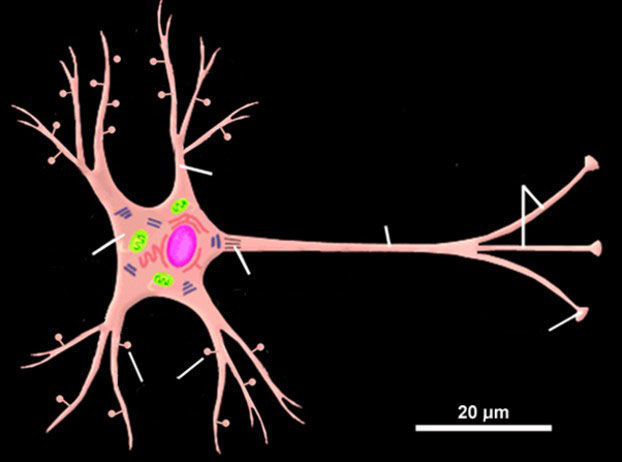
- Acell body
- Bdendritic spines
- Cdendrite
- Daxon hillock
- Eaxon
- Faxon branches
- Gaxon terminal
11The [blank_start]neuronal membrane[blank_end], similar to the membrane surrounding other cells, is a highly dynamic structure composed of a [blank_start]phospholipid bi-layer[blank_end] in which are immersed glycolipids, [blank_start]glycoproteins[blank_end] and other protein molecules.
The neuronal membrane acts as a [blank_start]selective barrier[blank_end] separating the internal chemical environment from that outside the neuron.
Some of the [blank_start]glycolipid[blank_end], glycoprotein and protein molecules embedded in the cell membrane act as [blank_start]chemical receptors[blank_end] for [blank_start]signalling molecules[blank_end].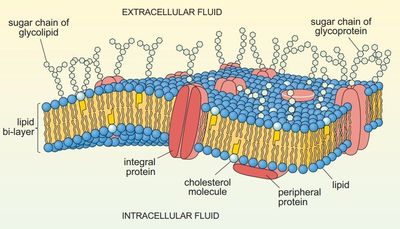
- Aneuronal membrane
- Bphospholipid bi-layer
- Cglycoproteins
- Dselective barrier
- Eglycolipid
- Fchemical receptors
- Gsignalling molecules
12There are three main transport mechanisms across the neuronal membrane:
◦ passive [blank_start]diffusion[blank_end]
◦ transport by [blank_start]membrane proteins[blank_end]
◦ in membrane-bound [blank_start]vesicles[blank_end].
The unequal distributions of K+ and Na+ on the inside and outside of the neuronal membrane produce [blank_start]concentration[blank_end] and potential [blank_start]gradients[blank_end].
When these concentration and potential gradients are at an [blank_start]electrochemical equilibrium[blank_end], there is a potential difference (a voltage) across the neuronal membrane of about [blank_start]−70 mV[blank_end]. This equilibrium or [blank_start]resting membrane potential[blank_end] can be calculated from the Nernst equation (and by the Goldman–Hodgkin–Katz equation if membrane permeability is considered).- Adiffusion
- Bmembrane proteins
- Cvesicles
- Dconcentration
- Egradients
- Felectrochemical equilibrium
- G−70 mV
- Hresting membrane potential
13When the neuronal membrane is sufficiently [blank_start]depolarised[blank_end] to a critical threshold value, an ‘all-or-nothing’ action potential is generated at the [blank_start]axon hillock[blank_end] and transmitted along its axon to the [blank_start]axon terminals[blank_end].
An action potential has [blank_start]three[blank_end] distinct phases – depolarisation, repolarisation and [blank_start]hyperpolarisation[blank_end] – which involve the highly ordered movement of [blank_start]Na+ and K+[blank_end] across the neuronal membrane through [blank_start]voltage gated ion channels[blank_end].
Action potentials travel faster in [blank_start]myelinated axons[blank_end] and those with a larger [blank_start]axon diameter[blank_end]. Temperature may also affect conduction speed.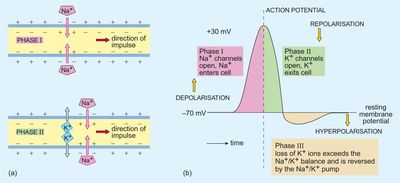
- Adepolarised
- Baxon hillock
- Caxon terminals
- Dthree
- Ehyperpolarisation
- FNa+ and K+
- Gvoltage gated ion channels
- Hmyelinated axons
- Iaxon diameter
14The passage of a signal across an [blank_start]electrical synapse[blank_end] can be in either direction ([blank_start]bidirectional[blank_end]) and there is no [blank_start]synaptic delay[blank_end]. By contrast, a [blank_start]chemical synapse[blank_end] is [blank_start]rectified[blank_end] (goes one way only) and subject to a synaptic delay caused by the need to release the [blank_start]neurotransmitter[blank_end], have it travel across the [blank_start]synaptic cleft[blank_end] and have its affect on the [blank_start]postsynaptic neuron[blank_end].
- Aelectrical synapse
- Bbidirectional
- Csynaptic delay
- Dchemical synapse
- Erectified
- Fneurotransmitter
- Gsynaptic cleft
- Hpostsynaptic neuron
15The release of [blank_start]neurotransmitter[blank_end] from a chemical synapse requires that there is first an influx of [blank_start]Ca2+ ions[blank_end] across the [blank_start]presynaptic membrane[blank_end].
After release, the neurotransmitter binds to [blank_start]receptors[blank_end] on the [blank_start]postsynaptic membrane[blank_end] and, directly or indirectly, this leads to the opening of [blank_start]channels[blank_end] so that ions can cross the membrane.- Aneurotransmitter
- BCa2+ ions
- Cpresynaptic membrane
- Dreceptors
- Epostsynaptic membrane
- Fchannels
16Depending on the type of [blank_start]channel[blank_end] opened and the specific [blank_start]ion[blank_end] that can cross the [blank_start]postsynaptic membrane[blank_end], the membrane will be [blank_start]depolarised[blank_end] (EPSP) or [blank_start]hyperpolarised[blank_end] (IPSP). The neurotransmitter is [blank_start]actively removed[blank_end] from the [blank_start]synaptic cleft[blank_end].
Neurons [blank_start]integrate[blank_end] afferent inputs using [blank_start]spatial[blank_end] and temporal [blank_start]summation[blank_end].- Achannel
- Bion
- Cpostsynaptic membrane
- Ddepolarised
- Ehyperpolarised
- Factively removed
- Gsynaptic cleft
- Hspatial
- Isummation
- Jintegrate
17There is a great variety of [blank_start]sensory receptor cells[blank_end] but they all have specific [blank_start]receptive fields[blank_end] and are capable of generating a [blank_start]receptor potential[blank_end] which can affect the firing of [blank_start]afferent neurons[blank_end] sending sensory information to the [blank_start]brain[blank_end]. In some cases, the afferent neuron and receptor cell are the same.
Alternatively, where the receptor cell is not equipped to produce an action potential, it will [blank_start]synapse[blank_end] with an afferent [blank_start]neuron[blank_end] capable of doing so.- Asensory receptor cells
- Breceptive fields
- Creceptor potential
- Dafferent neurons
- Ebrain
- Fsynapse
- Gneuron
18Sensory signals reach the CNS via the [blank_start]spinal[blank_end] and cranial [blank_start]nerves[blank_end].
Once in the CNS, the majority of information crosses the [blank_start]midline[blank_end] to be processed on the [blank_start]contralateral[blank_end] side of the brain.- Aspinal
- Bnerves
- Cmidline
- Dcontralateral
19The majority of information travels to the [blank_start]cortex[blank_end] for processing via the [blank_start]thalamus[blank_end] which acts as a filter for [blank_start]sensory information[blank_end].
The architecture of the cortex includes both [blank_start]horizontal[blank_end] layers and vertical [blank_start]columns[blank_end]. These columns are functional units where incoming [blank_start]stimuli[blank_end] are integrated into information [blank_start]processing streams[blank_end] within the cortex.
There are two main types of [blank_start]neuron[blank_end] within the cortex: the [blank_start]pyramidal[blank_end] cell which projects to other areas and [blank_start]interneurons[blank_end] which remain within the cortex.- Acortex
- Bthalamus
- Csensory information
- Dhorizontal
- Ecolumns
- Fstimuli
- Gprocessing streams
- Hneuron
- Ipyramidal
- Jinterneurons
20Neurons can be combined in a variety of different types of [blank_start]network[blank_end] which can have implications for [blank_start]perception[blank_end], as illustrated by [blank_start]lateral inhibition[blank_end].
There are two main theories for understanding [blank_start]sensory signals[blank_end]: the [blank_start]labelled[blank_end] line theory and the [blank_start]pattern[blank_end] theory.- Anetwork
- Bperception
- Clateral inhibition
- Dsensory signals
- Elabelled
- Fpattern
21Modern imaging techniques are classified as being structural or functional.
[blank_start]Structural[blank_end] imaging techniques (CT, MRI) are essentially static techniques that provide images of the [blank_start]physical structure[blank_end], or anatomy, of different parts of the body.
[blank_start]Functional[blank_end] brain imaging techniques aim to map sensory, motor and cognitive functions to specific regions. In functional imaging, [blank_start]spatial resolution[blank_end] relates to the smallest distance over which distinct and reliable information relating to brain activity can be established. [blank_start]Temporal resolution[blank_end] relates to the smallest timescale over which functional images can be measured.- AStructural
- Bphysical structure
- CFunctional
- Dspatial resolution
- ETemporal resolution
22There are four main functional brain imaging techniques: [blank_start]electroencephalography[blank_end] (EEG), [blank_start]magnetoencephalography[blank_end] (MEG), [blank_start]positron emission tomography[blank_end] (PET) and [blank_start]functional magnetic resonance imaging[blank_end] (fMRI).
MEG and EEG are [blank_start]direct[blank_end] techniques since they measure, respectively, [blank_start]magnetic[blank_end] fields and [blank_start]electric[blank_end] currents associated with neuronal activity.
PET and fMRI are [blank_start]indirect[blank_end] techniques since they measure local changes in the [blank_start]metabolism[blank_end] of the brain, for example those associated with increased [blank_start]blood flow[blank_end], which are taken to correlate with [blank_start]activity[blank_end] in the brain.
PET involves a participant being administered a substance that is specifically labelled with a [blank_start]radioisotope[blank_end] that decays by positron emission.
A popular fMRI technique is based on [blank_start]BOLD[blank_end]: blood oxygenation level dependent contrast.- Aelectroencephalography
- Bmagnetoencephalography
- Cpositron emission tomography
- Dfunctional magnetic resonance imaging
- Edirect
- Fmagnetic
- Gelectric
- Hindirect
- Imetabolism
- Jblood flow
- Kactivity
- Lradioisotope
- MBOLD
23Which of these are structural imaging techniques ONLY?
- ACT
- BMRI
- CfMRI
- DPET
- EEEG
24Which of these are DIRECT functional imaging techniques?
- AEEG
- BMEG
- CPET
- DfMRI
25Which of these are INDIRECT functional imaging techniques?
- AfMRI
- BPET
- CEEG
- DMEG
26[blank_start]Spatial resolution[blank_end] in the order of a few millimetres can be achieved for MEG, PET and fMRI. In PET and fMRI, all parts of the brain are sampled with equal spatial resolution, whereas using MEG spatial resolution degrades for regions [blank_start]deeper[blank_end] inside the brain. The spatial resolution for [blank_start]EEG[blank_end] is not well defined.
MEG and EEG recordings can be taken on a [blank_start]millisecond[blank_end] timescale. For [blank_start]PET[blank_end], temporal resolution is at best in the order of 40 s, whereas for [blank_start]fMRI[blank_end] it can be reduced to the order of a second.- ASpatial resolution
- Bdeeper
- CEEG
- Dmillisecond
- EPET
- FfMRI
27Diffusion tensor imaging ([blank_start]DTI[blank_end]) is a relatively new procedure that is able to chart the probabilistic course and distribution of [blank_start]fibre bundles[blank_end] in the white matter of the living brain on the basis of the diffusion of [blank_start]water molecules[blank_end] along [blank_start]axons[blank_end].
- ADTI
- Bfibre bundles
- Cwater molecules
- Daxons
28Designing suitable stimulus paradigms is an important part of functional imaging and the choice of [blank_start]stimulus[blank_end] itself can be critical. A common stimulus presentation pattern in PET and fMRI is to use regular periods of [blank_start]rest and stimulus.[blank_end] In EEG and MEG studies a single, [blank_start]random event[blank_end] strategy is often used.
- Astimulus
- Brest and stimulus.
- Crandom event
29Neurons in the CNS have a central [blank_start]cell body[blank_end] containing different [blank_start]organelles[blank_end]. Most neurons have numerous [blank_start]dendrites[blank_end] which radiate outwards from the cell body and can have an abundance of [blank_start]dendritic spines[blank_end] over their surfaces. A neuron also possesses an [blank_start]axon[blank_end] which can transmit electrical signals in the form of [blank_start]action potentials[blank_end]. These signals are generated at the [blank_start]axon hillock[blank_end]. If the axon is [blank_start]myelinated[blank_end] the electrical signals travel via [blank_start]saltatory[blank_end] conduction to the axon [blank_start]terminals[blank_end] where [blank_start]synapses[blank_end] are established with other neurons.
- Acell body
- Borganelles
- Cdendrites
- Ddendritic spines
- Eaxon
- Faction potentials
- Gaxon hillock
- Hmyelinated
- Isaltatory
- Jterminals
- Ksynapses
30Which of these organelles is directly involved protein production in neurons?
- Anucleus
- Brough endoplasmic reticulum
- Csmooth endoplasmic reticulum
- DGolgi apparatus
31Which of these statements about glial cells are true? Pick 3.
- AGlial cells have axons that project to different parts of the brain.
- BGlial cells do not communicate with each other.
- CMicroglia are sedentary cells located around blood vessels.
- DAstroctyes play no role in the functioning of synapses.
- EIn the brain, oligodendrocytes can ensheath the axons of neurons in an insulating material called myelin.
- FAstrocytes supply neurons with oxygen, glucose and other nutrients.
- GGlial cells provide a structural scaffolding for neurons - especially during development.
32The first phase in the production of an action potential is the opening of [blank_start]voltage gated Na+ channels[blank_end] which cause [blank_start]Na+[blank_end] to enter the cell. This initiates a [blank_start]depolarisation[blank_end] of the potential difference across the cell membrane from its [blank_start]resting potential[blank_end] of [blank_start]-70mV[blank_end] towards a membrane potential of about +30mV.
During the second phase, [blank_start]voltage gated K+ channels[blank_end] open allowing [blank_start]K+[blank_end] to leave the cell. As a result there is a [blank_start]repolarisation[blank_end] of the membrane potential back towards its initial negative value.
The loss of K+ together with the [blank_start]closure[blank_end] of Na+ channels, causes the potential difference across the membrane to become more negative inside the axon than its initial polarised value - this third phase is called [blank_start]hyperpolarisation[blank_end]. The situation is reversed by the action of [blank_start]Na+/K+[blank_end] pumps which gradually return the membrane potential to its resting potential - the time when the neuron is in this state is named the [blank_start]refractory[blank_end] period.- Avoltage gated Na+ channels
- BNa+
- Cdepolarisation
- Dresting potential
- E-70mV
- Fvoltage gated K+ channels
- GK+
- Hrepolarisation
- Iclosure
- Jhyperpolarisation
- KNa+/K+
- Lrefractory
33Label the chemical synapse!
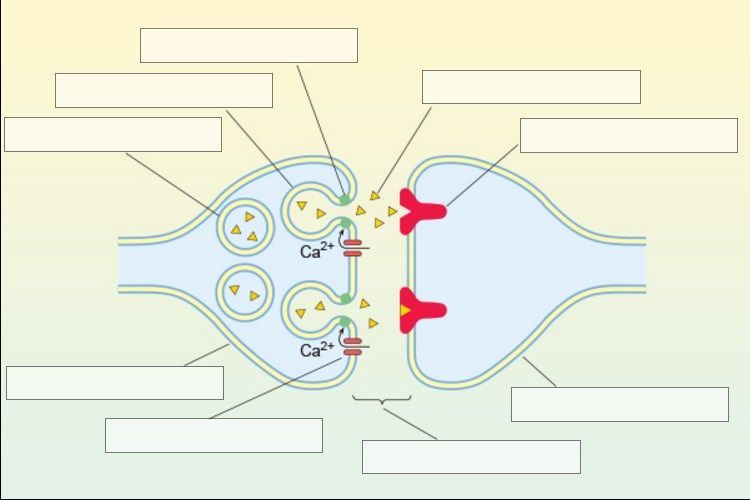
- Asynaptic vesicle
- Bfused synaptic vesicle
- Ccomplex of docking proteins
- Dneurotransmitter
- Ecell surface receptor
- Fpostsynaptic cell
- Gsynaptic cleft
- Hpresynaptic cell
- Ipresynaptic calcium channel
34For each of the thalamic nuclei below select the appropriate type of sensory information processed from the drop down menu.
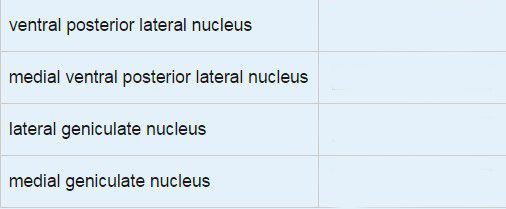
- Aauditory system
- Bbodily senses
- Cgustatory system
- Dvisual system
- Eauditory system
- Fbodily senses
- Ggustatory system
- Hvisual system
- Iauditory system
- Jbodily senses
- Kgustatory system
- Lvisual system
- Mauditory system
- Nbodily senses
- Ogustatory system
- Pvisual system
35Which of the following statements about the cerebral cortex are correct? Select 3
- AThe cerebral cortex can be divided up into four anatomically discrete areas.
- BThere are two basic types of neuron in the cortex – pyramidal cells and ganglion cells.
- CSensory afferents to the cortex are topographically organised.
- DVertically oriented columns of neuronal cell bodies in the cortex form structurally and functionally isolated units.
- EAfferent input to the cortex from thalamic nuclei processing specific sensory information mainly terminates in layer IV.
- FThe cortex is a highly folded laminated sheet with each layer having characteristic types of neurons and neuron densities, as well as specific input and output pathways.
36This question concerns imaging techniques used to study human brain functions. You should select three choices.
Identify the correct statements below.- APositron Emission Tomography (PET) is a completely safe procedure which can be used repeatedly on the same individual.
- BFor both Magnetic Resonance Imaging (MRI) and functional MRI (fMRI) there is a requirement to have a large static magnetic field and a radio frequency (rf) magnetic field.
- CEEG and magnetoencephalography (MEG) both have better temporal resolution than the indirect methods that can be used to image the brain.
- DDiffusion Tensor Imaging (DTI) detects the magnetic behaviour of the hydrogen nuclei in water.
- EElectroencephalography (EEG) uses squids to detect very small electric currents produced in the brain.
- FIn MEG all parts of the brain are sampled with equal spatial and temporal resolutions.
Information
- Description
- Quiz based on the content and summaries of Block 2 of SD329
- Author
- Mikki M
- Language
- English
- Views
- 99
- Tags
- Rating
- No ratings yet Rate this quiz