
Quiz
Merrill's Chapter 8
This quiz has question types that open in the usual player.
Questions in this quiz (26)
1Label the image
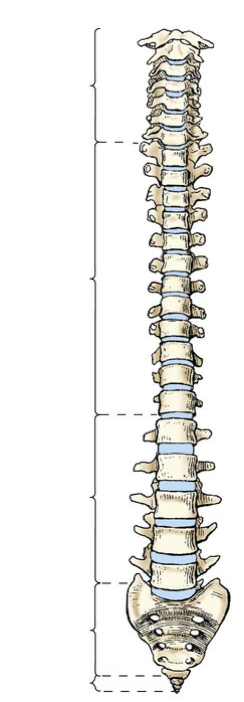
- ACervical
- BThoracic
- CLumbar
- DSacrum
- ECoccyx
2What are the function(s) of the vertebral column?
- AEncloses and protects the spinal cord
- BActs as as support for the trunk
- CSupports the skull
- DProvides attachment for the deep muscles of the back and ribs laterally
3What holds the vertebral column together?
- ATendons
- BCartilage
- CLigaments
- DMuscle
4How many vertebrae make up the sacrum?
- A2
- B3
- C4
- D5
5The coccyx is made up of 3 vertebrae.
- ATrue
- BFalse
6The 24 vertebral segments in the upper three regions are termed the [blank_start]true[blank_end] or [blank_start]movable[blank_end] vertebrae. The pelvic segments in the lower regions are called [blank_start]false[blank_end] or [blank_start]fixed[blank_end] vertebrae.
- Atrue
- Bfalse
- Cmovable
- Dfixed
- Efalse
- Ftrue
- Gfixed
- Hmovable
7The vertebral column is made up of three curves.
- ATrue
- BFalse
8The cervical and lumbar curves, which are [blank_start]convex[blank_end] anteriorly, are called [blank_start]lordotic[blank_end] curves. The thoracic and pelvic curves are [blank_start]concave[blank_end] anteriorly and are called [blank_start]kyphotic[blank_end] curves
- Aconvex
- Bconcave
- Clordotic
- Dkyphotic
- Econcave
- Fconvex
- Gkyphotic
- Hlordotic
9The [blank_start]thoracic[blank_end] and [blank_start]pelvic[blank_end] curves are called primary curves because they are present at birth. The [blank_start]cervical[blank_end] and [blank_start]lumbar[blank_end] curves are called secondary or compensatory curves because they develop after birth.
- Athoracic
- Bcervical
- Clumbar
- Dpelvic
- Esacral
- Flumbar
- Gcervical
- Hpelvic
- Ithoracic
- Jlumbar
- Ksacral
- Lthoracic
10The [blank_start]cervical[blank_end] curve, which is the least pronounced of the curves, develops when an infant begins to hold the head up at about [blank_start]3[blank_end] or [blank_start]4[blank_end] months of age and begins to sit alone at about [blank_start]8[blank_end] or [blank_start]9[blank_end] months of age. The [blank_start]lumbar[blank_end] curve develops when the child begins to walk at about [blank_start]1[blank_end] to [blank_start]1.5[blank_end] years of age.
- Acervical
- Bthoracic
- Clumbar
- Dlumbar
- Ecervical
- Fthoracic
- G3
- H2
- I1
- J4
- K4
- L5
- M3
- N2
- O8
- P6
- Q7
- R9
- S9
- T8
- U10
- V11
- W1
- X0.5
- Y2
- Z1.5
- AA1.5
- AB2
- AC2.5
- AD3
11The lumbar and pelvic curves are more pronounced in females, who have a more acute angle at the lumbosacral junction.
- ATrue
- BFalse
12Any abnormal increase in the anterior concavity (or posterior convexity) of the thoracic curve is termed [blank_start]kyphosis[blank_end]. Any abnormal increase in the anterior convexity (or posterior concavity) of the lumbar or cervical curve is termed [blank_start]lordosis[blank_end].
- Akyphosis
- Blordosis
- Clordosis
- Dkyphosis
13The superior and inferior surfaces of the vertebra bodies are flattened and are covered by a thin layer of articular cartilage.
- ATrue
- BFalse
14In the articulated spine, the vertebral bodies are separated by intervertebral disks, forming the cartilaginous intervertebral joints. These disks account for approximately one fourth of the length of the vertebral column. Each disk has a central mass of soft, pulpy, semigelatinous material called the [blank_start]nucleus pulposus[blank_end], which is surrounded by an outer fibrocartilaginous disk called the [blank_start]anulus fibrosus[blank_end].
- Anucleus pulposus
- Banulus fibrosus
- Canulus fibrosus
- Dnucleus pulposus
15It is common for the pulpy nucleus to rupture or protrude into the vertebral canal, impinging on a spinal nerve. This condition is called herniated nucleus pulposus (HNP) or, more commonly, [blank_start]slipped disk[blank_end].
- Aslipped disk
16The vertebral arch is formed by two pedicles and two laminae that support four articular processes, two transverse processes, and one spinous process.
- ATrue
- BFalse
17A congenital defect of the vertebral column in which the laminae fail to unite posteriorly at the midline is called [blank_start]spina bifida[blank_end].
- Aspina bifida
18What cervical vertebra is a ringlike structure with no body and a very short spinous process?
- AAtlas
- BAxis
19Which cervical vertebra is termed the vertebra prominens?
- AC3
- BC5
- CC7
- DC1
20The bodies of the typical ([blank_start]third through ninth[blank_end]) thoracic vertebrae are approximately triangular in form.
- Athird through ninth
- Bthird through eleventh
- Csecond through ninth
- Dfourth through twelfth
21Although the size and degree of curvature of the sacrum vary considerably in different patients, the bone is normally longer, narrower, more evenly curved, and more vertical in position in [blank_start]males[blank_end] than in [blank_start]females[blank_end].
- Amales
- Bfemales
- Cfemales
- Dmales
22The male sacrum is more acutely curved.
- ATrue
- BFalse
23Which of the following are cartilaginous joints?
- AIntervertebral
- BZygapophyseal
- CAtlantoaxial
- DCostovertebral
24The atlantoaxial joint is both a gliding and pivot type of joint.
- ATrue
- BFalse
25The zygapophyseal joint is the only slightly movable joint.
- ATrue
- BFalse
26[blank_start]Jefferson[blank_end]: Comminuted fracture of the ring of C1.
[blank_start]Sponylolisthesis[blank_end]: Forward displacement of a vertebra over a lower vertebra.
[blank_start]Spina bifida[blank_end]: Failure of the posterior encasement of the spinal cord to close.
[blank_start]Hangman's[blank_end]: Fracture of the anterior arch of C2 owing to hyperextension.
[blank_start]Spondylolysis[blank_end]: Breaking down of the vertebra.
[blank_start]Subluxation[blank_end]: Incomplete or partial dislocation.
[blank_start]Scoliosis[blank_end]: Lateral deviation of the spine with possible vertebral rotation.
[blank_start]Clay shoveler's[blank_end]: Avulsion fracture of the spinous process in the lower cervical and upper thoracic region.
[blank_start]Scheuermann disease[blank_end]: Kyphosis with onset in adolescence.- AJefferson
- BSponylolisthesis
- CSpina bifida
- DHangman's
- ESpondylolysis
- FSubluxation
- GScoliosis
- HClay shoveler's
- IScheuermann disease
Information
- Description
- whatever
- Author
- Korie Hi
- Language
- English
- Views
- 430
- Tags
- Rating
- 4.0 out of 5 · 2 ratings Rate this quiz