
Quiz
Ear and Eye Test study guide
This quiz has question types that open in the usual player.
Questions in this quiz (10)
1Label the parts of the ear.
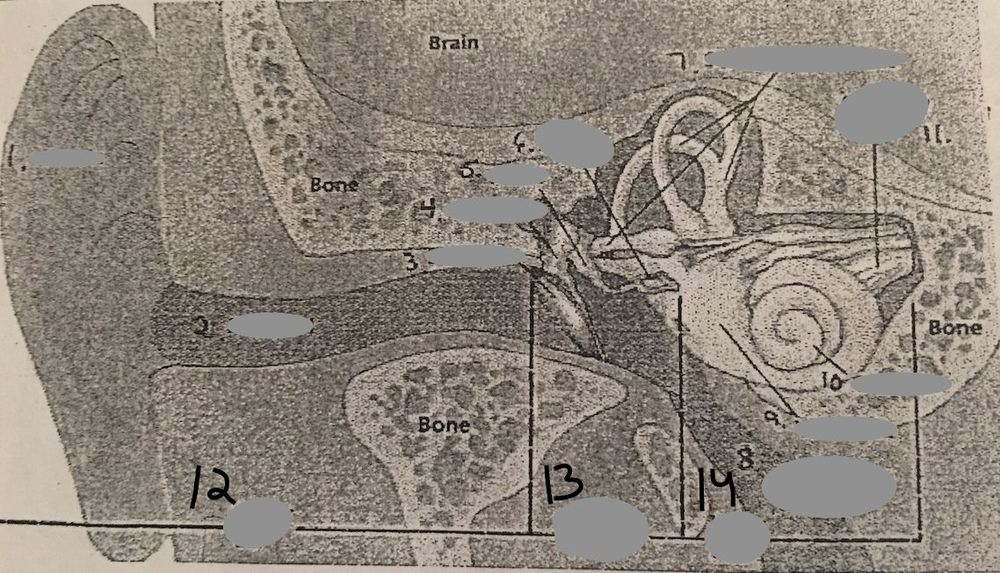
- Aauricle/pinna
- Bear canal
- Ceardrum
- Dhammer
- Eanvil
- Fstirrup
- Gsemi-circular canals
- Houter ear
- Imiddle ear
- Jinner ear
- Keustachian tube
- Lvestibule
- Mcochlea
- Nauditory nerve
2The function of the human ear is to gather [blank_start]sound waves[blank_end] and transmit information about the [blank_start]sound[blank_end].
- Asound waves
- Bsound
3check off an item when done studying statement. these are the functions of the three sections of the ear.
- AThe function of the outer ear is to funnel sound waves. It collects sound waves and directs them into a narrow region called the ear canal.
- BThe middle ear is located BEHIND the eardrum. The function of the middle ear is to transmit the sound waves inward. This part of the ear contains the three smallest bones in your body-the hammer, anvil, and stirrup.
- CThe function of the inner ear is to convert sound waves into a form that travels to your brain.
- DI have not read all the terms.
4Sound waves enter the [blank_start]outer ear[blank_end]. The outer ear acts like a funnel for the waves and moves them towards the [blank_start]ear canal[blank_end]. The waves strike the [blank_start]eardrum[blank_end] making vibrations in the [blank_start]middle ear[blank_end]. The [blank_start]hammer[blank_end] is stimulated by the vibrations and the sends these vibrations to the [blank_start]Anvil[blank_end] and then to the [blank_start]stirrup[blank_end]. The membrane then sends the vibrations to the liquid filled [blank_start]inner ear[blank_end]. These vibrations are channeled into the [blank_start]cochlea[blank_end]. Once inside the cochlea, nerve cells pick up the vibrations into electrical impulses. These electrical impulses are sent to the [blank_start]brain[blank_end] where the [blank_start]brain[blank_end] recognizes the impulses as [blank_start]sound[blank_end].
- Aouter ear
- Bear canal
- Ceardrum
- Dmiddle ear
- Ehammer
- Fanvil
- Gstirrup
- Hinner ear
- Icochlea
- Jbrain
- Kbrain
- Lsound
5check off an item after studying statement, these are the illuminated vs. luminous and transparent vs translucent vs opaque
- ALuminous objects are anything that can give off its own light. Illuminated objects are any object that can be seen because it is lit up, but not by its own light.
- BTransparent materials transmits most of the light that strikes it. You can clearly see other objects through transparent materials. Opaque materials let no light pass through them. You cannot see through opaque materials because light cannot pass through them. Translucent materials only allow some light to pass through them. When looking through translucent materials, you can see the object but the details are blurred.
6The function of the human eye is to [blank_start]allow you to sense light[blank_end].
- Aallow you to sense light
7The cornea [blank_start]protects[blank_end] the eye and [blank_start]bends[blank_end] light as it enters the eye. It also acts as a lens to help focus [blank_start]light rays[blank_end].
- Alight rays
- Bprotects
- Cbends
8The pupil and Ciliary muscles are both muscles inside the eye.
- ATrue
- BFalse
9Light enters the eye through the [blank_start]cornea[blank_end]. After passing through the cornea, light enters the [blank_start]pupil[blank_end]. the [blank_start]iris[blank_end] then expands or contracts depending on the amount of light. the light passes through the [blank_start]lens[blank_end] depending on what you are focusing on, the [blank_start]ciliary muscles[blank_end] Relax or contract. when did cornea and lens refract, an upside-down image is formed on the [blank_start]retina[blank_end]. The [blank_start]rods[blank_end] and cones help change the image on the retina into signals that travel to the [blank_start]brain[blank_end] along the short nerve called the [blank_start]optic nerve.[blank_end] The optic nerve combines the images from both of your eyes into a single three-dimensional image. your [blank_start]brain[blank_end] then interpret the signals as an upright image.
- Apupil
- Bcornea
- Ciris
- Dlens
- Eciliary muscles
- Frods
- Gretina
- Hbrain
- Ioptic nerve
- Jbrain
10Rods allow you to see in dim light (black and white) and the cones allow you to see the primary colors of light (bright light).
- ATrue
- BFalse
Information
- Description
- Quiz on Ear and Eye Test study guide, created by Bodey Good on 24/04/2017.
- Author
- Bodey Good
- Language
- English
- Views
- 29
- Tags
- Rating
- No ratings yet Rate this quiz