
E- LEARNING
Slides in this set (7)
-
-
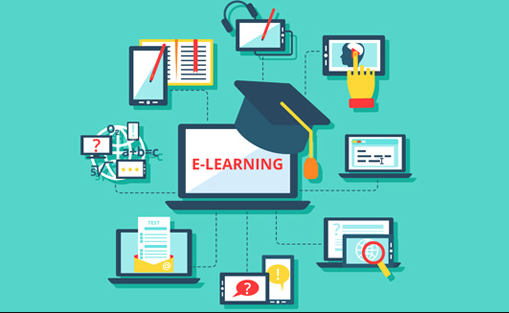
- E- learning is learning to utilize electronic to access educational curriculum outside of a traditional classroom. In most cases, it refers to a course, program or degree divides completely online.
- It is learning electronic, using Internet, social media, messages, email ect. In the learning we use platforms, web- pages and discussing forums.
- In E- learning the students will allways be on the first row. They learn in many different ways. They can do it everywhere and at any time in the world.
- It is individual, social and active.
-
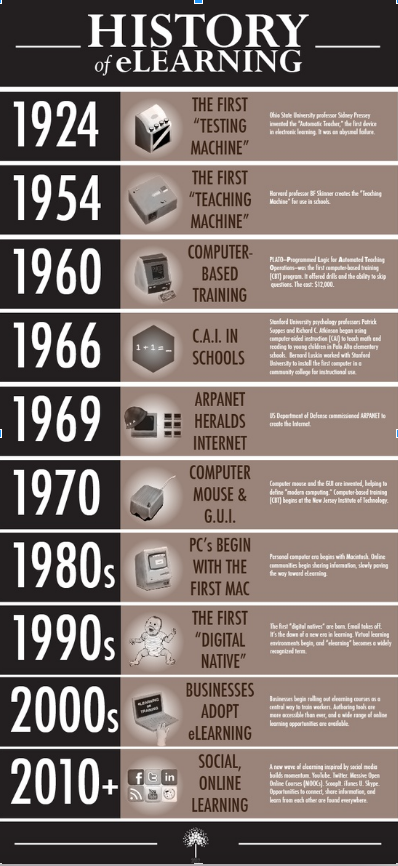
- The term “E- learning” has only been in existence since 1999, when the word was first utilized at a CBT systems seminar. Other words also began to spring up in search of an accurate description such as “online learning” and “virtual learning”. However, the principles behind E-learning have been well documented throughout history, and there is even evidence which suggests that early forms of E-learning existed as far back as the 19th century.
- In 1924, the first testing machine was invented. This device allowed students to tests themselves. Then, in 1954, BF Skinner, a Harvard Professor, invented the “teaching machine”, which enabled schools to administer programmed instruction to their students. It wasn’t until 1960 however that the first computer based training program was introduced to the world.
-

- With the introduction of the computer and internet in the late 20th century, E- learning tools and delivery methods expanded. The first MAC in the 1980’s enabled individuals to have computers in their homes, making it easier for them to learn about particular subjects and develop certain skill sets. Then, in the following decade, virtual learning environments began to truly thrive, with people gaining access to a wealth of online information and E-learning opportunities.
- In the 2000’s, businesses began using E-learning to train their employees. New and experienced workers alike now had the opportunity to improve upon their industry knowledge base and expand their skill sets. At home individuals were granted access to programs that offered them the ability to earn online degrees and enrich their lives through expanded knowledge. Today, E-learning is more popular than ever, with countless individuals realizing the benefits that online learning can offer.
-
The emergence and current state
- Many believe that e-learning can make the learning experience richer, more engaging and more interactive and that it provides faster learning at reduced costs, dramatically expands access to learning, and assures clear accountability for all parties in the learning process. The expectations about the growth of e-learning is so great that in the year 2000, four U.S. investment firms conducted detailed market analyses of what they refer to as the e-learning sector, and encouraged their clients to consider investing in e-learning companies.
- Broadband access increases the speed of Internet access and does away with the frustration of waiting for Web pages to download – a disincentive for the e-learning process.
- A rapidly growing number of organisations worldwide are now delivering training and education over the Internet. There are an estimated ten-million courses now online.
- Increasingly, training and support for teachers is occurring online, and a number of institutions now offer either partial or complete secondary diplomas through e-learning.
-
Information and Knowledge Society
- Knowledge and information are more and more becoming the foundation of economic and social relationships. At the core of this transformation is the rapid growth of Information and Communication Technologies.
- Creating, sharing and using information and knowledge are key factors of economic growth and essential for our competitiveness. This driving force of the information society can ensure better quality of life and work, sustainable employment with a sufficient number of competent ICT specialists, access costs, and digital literacy for all to avoid social exclusion.
- In the knowledge society, the life cycle of knowledge and skills becomes shorter and shorter. This is why we have to invest in human capital and learning technologies to shape our own future.
-
- I think that E- learning is a very good education. In my case, I think it´s great to study online. I can do it from everywhere and at any time.. For me it´s perfect, because I can study when my children don´t need me, and I don´t need to leave them and go to the university when they need me.
- You get all the instructions you need online to do what you must do. You can also easily get help if you need it.
- I learn best BY DOING! In E- learning you have to learn by doing. E- learning let you also learn in different kinds of ways. Everyone can do it!
Information
- Description
- Slide Set on E- LEARNING, created by Marianne Emmelhainz on 13/03/2018.
- Created by
- Marianne Emmelhainz · Mar 2018
- Updated
- Apr 9, 2018
- Views
- 2
- Rating